
Before You Can Change Your World, You Must Understand Your World
For two thousand years Epicurus has been accused of the same things by the same kinds of accusers. This short video sets out ten of those charges and how Epicurus answered each one. The full script and the slides follow the video, so you can read it at your own pace and follow the sources for every quotation.
Watch on YouTube · Discuss it at EpicureanFriends.com
The Script and Slides
Section titled “The Script and Slides”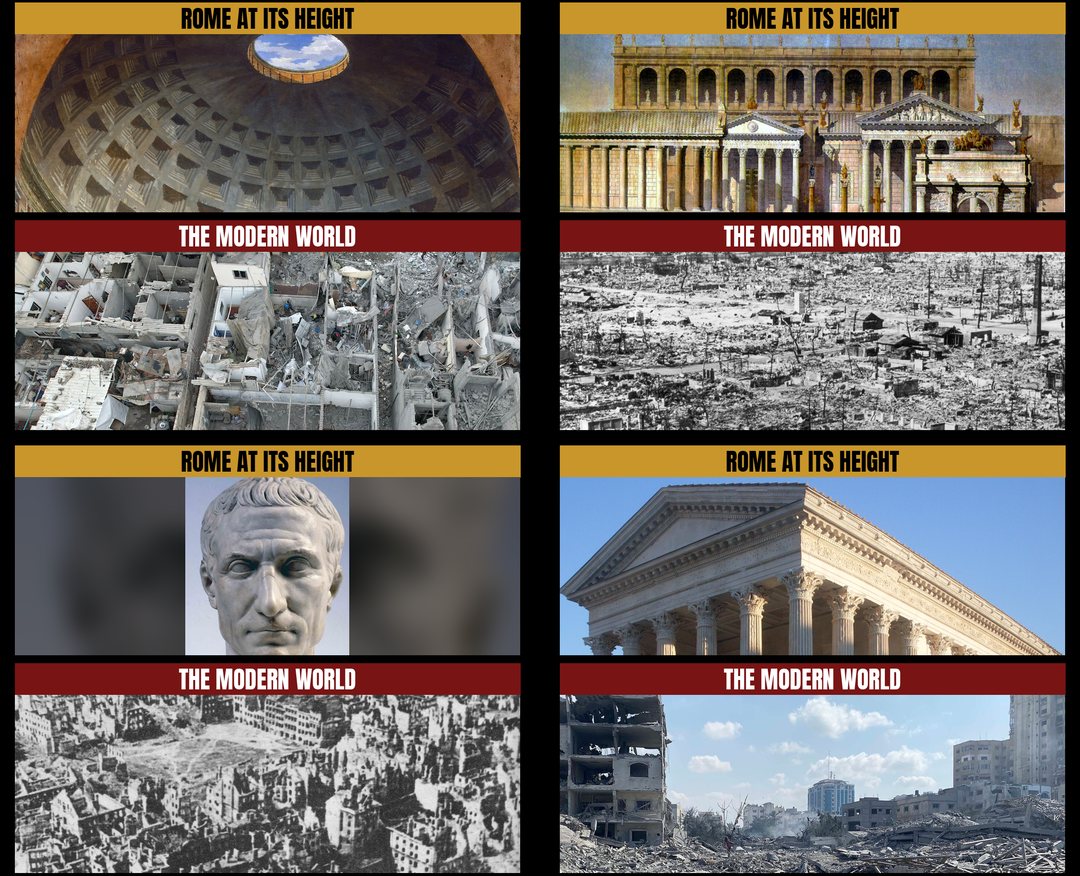
Before you can change your world, you must understand your world. For 2000 years politicians and religious leaders have built on the foundations of Socrates, Plato, Aristotle, and the revealed religions. What have they produced? Today, many people have turned their eyes away from this world and toward an imaginary other world, and we have fallen from the heights of the Roman period to the destruction we see around us today.
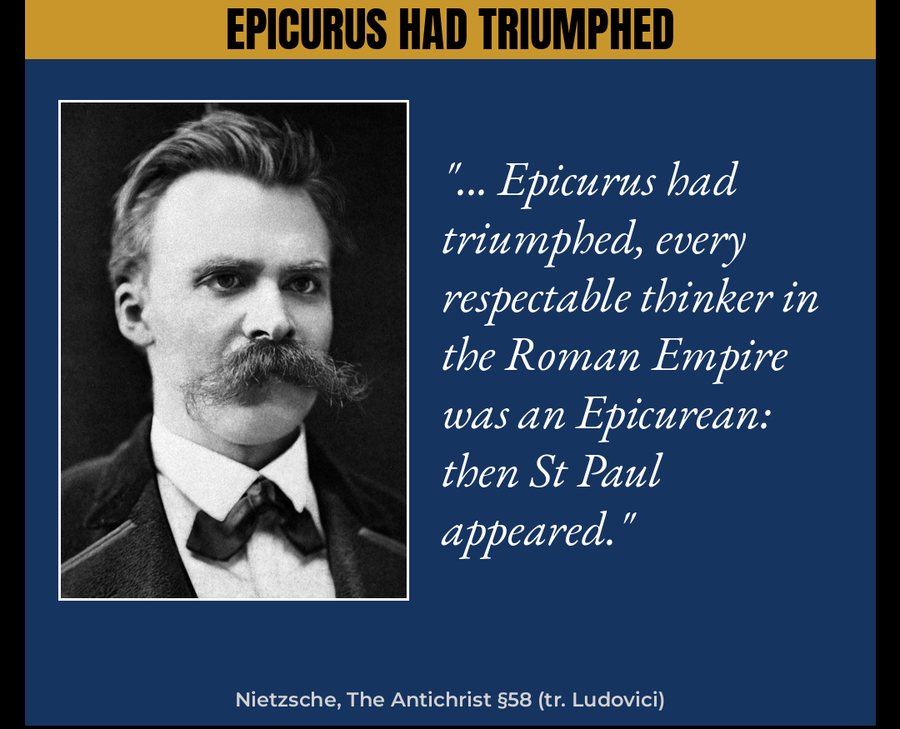
Source: Nietzsche, The Antichrist §58 (tr. Ludovici)
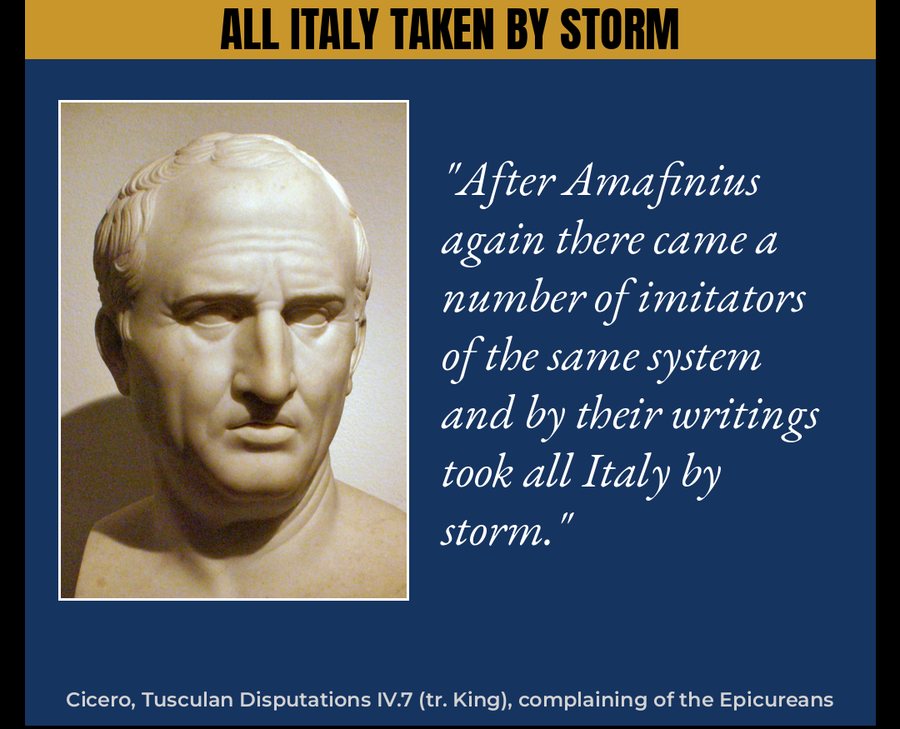
Source: Cicero, Tusculan Disputations IV.7 (tr. J. E. King, Loeb Classical Library, 1927, p. 335)
Nietzsche tells us that there was once a philosopher who fought the politicians and religious leaders well before they destroyed the ancient world, and that “Epicurus had triumphed, every respectable thinker in the Roman Empire was an Epicurean” - until St. Paul appeared. Even Cicero, who opposed Epicurus, complained that Epicurus had taken all Italy as if by storm.
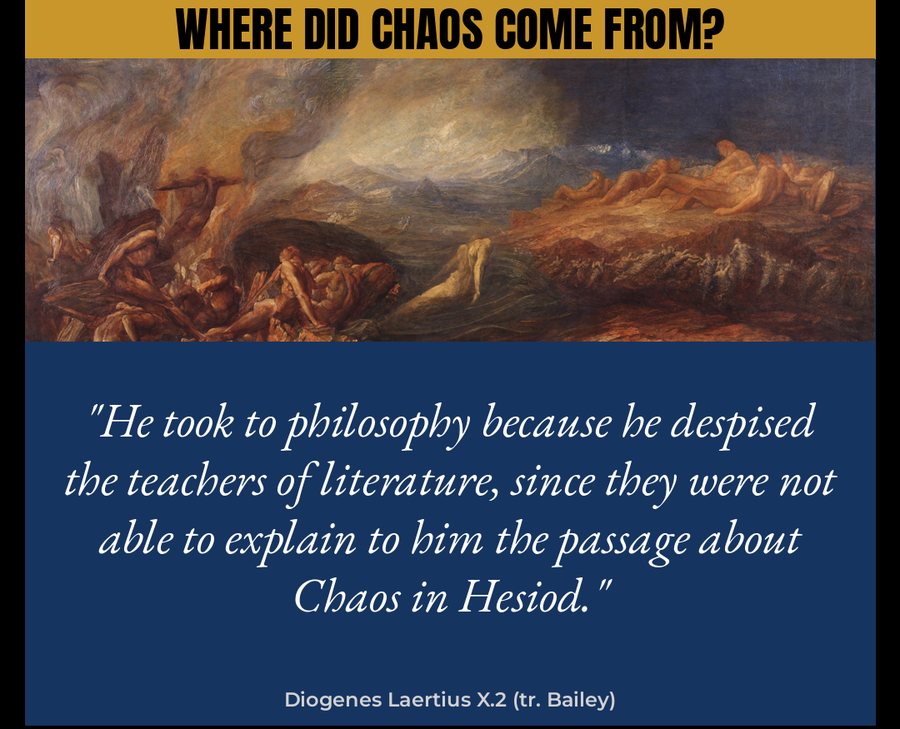
Source: Diogenes Laertius X.2 (tr. Bailey)
As a boy, Epicurus had objected when his teachers told him that the universe had come from Chaos. Epicurus asked where Chaos itself had come from, and when his teachers could not answer he went looking for the truth himself.
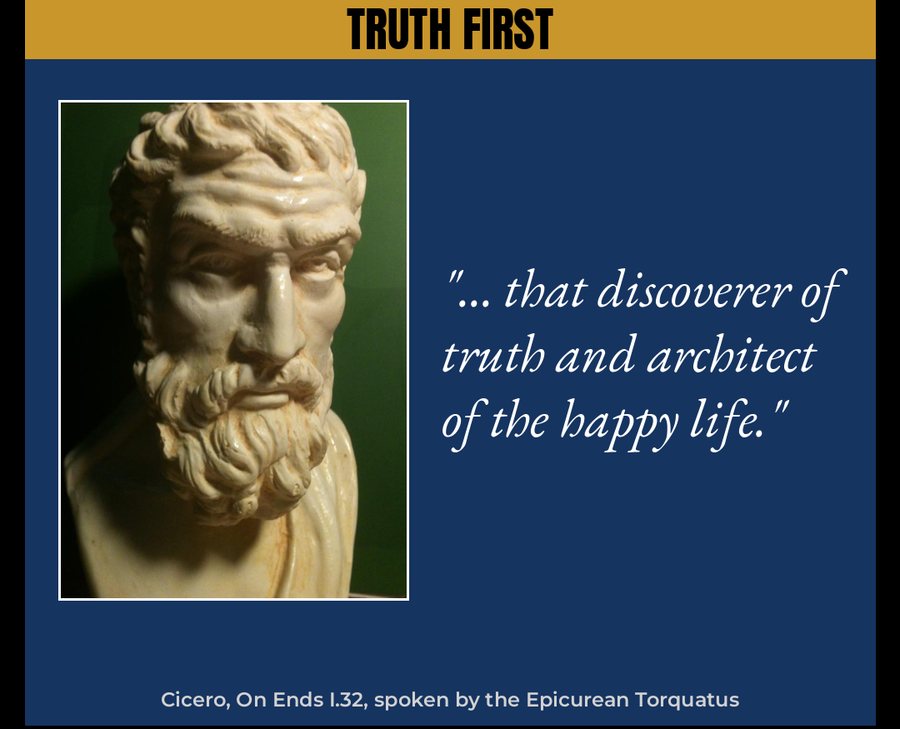
Source: Cicero, On Ends I.32, spoken by the Epicurean Torquatus (our translation; compare Rackham)
Epicurus’ followers called him “the discoverer of truth and architect of the happy life.” Opposing philosophers and religions, however, have attacked Epicurus ever since and raised a series of charges that you’ll find very familiar even today.
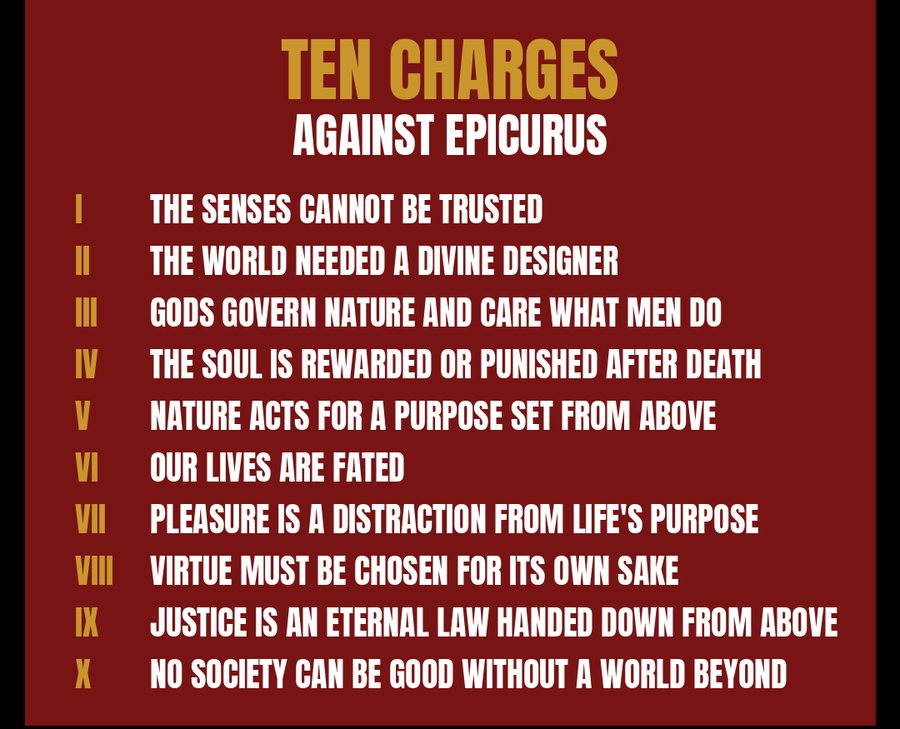
Here are ten of the basic charges that Epicurus’ enemies have brought.
Charge I: The Senses Cannot Be Trusted
Section titled “Charge I: The Senses Cannot Be Trusted”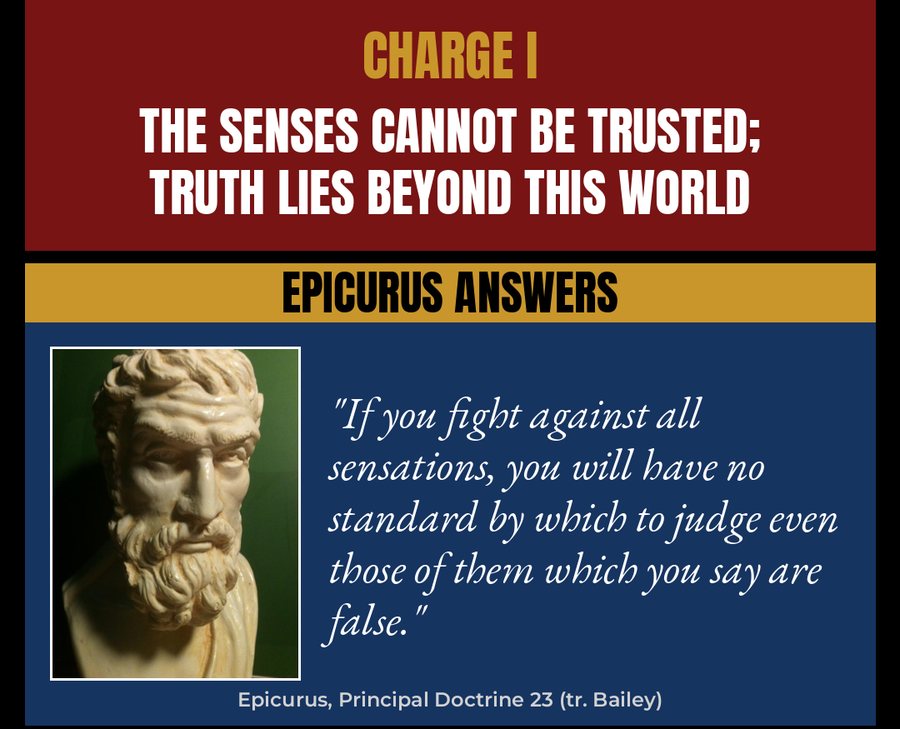
Source: Epicurus, Principal Doctrine 23 (tr. Bailey)
Epicurus’ enemies charge that the senses cannot be trusted - that true knowledge lies beyond the senses. Socrates said all he knew was that he knew nothing. Plato said that this world is a flickering shadow on a cave wall, and the real truth lies outside this world. The Skeptics said Socrates was wrong even to claim that he knew that he knew nothing. The Stoics said a wise man can know what is true, but they also said that the wise man is as rare as a phoenix. The Epicureans rejected all of that, and held that Nature gives us our five senses, our feelings, and our ability to notice patterns as the way to find out what is true and real in this world.
Charge II: The World Needed a Divine Designer
Section titled “Charge II: The World Needed a Divine Designer”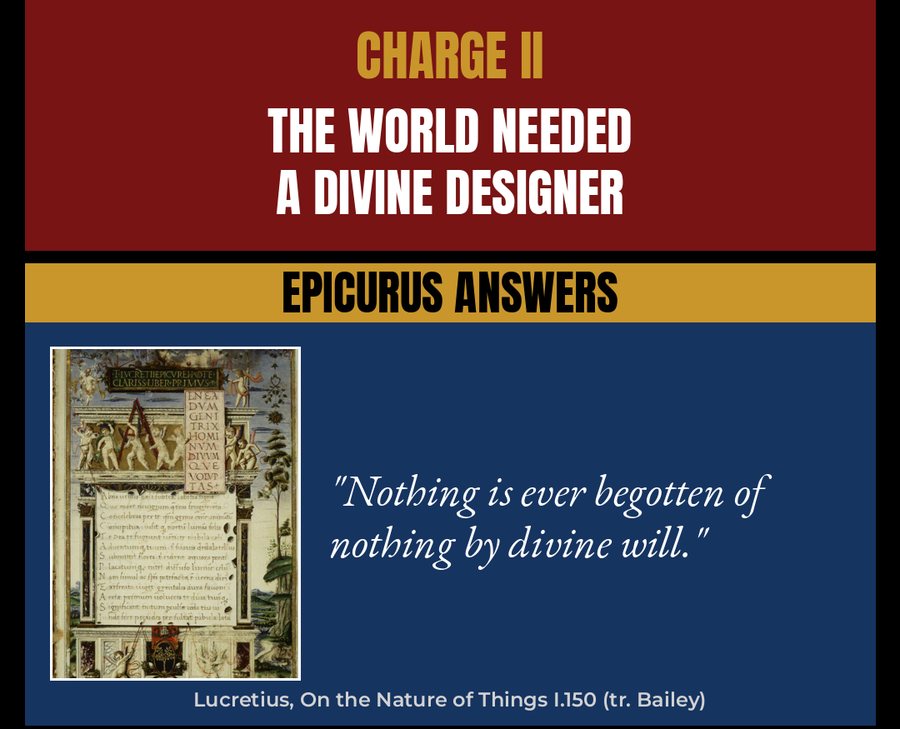
Source: Lucretius I.150 (tr. Bailey)
Epicurus’ enemies charge that the world could not have been created without a divine designer. They point to eyeballs and to all sorts of complexity and say that those can’t have happened by accident. Epicurus answers that nothing comes from nothing, and that Nature herself - working through an infinity of time and space - can create things that we think of as miraculous. Nature does this entirely on its own, without any need for a supernatural intelligent designer.
Charge III: Gods Govern Nature and Care What Men Do
Section titled “Charge III: Gods Govern Nature and Care What Men Do”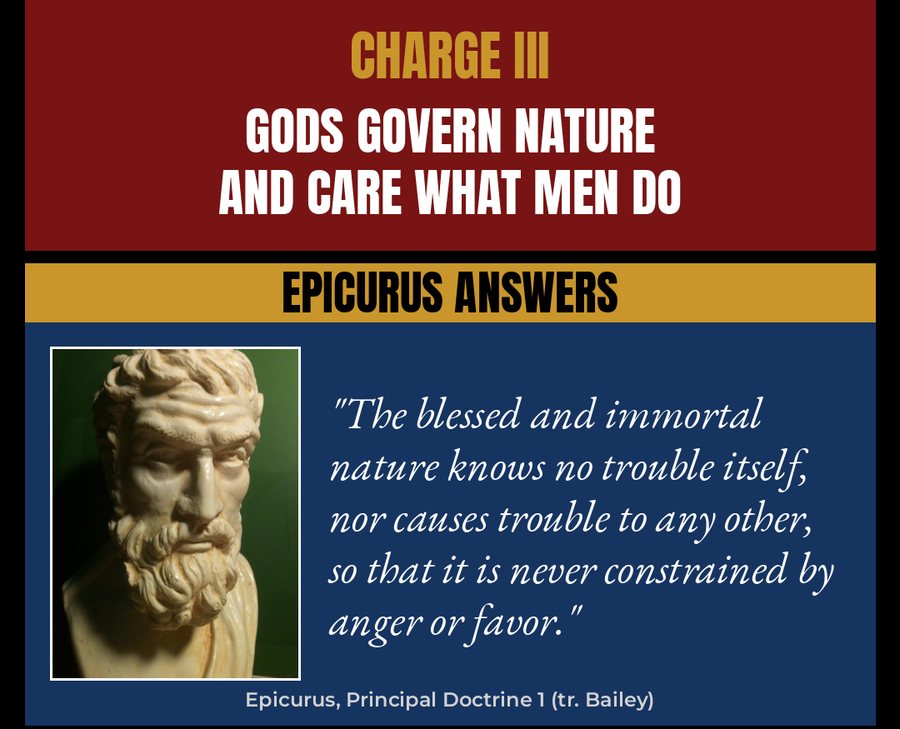
Source: Epicurus, Principal Doctrine 1 (tr. Bailey)
Epicurus’ enemies charge that supernatural gods govern nature and choose friends to reward and enemies to punish. Epicurus answered that any being worthy of being called a god is truly blessed and immortal, and needs nothing that it doesn’t already have. A true god would never wake up one morning and decide that it needed a world of humans to meddle in.
Charge IV: The Soul Will Be Rewarded or Punished After Death
Section titled “Charge IV: The Soul Will Be Rewarded or Punished After Death”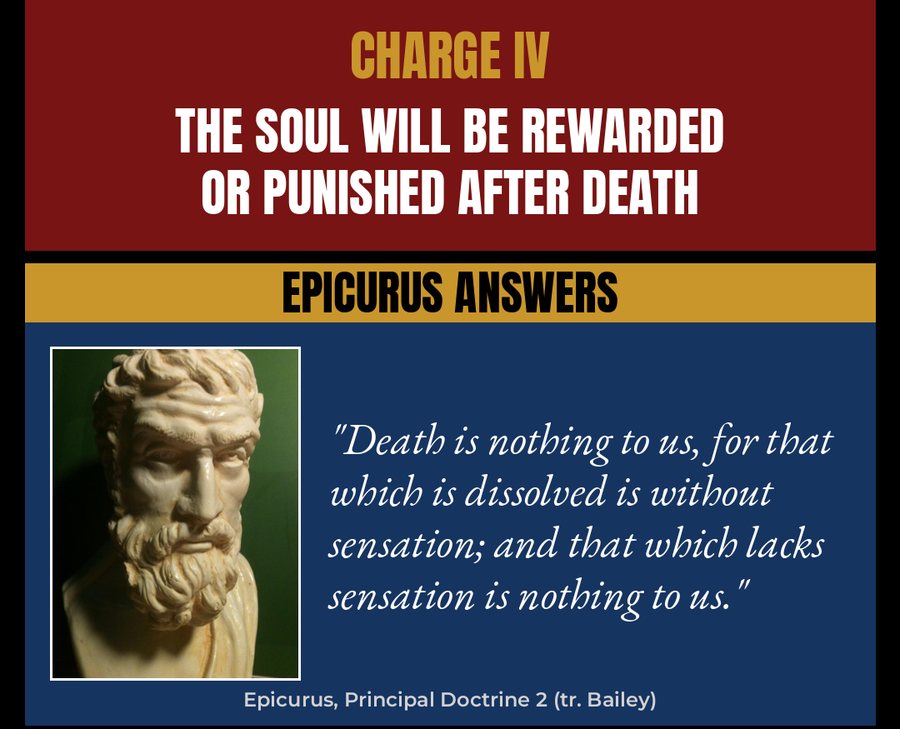
Source: Epicurus, Principal Doctrine 2 (tr. Bailey)
Epicurus’ enemies charge that humans have immortal souls that survive death, and that you will be punished or rewarded after you die for the things that you do while you are alive. Epicurus answers that our consciousness ceases to exist at death, and death is therefore nothing to us. After death we will be just as we were before we were born - nonexistent - and that means that this life is the only one we have.
Charge V: Nature Acts for a Purpose Set From Above
Section titled “Charge V: Nature Acts for a Purpose Set From Above”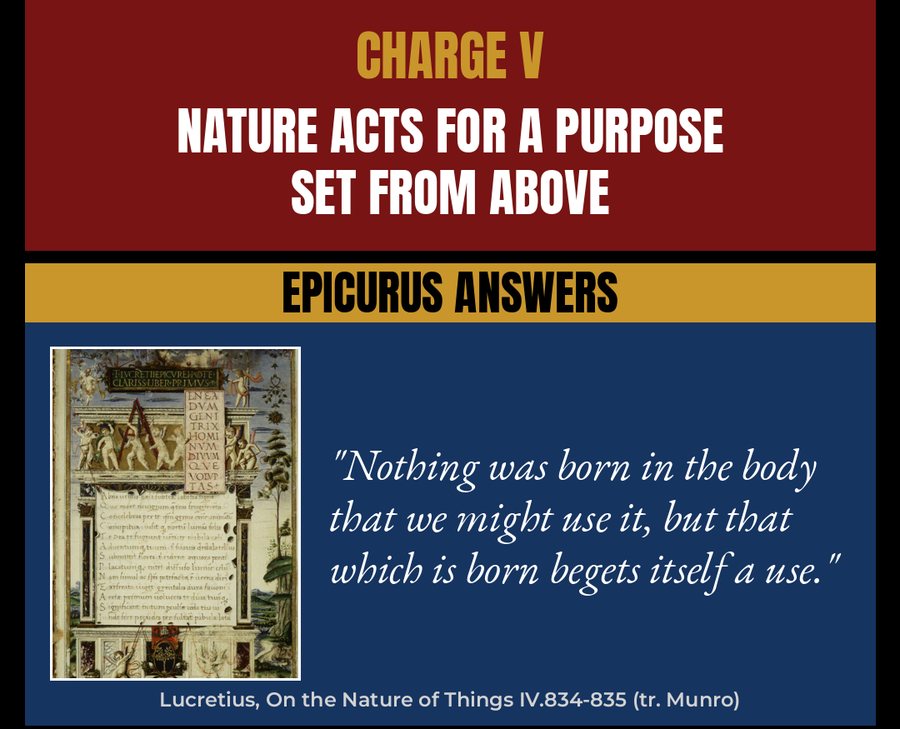
Source: Lucretius IV.834–835 (tr. Munro)
Epicurus’ enemies charge that even if we don’t say that a particular god rules over nature, nature always acts for a purpose, and since we too are part of Nature we need to look beyond ourselves for that purpose. Epicurus saw that argument as mysticism in another form. He answered that Nature brings nothing into being for a purpose, but that the things which come into being can combine in new ways and develop purposes of their own. Nature creates intelligent beings even though nature herself has no intelligence, just as our brains can think even though the individual atoms that make up our brains cannot.
Charge VI: Our Lives Are Fated
Section titled “Charge VI: Our Lives Are Fated”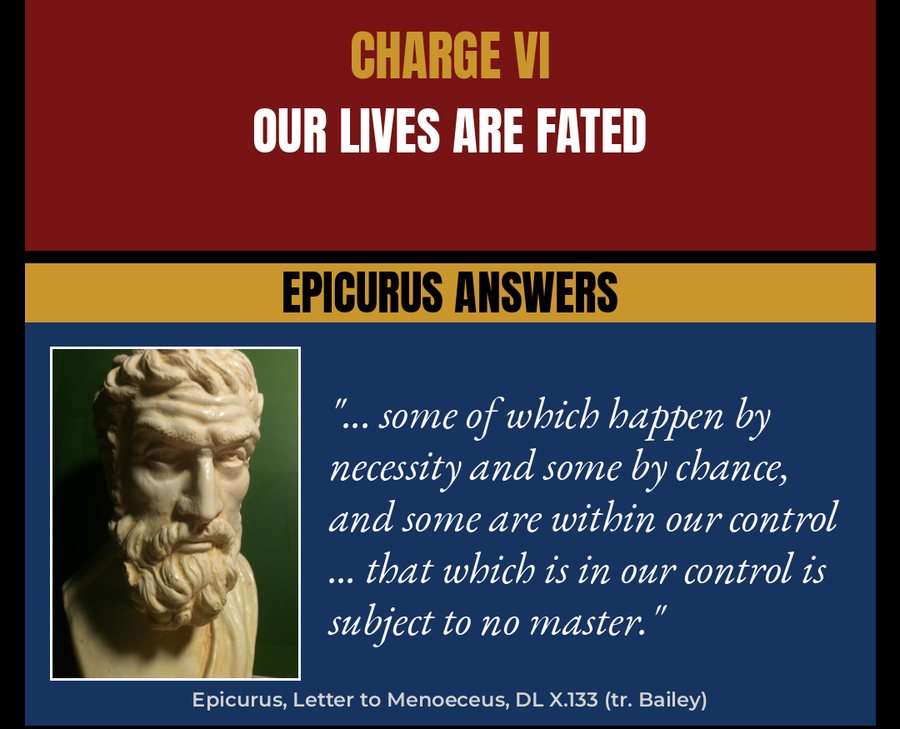
Source: Diogenes Laertius X.133 (tr. Bailey)
Epicurus’ enemies charge that humans are ruled by fate and necessity just like balls on a billiard table. Epicurus answered that atoms can swerve, that we see our own freedom to choose every day, and that some things happen by necessity, some by chance, and some are up to us.
Charge VII: Pleasure Is a Distraction From Life’s Purpose
Section titled “Charge VII: Pleasure Is a Distraction From Life’s Purpose”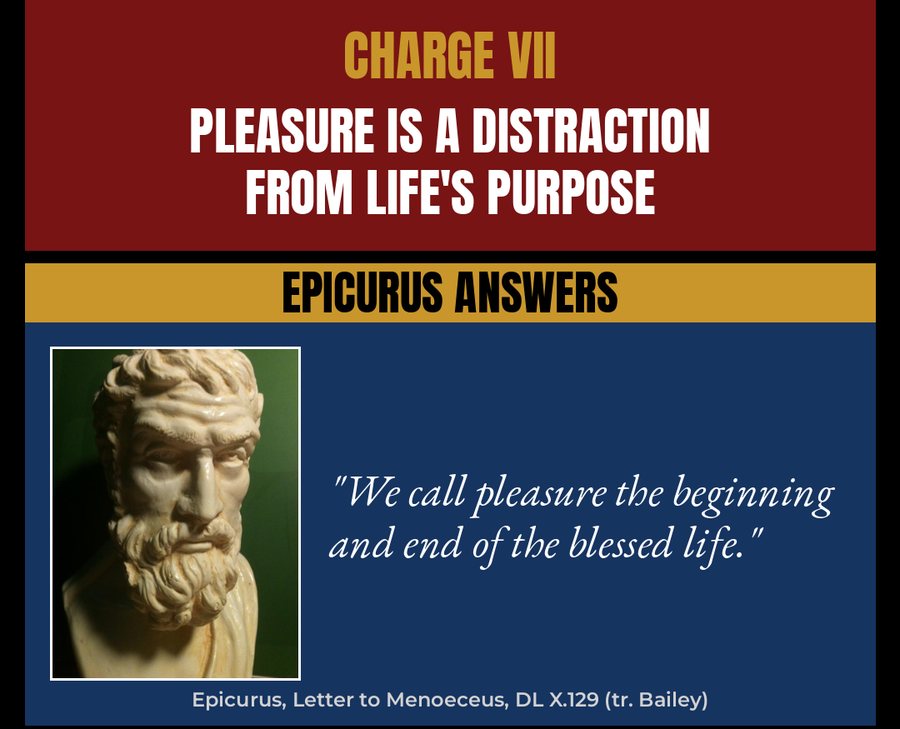
Source: Diogenes Laertius X.129 (tr. Bailey)
Epicurus’ enemies charge that pleasure leads to evil and is a distraction from the real purpose of life, which is virtue. Epicurus answered that the kind of narrow-minded immediate bodily indulgences that those people equate with pleasure is far from the only kind of pleasure that exists, and that in fact Nature gives us ONLY the feelings of pleasure and pain by which to determine what is agreeable and what is disagreeable. When you realize that everything in life is either agreeable or disagreeable, you realize that pleasure is the term that best describes everything we want out of life, no matter what path we choose to follow to obtain it.
Charge VIII: Virtue Must Be Chosen for Its Own Sake
Section titled “Charge VIII: Virtue Must Be Chosen for Its Own Sake”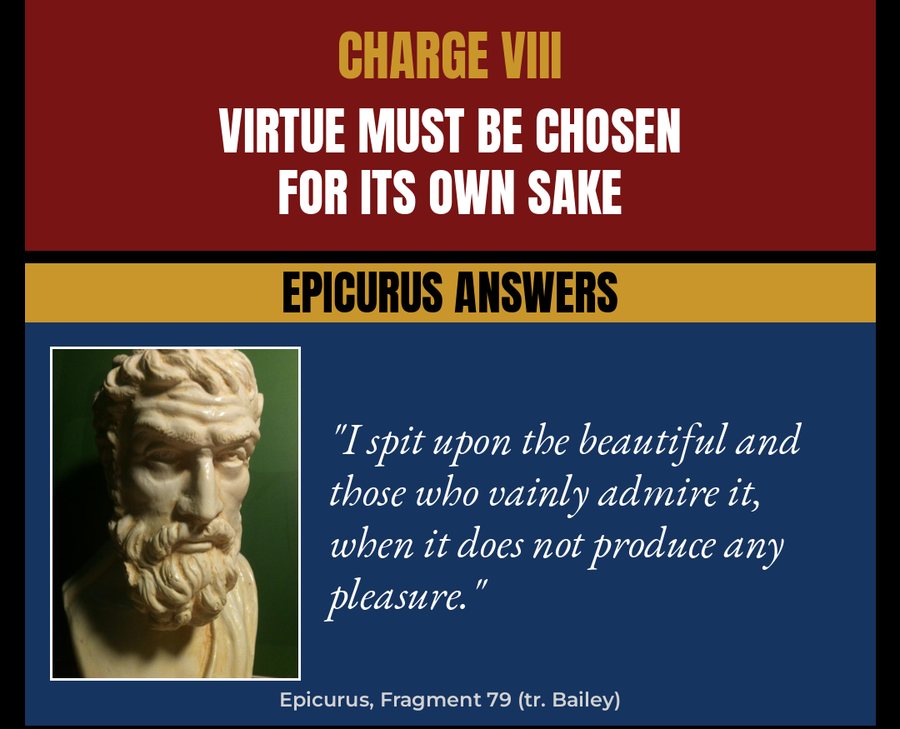
Source: Epicurus, Fragment 79 (tr. Bailey)
Epicurus’ enemies charge that virtue is its own reward, and that if you seek pleasure or any other reward for your actions you’re evil. Epicurus answered that virtue has no meaning apart from the result that it brings, and all desirable results bring pleasure.
Charge IX: Justice Is an Eternal Law Handed Down From Above
Section titled “Charge IX: Justice Is an Eternal Law Handed Down From Above”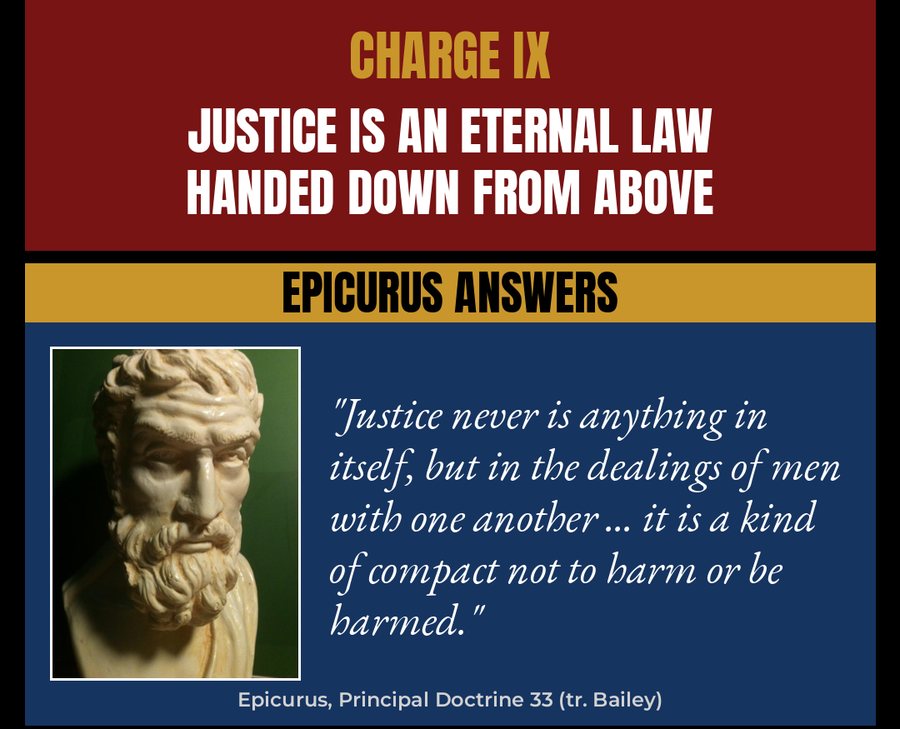
Source: Epicurus, Principal Doctrine 33 (tr. Bailey)
Epicurus’ enemies charge that there are eternal laws of justice handed down from above that apply to all people at all places and all times, and that they have a right to enforce those laws. Epicurus answered that justice is like any other virtue and has no meaning in itself and it exists only to the extent that people reach agreements for their own mutual advantage - and that as soon as one side stops acting for the advantage of all, that agreement is no longer valid.
Charge X: No Society Can Be Good Without a World Beyond This One
Section titled “Charge X: No Society Can Be Good Without a World Beyond This One”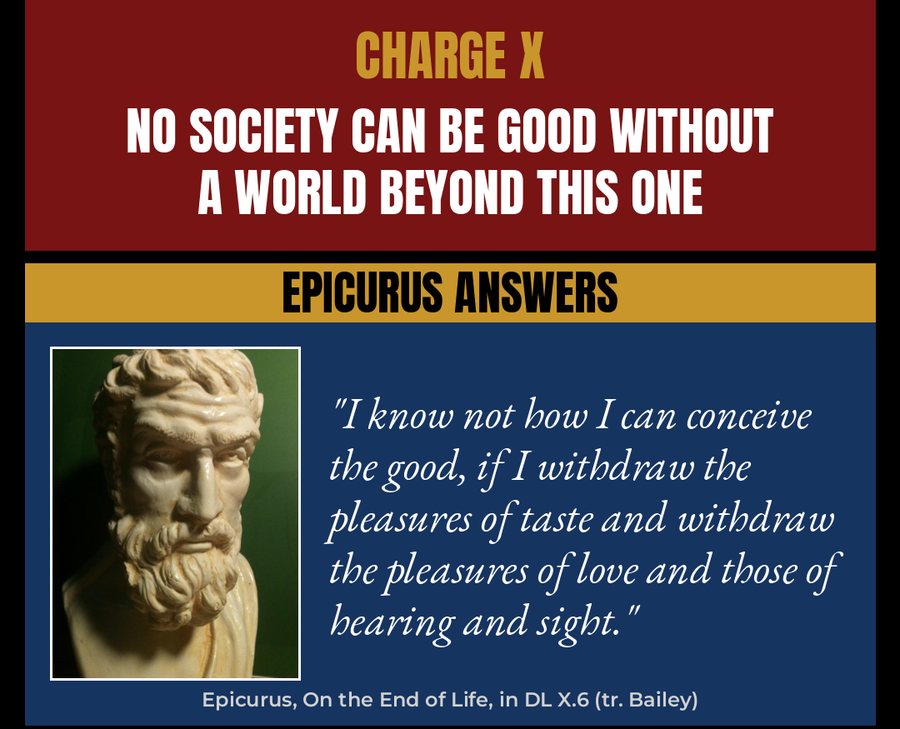
Source: Diogenes Laertius X.6 (tr. Bailey)
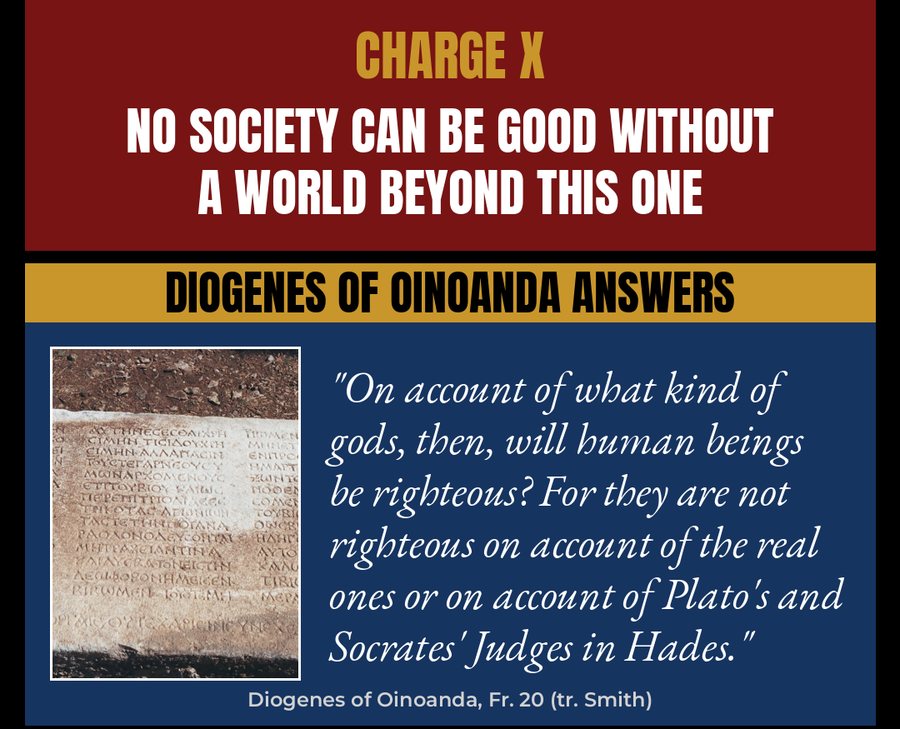
Source: Diogenes of Oinoanda, Fr. 20 (tr. Smith)
Epicurus’ enemies charge that no person or society can be good if they do not look to a world beyond this one and to a law that is above their own. Epicurus answered that the word good has no meaning apart from pleasure, and that this good is found here, in this world. People live together happily when they agree to act for their mutual advantage, not because they fear judgment in another life. The Epicurean Diogenes of Oinoanda wrote in stone that fear of gods does not stop the wrongdoers that live among us, and that in fact the most superstitious peoples are frequently the worst.
In his own words: “A clear indication of the complete inability of the gods to prevent wrong-doings is provided by the nations of the Jews and Egyptians, who, as well as being the most superstitious of all peoples, are the vilest of all peoples” (Fr. 20, tr. Smith).
You Be the Judge
Section titled “You Be the Judge”These are the major charges. What do you believe, and do you consider yourself a friend or an enemy of Epicurus’ views? If you agree with Epicurus, we invite you to join us in the study of his philosophy at EpicureanFriends.com.

We study Epicurus and his methods for finding out what is true and real, how we can be confident of it, and how to live the best life based on it. At EpicureanFriends we don’t argue about politics or religion, just truth, because before you can change your world, you must understand your world.
Image Credits
Section titled “Image Credits”- Gaza, aerial view of Nuseirat camp: Ashraf Amra, CC BY-SA 3.0 IGO.
- Gaza street, October 2023: WAFA (APAimages), CC BY-SA 3.0.
- Inscription of Diogenes of Oinoanda: Odoxo, CC BY-SA 4.0.
- Other pictures from Wikimedia Commons: Giovanni Paolo Panini, Interior of the Pantheon; Constant Moyaux, Forum Romanum (1866); bust of Julius Caesar (Vatican Museums); the Maison Carrée, Nîmes (Danichou); Hiroshima, 1945 (US government); Warsaw, January 1945 (Maciej Świerczyński); George Frederic Watts and workshop, Chaos; Nietzsche (Friedrich Hermann Hartmann); bust of Cicero (Capitoline Museums); Lucretius manuscript (Girolamo di Matteo de Tauris, 1483).


