
Twins, Eggs, and Duplicate Worlds - How Epicurus Deals With Identical Things
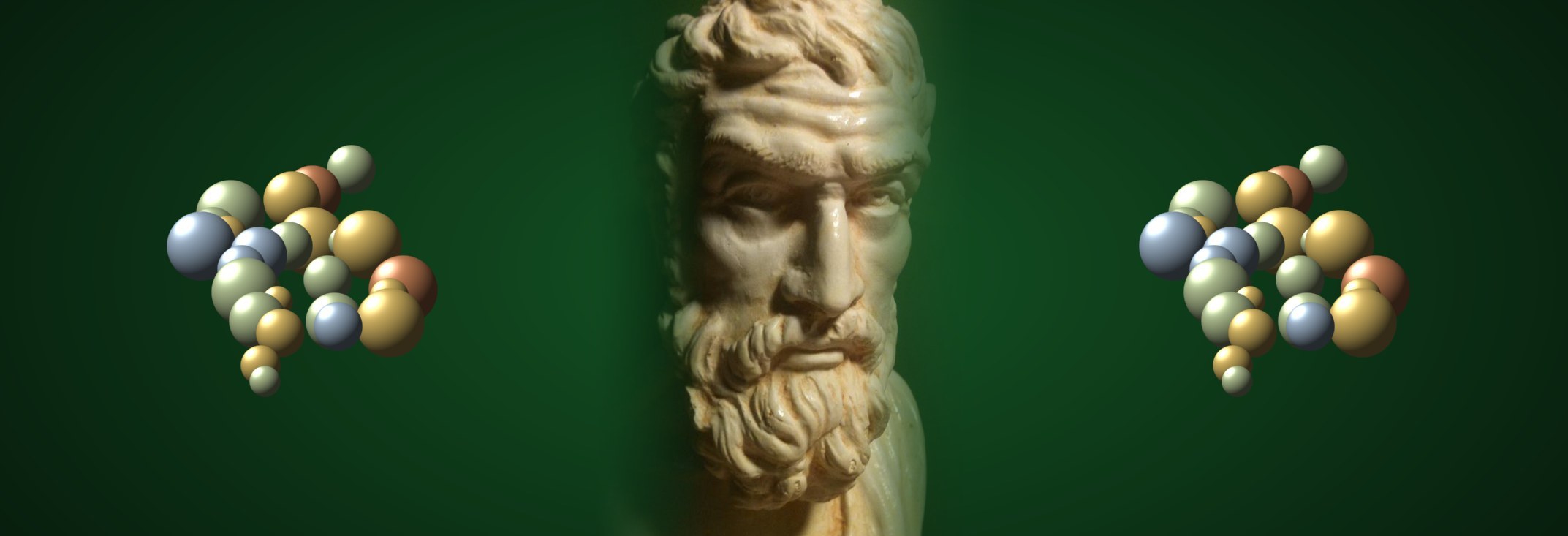
Suppose you see a man across the street and greet him as your friend Publius. It turns out to be Quintus, his identical twin. Were your eyes deceived? Did your senses lie to you? And if they could lie to you once, why should you trust them ever again?
This is one of the oldest problems in the theory of knowledge. In the ancient world it was fought out between the Stoics and the Academic skeptics, and Cicero preserves the battle in the second book of his Academic Questions. The Stoics lost that fight, and they lost it because of a mistake Epicurus never made.
The Epicurean answer has two parts. First, Epicurean physics holds that truly identical things can exist, and that across the infinite universe they exist in numbers beyond counting. Second, the existence of identical things does no damage at all to the Epicurean view that all sensations are true. To see why, we need to look first at what the Stoics needed, and why they could not get it.
The Stoics Needed Every Thing To Be Unique
Section titled “The Stoics Needed Every Thing To Be Unique”The founder of Stoicism, Zeno, held that knowledge rests on a special kind of impression, which the Stoics called “kataleptic,” or “grasping.” To qualify, an impression had to come from something that really exists, it had to match that thing exactly, and it had to be of such a kind that it could not come from anything else. That last condition was the heart of the theory. A true impression had to carry its own mark of truth, a stamp that no false impression could ever have.
This only works if no two things in the world are ever exactly alike. If two things could be truly identical, then an impression of one could not be told apart from an impression of the other, and the mark of truth would fail.
So the Stoics insisted that every single thing in nature has its own unique character. They meant this literally. Cicero reports their claim that “there is not a single hair or a single grain in every respect like another hair or grain” (Academic Questions 2.85). Seneca tells us where this uniqueness was supposed to come from:
“And among the other reasons for marvelling at the genius of the Divine Creator is, I believe, this, — that amid all this abundance there is no repetition; even seemingly similar things are, on comparison, unlike. God has created all the great number of leaves that we behold: each, however, is stamped with its special pattern.” (Seneca, Moral Letters 113.16)
The Stoic theory of knowledge therefore depended on a claim about the divine order of the world. Every thing is unique because the Creator made it so, and our ability to know anything depends on that uniqueness.
The Skeptics Attacked That Weak Point
Section titled “The Skeptics Attacked That Weak Point”The Academic skeptics saw the weakness and went straight at it. They pointed to twins such as the famous Servilii brothers, whom strangers could not tell apart. They pointed to eggs, to bees, to a hundred impressions of the same seal ring in wax. Cicero adds the case of the sculptor Lysippus:
“Tell me, could not Lysippus, using the same brass, the same composition of metals, the same atmosphere, water, and all other appliances, have made a hundred Alexanders exactly alike? How then could you distinguish between them?” (Academic Questions 2.85)
They even turned atomist physics against the Stoics. Democritus taught that there are countless worlds, and that some of them are so perfectly alike that there is no difference between them at all, “and so also are men.” If there can be countless identical copies of Catulus in other worlds, the skeptics asked, why not a second Catulus in this one? (Academic Questions 2.55)
The Stoic spokesman in Cicero’s dialogue is Lucullus, presenting the views of Antiochus. He answers in the only way the Stoic theory allows. He rejects Democritus outright: “you are bringing me to the arguments of Democritus, with whom I do not agree.” He repeats that “everything has its own separate property.” He argues that a mother can tell her twins apart, and that the poultry-keepers of Delos could tell which hen laid which egg. And he admits that where the wise man truly cannot tell two things apart, he must withhold judgment (Academic Questions 2.56-57).
Then he makes the admission that shows how much is at stake. He will not give up the uniqueness of the true impression “one finger’s breadth, as they say, lest I should throw everything into confusion” (Academic Questions 2.58). For the Stoic, a single true duplicate would bring down the whole structure of knowledge.
Cicero’s reply goes to the core of the matter. Even if the Stoics were right that no two things are exactly alike, “it has nothing in the world to do with the question whether the things which are seen do not differ at all in any part, or whether they cannot be distinguished from another even though they do differ” (Academic Questions 2.85). A difference no one can see is no help to someone trying to judge what he sees.
On the terms the Stoics themselves had set, this reply is decisive. The Stoics had made the impression itself responsible for certifying its own truth. Once two impressions can look the same, that certificate is worthless.
Epicurean Physics Requires Countless Duplicates
Section titled “Epicurean Physics Requires Countless Duplicates”Epicurus started from different premises, and they lead to the opposite conclusion about duplicates.
The atoms come in a limited number of shapes. Epicurus says their shapes are “not quite infinite, but only incomprehensible in number,” while “in each shape the atoms are quite infinite in number” (Letter to Herodotus 42). Lucretius proves both points at length (On The Nature of Things 2.478-568). The universe is unlimited in space and eternal in time, and “there are infinite worlds both like and unlike this world of ours” (Letter to Herodotus 45).
Put a limited number of building blocks together with unlimited material and unlimited time, and every possible arrangement will turn up again somewhere—and in infinite numbers.
The reasoning is simple. A world, a man, or an egg is made of a limited number of atoms. With a limited number of atomic shapes, there is only a limited number of ways to arrange that many atoms, even if that number is far too large to count. But the supply of atoms has no limit, and neither does the number of worlds. An infinite number of worlds built from a limited set of possible arrangements cannot all be different. The same arrangements must come up again and again without end. Epicurus says that the atoms able to make a world “have not been used up either on one world or on a limited number of worlds, nor again on all the worlds which are alike” (Letter to Herodotus 45). Note his words: there are worlds “which are alike.”
Lucretius says the same thing directly:
“This there is too that in the universe there is nothing single, nothing born unique and growing unique and alone, but it is always of some tribe, and there are many things in the same race. … Wherefore you must confess in the same way that sky and earth and sun, moon, sea, and all else that exists, are not unique, but rather of number numberless.” (On The Nature of Things 2.1077-1086)
Our sky, our earth, and our sun are not one of a kind. They are “of number numberless.” Velleius, the Epicurean speaker in Cicero’s On the Nature of the Gods, gives this principle its name. Epicurus called it isonomia, or “uniform distribution,” and it means that “in the sum of things everything has its exact match and counterpart” (On the Nature of the Gods 1.50).
He goes further still. He says that even the very atoms that make us up have probably been arranged exactly as they are now at some time in the endless past:
“For when you look back over all the lapse of immeasurable time that now is gone, and think how manifold are the motions of matter, you could easily believe this too, that these same seeds, whereof we now are made, have often been placed in the same order as they are now.” (On The Nature of Things 3.854-858)
None of this means that duplicates are common in any one place. In ordinary experience they are rare. Lucretius himself observes that “you will not find that every grain is like its fellows” (2.371-372), and he uses that ordinary variety as evidence for the variety of atomic shapes. On our own street, or in our own world, the chance of meeting a true duplicate is very small. But across the whole of an infinite and eternal universe, the total number of duplicates is not small at all. It is beyond counting. Duplicates are rare in any one place and innumerable in total.
The Epicureans did not dodge this conclusion. They were not looking for a unique mark in each thing. They had no reason to deny that identical things exist, and they did not deny it. The skeptics knew this. When Cicero mocks the atomist idea of a “countless host of men, of the same names and rank, and exploits, and talents, and appearances, and ages, arguing on the same subjects” in other worlds, he is describing the atomist position accurately (Academic Questions 2.125).
So the Epicureans accepted what the Stoics feared most. Why did it not destroy their theory of knowledge?
First Answer: An Identical Thing Is Not The Same Thing
Section titled “First Answer: An Identical Thing Is Not The Same Thing”The first reason is that identical in structure does not mean the same individual.
Lucretius makes this point in the passage just quoted. Right before saying that our atoms have probably been in their present order before, he says this:
“Nor, if time should gather together our substance after our decease and bring it back again as it is now placed, if once more the light of life should be vouchsafed to us, yet, even were that done, it would not concern us at all, when once the remembrance of our former selves were snapped in twain.” (On The Nature of Things 3.847-851)
The point here is very strong. Even the same atoms in the same order would not be us, because the chain of memory and life has been broken. If that is true of the same atoms, it is even more true of a duplicate made from different atoms in another place or another world. What makes a thing the particular thing it is includes its own history, its own place, and its own continuous existence. A perfect copy of Publius standing across the street is still a different man.
This is why Epicurean physics can accept duplicates without any confusion about identity. Two things can be alike in every part and still be two things.
Second Answer: Identical Sensations Are Still True Sensations
Section titled “Second Answer: Identical Sensations Are Still True Sensations”The second reason goes deeper, and it is the one that answers the skeptics.
Cicero lists the four premises the Academics used to prove that nothing can be known. The first was “that some perceptions are false.” Cicero then tells the Stoic Lucullus: “Epicurus does not admit the first, but you, with whom we are now arguing, admit that one too” (Academic Questions 2.83).
That single sentence explains the whole outcome. The twins argument works only against someone who believes that a sensation can be false, and who therefore needs a mark to tell the true sensations from the false ones. The Stoics believed this. Epicurus did not.
For Epicurus, a sensation is a report of what actually reaches the sense organ. When you see Quintus across the street, the image that reaches your eyes really does come from a man who looks exactly like Publius. Your eyes report that accurately. There is nothing false in the sensation. The sensation never said “this is Publius.” That statement came from your mind. It was an opinion added to the sensation.
Lucretius draws exactly this line when he discusses a moving shadow. The eyes report where there is light and where there is shade. But “whether it is the same shadow which was here, that now passes there,” the eyes cannot say: “this the reasoning of the mind alone must needs determine, nor can the eyes know the nature of things. Do not then be prone to fasten on the eyes this fault in the mind” (On The Nature of Things 4.379-386). Whether a thing is the same thing is a question for judgment. It is never a question the sensation claims to answer.
And judgment has its own test. Epicurus taught that an opinion must be held as “awaiting confirmation” until further evidence confirms it or contradicts it. He warned that if we confuse the opinion with the sensation itself, “you will confound all other sensations as well with the same groundless opinion, so that you will reject every standard of judgment” (Principal Doctrine 24). Notice that Epicurus and Lucullus both fear the same thing, the confounding of everything. But they locate the danger in opposite places. Lucullus thought the danger came from admitting a single duplicate. Epicurus saw that it came from mixing up what the senses report with what the mind adds.
So the man who mistakes Quintus for Publius has made an error of opinion, not of sensation. He corrects it the ordinary way. He walks closer, hears the voice, asks a question, or learns that Publius is out of town. Further evidence either confirms the first opinion or contradicts it. The mother who can tell her twins apart, and the poultry-keeper who knows his eggs, are not reading a divine mark stamped into each impression. They are using experience to form better judgments. Epicurus has no quarrel with them.
Why This Matters
Section titled “Why This Matters”The Stoics built their theory of knowledge on a guarantee they could not deliver. They needed every impression of a real thing to carry a unique stamp, and they needed the world to be built so that this stamp was always present. When the skeptics showed that two things can look the same, the Stoics had nowhere to retreat except to deny the plain facts about twins and statues, or to suspend judgment in exactly the cases where the skeptics had pressed them.
Epicurus never made that bet. He did not need the world to be made of unique things. He did not need a Creator to stamp every leaf with its own pattern. He needed only what nature actually provides: senses that report what reaches them, and a mind able to test its opinions against more evidence. Because he expected nothing more from the senses than they can give, the twins argument cannot touch him.
This is not a dusty dispute. Modern technology can now produce images and sounds that cannot be told apart from the real thing. Anyone who believes that knowledge depends on a self-certifying mark is in the same trap as the Stoics. The Epicurean is not. He knows that his senses report truly what reaches them, that sameness and identity are matters for judgment, and that judgment is settled by gathering more evidence.
The universe may contain twins, eggs, and even countless duplicate worlds. None of that makes knowledge impossible. It only means that a reasonable person must keep his opinions open to confirmation.