
EpicOrg Outline
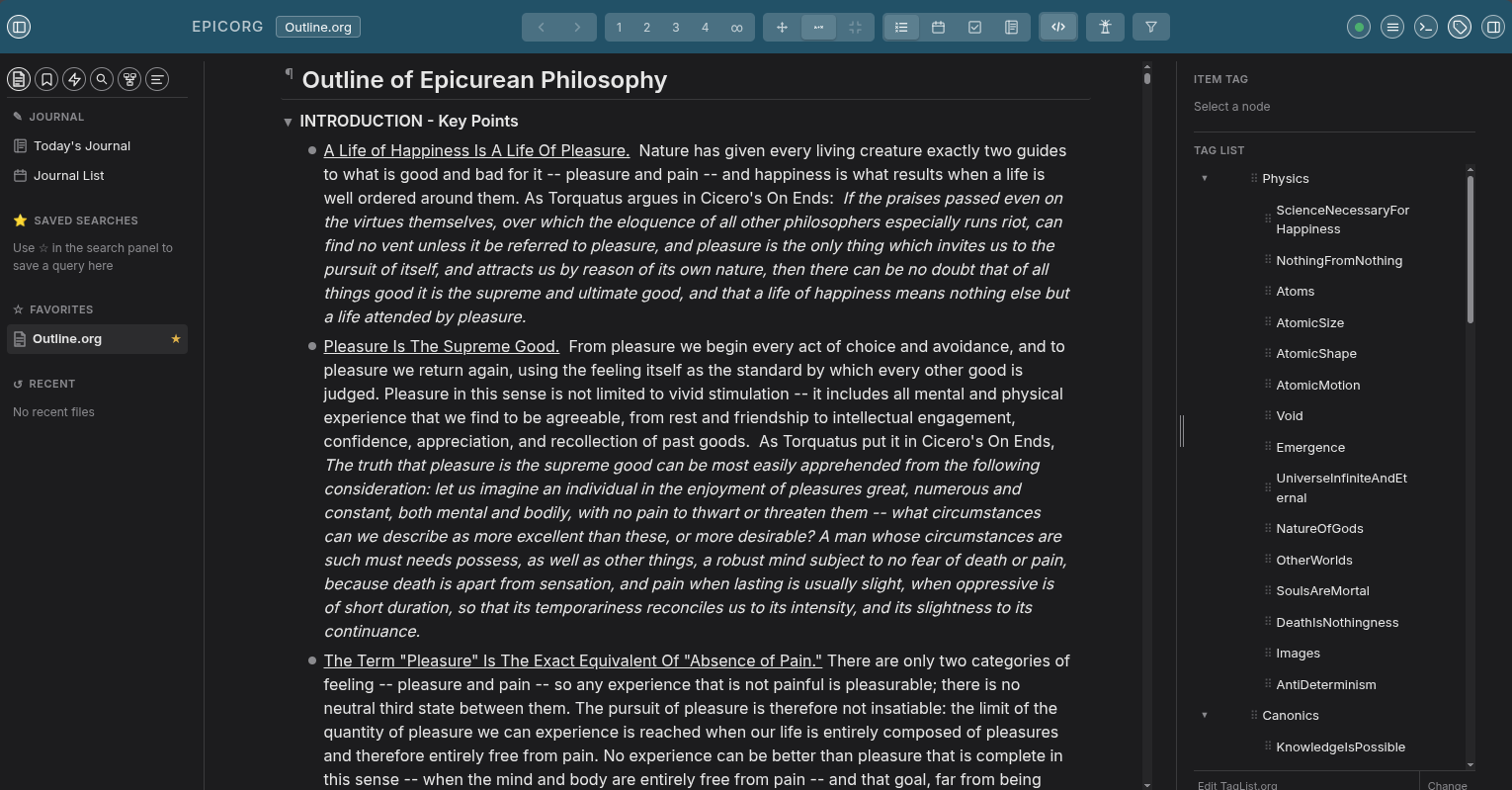
The Working Outline
Section titled “The Working Outline”Everything on this site — every citation, every commentary, every topic — is drafted and organized first in a single working outline, kept in a free outliner program called EpicOrg. That outline is not a finished, static document. It is a living reference that grows and gets corrected continuously, and you can watch it change in something close to real time.
This is a live export of the actual file, regularly updated as new citations are added, topics are reorganized, and commentary is corrected. It is not a polished article — it is the raw material, organized by topic and tagged for cross-reference, that the articles and the Key Quotations page on this site are drawn from. In fact, the Key Quotations page is generated automatically from this same outline every time the site is rebuilt, so the two stay in sync without separate manual upkeep.
About EpicOrg
Section titled “About EpicOrg”Visit the EpicOrg program page →
EpicOrg is a free, open-source outline editor, built to make working in the powerful org-mode outlining format approachable without requiring Emacs. It runs as a single small program on your own computer — there is nothing to install beyond one binary, nothing is sent anywhere over the internet, and your notes stay in plain text files on your own machine the whole time.
EpicOrg is released under the GNU General Public License v3.0 — it is free software in every sense: free to use, free to inspect, free to modify, and free to redistribute. The complete source code is public on GitHub, and pre-built binaries for Linux, macOS, and Windows are published automatically as nightly releases, so anyone can download and run it without paying anything or asking permission:
github.com/cassiusamicus/epicorg →
EpicOrg was written for the specific purpose of maintaining the outline behind this site, but it isn’t limited to that use. It supports infinite nesting, tags, bookmarks, wiki-style links between notes, an agenda view for dated items, and export to a self-contained HTML file — all built on top of the standard .org file format, so anything created in EpicOrg can also be opened and edited in Emacs or any plain text editor.
Why An Outline?
Section titled “Why An Outline?”The practice of reducing a large body of philosophy to a well-organized outline is not a modern convenience — it goes back to Epicurus’s own instructions to his students. In the Letter to Herodotus, Epicurus explains directly why he is providing his student with a compressed summary of the whole of his physical doctrine, rather than expecting him to work only from the complete, unabridged treatises:
“Indeed it is necessary to go back on the main principles, and constantly to fix in one’s memory enough to give one the most essential comprehension of the truth. And in fact the accurate knowledge of details will be fully discovered, if the general principles in the various departments are thoroughly grasped and borne in mind; for even in the case of one fully initiated the most essential feature in all accurate knowledge is the capacity to make a rapid use of observation and mental apprehension, and this can be done if everything is summed up in elementary principles and formulae. For it is not possible for anyone to abbreviate the complete course through the whole system, if he cannot embrace in his own mind by means of short formulae all that might be set out with accuracy in detail.” — Epicurus, Letter to Herodotus
The point is not that detail doesn’t matter — Epicurus wrote at enormous length across many treatises, and expected serious students to study them. The point is that detail is only usable once it is anchored to a clear structure held in the mind as a whole. Without that structure, a student drowns in isolated facts and quotations with no way to see how they connect or to retrieve the right one when it is needed. An outline — organized by topic, cross-referenced, and kept current — is exactly the kind of “short formulae” instrument Epicurus described: a tool for holding the whole system in view at once, so that any point of detail can be found, checked against its source, and understood in relation to everything else. EpicOrg and the outline it maintains exist to serve that same purpose.