
The Continuing Vitality of Epicurean Physics - An Introduction
Introduction: A Story About the Sun That Is Really About Everything
Section titled “Introduction: A Story About the Sun That Is Really About Everything”In a recent scholarly essay, T.H.M. Gellar-Goad takes up one of the most ridiculed positions in the history of ancient philosophy: the Epicurean claim that the sun is the size it appears to be. Cicero mocked it. Stoic philosophers used it as evidence that Epicureans were intellectually unserious. Modern critics have repeated the mockery. And on the surface, the laughter seems justified — the sun is enormous, roughly a million times the volume of the earth, yet it looks to the naked eye like a disk about the size of the full moon.
But Gellar-Goad’s analysis shows that the critics have consistently misread what Epicurus was actually doing. When Epicurus says the sun is “as big as it appears,” he is not asserting that it is the size of a dinner plate. He is making a precise epistemological point: that in the ancient world, before the development of advanced telescopes and spacecraft, no more advantageous vantage point was available from which to measure the sun’s size — and that the honest philosophical position, given those limitations, was to remain uncertain rather than substitute confident mathematical speculation for evidence that was simply not available.
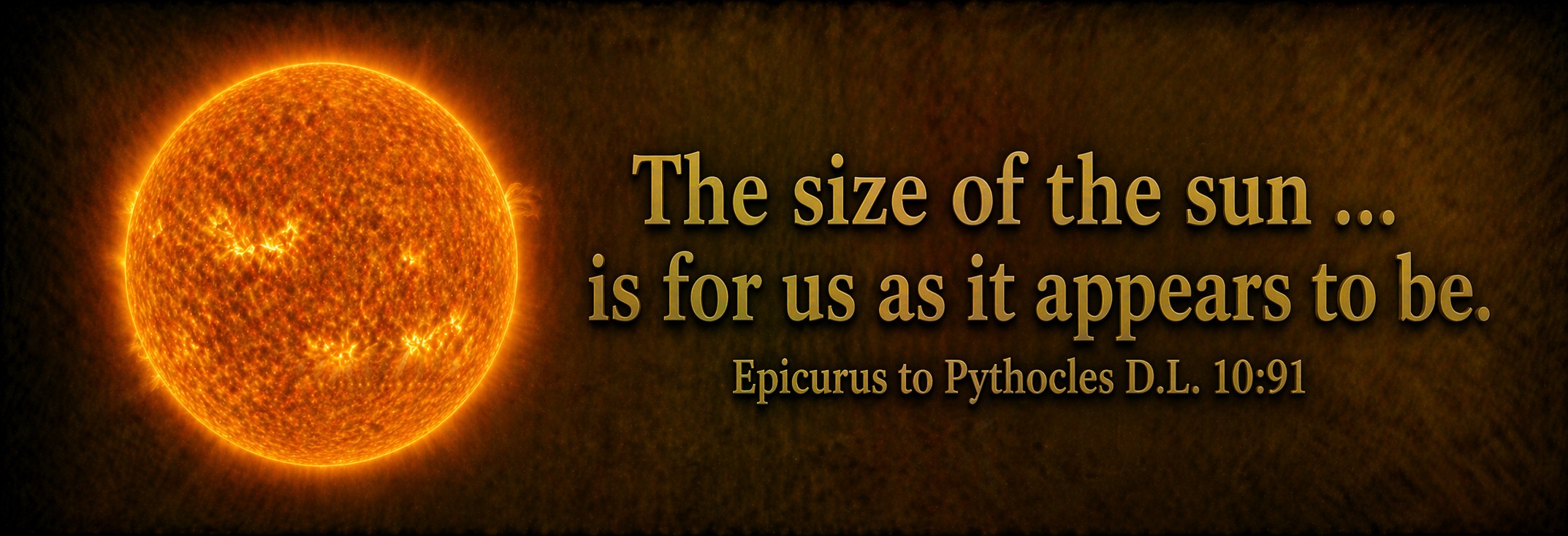
The result was that the Epicureans turned out to be less wrong than everyone who laughed at them. Every ancient astronomer who provided a specific measurement of the sun was wrong — dramatically, confidently, and precisely wrong. The Epicureans, by refusing to commit to a measurement they could not verify, avoided being concretely wrong. This was not timidity. It was good epistemology.
This insight — that Epicurus was doing good epistemology rather than bad astronomy — is the key to understanding the whole of Epicurean physics. Epicurus was not attempting to write a science textbook that would be superseded when better instruments were developed. He was building logical guardrails — identifying what any coherent account of the natural world must include and what it cannot coherently claim — guardrails that no subsequent discovery has knocked down.
Part One: What Kind of Enterprise Is Epicurean Physics?
Section titled “Part One: What Kind of Enterprise Is Epicurean Physics?”Not a Textbook — A Framework
Section titled “Not a Textbook — A Framework”The first thing to understand about Epicurean physics is what it is not. It is not an attempt to track the most recent discoveries in astronomy or biology. Epicurus knew perfectly well that specific questions — the exact size of the sun, the cause of lightning, the mechanism of earthquakes — were questions on which multiple explanations might be consistent with the evidence and none definitively provable. For such questions he explicitly endorsed offering multiple possible explanations rather than committing to one.
Epicurus tells us directly what physics is actually for. The Twelfth Principal Doctrine: “There is no way to dispel the fear about matters of supreme importance, for someone who does not know what the nature of the universe is but retains some of the fears based on mythology. Hence without natural philosophy there is no way of securing the purity of our pleasures.”
Physics is in the service of human wellbeing. It is required because false beliefs about the nature of the universe generate the specific fears that poison happiness — fear of divine punishment, fear of death, fear of cosmic fate. The physics exists to dissolve those fears by establishing, with the firmness of logical argument, what the nature of things must be.
This means Epicurean physics operates at two distinct levels. At the level of specific hypotheses — what causes thunder, how the moon produces its phases, why earthquakes happen — the answers are uncertain, multiple explanations are offered, and Epicurus is explicit that he does not know which is correct. At the level of necessary propositions — claims about what must be true given what we observe — the answers are meant to be definitive. These are not provisional hypotheses to be replaced when better instruments are developed. They are logical arguments from features of experience so universal that no future discovery could undermine them without undermining the experience itself.
The philosopher A.A. Long identifies exactly this dual character of Epicurean physics in his landmark 1977 article “Chance and Natural Law in Epicureanism.” The foundational arguments are meant to be settled. The specific hypotheses are tentative and revisable. What follows addresses only the foundational level.
The Epistemological Foundation
Section titled “The Epistemological Foundation”Before examining specific propositions, the epistemological foundation must be in view. Epicurus established three and only three reliable criteria of truth: sensation, preconception, and feeling — as analyzed in the companion Canonics article. These are the sources of all genuine knowledge, and any argument that leads to a conclusion contradicting what they plainly show must be suspected of containing a flaw.
When a chain of reasoning in physics arrives at a conclusion that contradicts universal human experience — that matter is nothing, that the universe was created from absolute non-existence, that everything is necessarily determined, that nothing can be known — the Epicurean response is not to accept the conclusion as a sound discovery. It is to search for the error in the argument. The senses do not lie. The reasoning may.
Part Two: Nothing Comes From Nothing — and Nothing Goes to Nothing
Section titled “Part Two: Nothing Comes From Nothing — and Nothing Goes to Nothing”The Foundation of All Epicurean Physics
Section titled “The Foundation of All Epicurean Physics”Before examining any specific proposition about atoms or the infinite universe, there is one principle that underlies all of them. It is the very first claim Epicurus makes in the Letter to Herodotus, and Lucretius places it at the opening of De Rerum Natura as the foundation on which the entire system rests:
“Nothing is ever begotten of nothing by divine power.” — Lucretius, De Rerum Natura Book I
“Nothing comes into being out of what is not. For in that case everything would come into being out of everything, with no need for seeds. Also, if that which disappears were destroyed into what is not, all things would have perished, for lack of that into which they dissolved.” — Epicurus, Letter to Herodotus 38–39
The principle has two inseparable halves. Nothing comes from nothing. Nothing passes away into nothing. Together they assert that the total quantity of what exists neither increases nor decreases. Matter is neither created nor destroyed; it is only rearranged.
Why This Is a Logical Claim, Not an Empirical One
Section titled “Why This Is a Logical Claim, Not an Empirical One”These are not empirical claims of the kind future instruments might overturn. They are logical claims about what is possible.
If things could arise from nothing — from the complete absence of any prior condition — then there would be no reason why they should arise here rather than there, now rather than then, in this form rather than another. Anything could arise anywhere at any time. But we observe that nature is not like that. Particular outcomes arise from particular prior conditions, reliably and consistently. Wheat grows from wheat seed, not from arbitrary circumstances. Fire requires fuel and oxygen. The very orderliness of nature — the fact that it is governed by regularities we can learn — is evidence that events have prior causes and that those causes have genuine causal power.
If things could pass away into absolute nothing, then over infinite time everything would eventually disappear. Since things exist now, they have not disappeared into nothing. The matter of the universe persists.
This double principle does two things of enormous importance. It eliminates supernatural creation from any coherent account of nature — if nothing can come from nothing, the universe cannot have been created from nothing by divine act. And it establishes the basis for natural science itself — if effects have prior material causes, then the world is in principle intelligible and its workings can be understood.
Modern physics states the same principle in precise mathematical form as the conservation laws: conservation of energy, conservation of mass-energy, conservation of momentum, conservation of charge. The total quantity of what exists is conserved through all transformations. What cannot happen — what modern physics agrees cannot happen — is the spontaneous appearance of energy or matter from absolute zero. The quantum vacuum, which is sometimes described as “nothing,” is in fact something: a physical field with specific properties and specific energy. It is emphatically not the Epicurean nothing — the absolute non-being from which Epicurus says nothing can arise.
Part Three: Matter Is Not Infinitely Divisible
Section titled “Part Three: Matter Is Not Infinitely Divisible”The Logical Argument Against Infinite Division
Section titled “The Logical Argument Against Infinite Division”Epicurus argued that matter cannot be divided without limit. The key passage from the Letter to Herodotus:
“Moreover, we must not suppose that in finite bodies there are infinitely many parts, however small. We must not only do away with division into smaller and smaller parts to infinity, so that we do not make all things weak, and in our conceiving of aggregates be forced to grind down things that exist and let them go off into the non-existent.”
The argument has two strands. First: if any finite body were infinitely divisible, dividing it completely would produce infinitely many parts — and an infinite sum of even the smallest finite quantities would be infinite, not finite. But we observe that finite bodies are finite in size. Therefore division must stop somewhere. There must be a smallest unit — not the smallest we have yet found with current instruments, but the smallest that can exist, such that dividing further would yield nothing at all.
Second: if you can always divide further, traversing any finite body in thought would require traversing infinitely many steps. But an infinite process has no end, which means you could never reach the other side of even the smallest pebble. The observable fact that finite distances can be traversed — that we walk across rooms, that light crosses from the sun to the earth — establishes that there must be a minimum unit of extension.
Epicurus made an important advance beyond his predecessor Democritus by introducing the concept of minima — theoretical minimums of extension that are the smallest units of which atoms themselves are composed. Atoms are the smallest physical units — the smallest pieces of matter that actually move independently through the void. But each atom contains a finite number of theoretical minima, the smallest conceivable units of extension. This precise concept addressed the Aristotelian objection that a “smallest magnitude” is self-contradictory — Epicurus answered with the analogy of perceptual minima, the smallest unit visible to the human eye, which has no detectable smaller parts but is nonetheless a genuine unit of size rather than a geometric point.
What Epicurus Was Actually Claiming
Section titled “What Epicurus Was Actually Claiming”Epicurus was not claiming that the specific particles known to fourth-century Greeks are the ultimate constituents of matter. He was claiming that some level of ultimate constitution must exist, for logical reasons no future discovery can undermine. The argument is: if matter were infinitely divisible, finite bodies would be either infinite in size or would dissolve into nothing. Neither is observed. Therefore, division stops somewhere.
That conclusion is not refuted by discovering that what we once thought was the stopping point turns out to be further divisible. Every such discovery simply relocates the stopping point. The logical argument remains intact.
Victor Stenger, physicist and author of God and the Atom (2013), traces the history of atomism from Democritus through the Standard Model of particle physics and concludes that the framework predicted there must be ultimate constituents of matter — and physics has been finding them, progressively, for two centuries. Quarks, leptons, and the bosons of the Standard Model appear to be genuinely elementary. We do not know with certainty that these are the final minima. Physics may discover further structure. But the logical argument that there must be some level at which division stops has been repeatedly vindicated, and the existence of the Planck length — the scale below which current physics cannot meaningfully apply — is consistent with the Epicurean position that division cannot proceed without limit.
Part Four: The Universe Has No Boundary in Space and No Beginning or End in Time
Section titled “Part Four: The Universe Has No Boundary in Space and No Beginning or End in Time”The Infinite Extent of the Universe
Section titled “The Infinite Extent of the Universe”Epicurus’ argument for the infinite extent of the universe from the Letter to Herodotus:
“The universe is boundless. For that which is bounded has an extreme point; and the extreme point is seen against something else. So that as it has no extreme point, it has no boundary; and as it has no boundary, it must be boundless and not limited.”
This is a logical argument from the concept of a boundary itself. A boundary is a point at which something ends and something else begins. A bounded universe would therefore have an “outside.” If there is something beyond the edge, the universe includes that something — and what we called the edge was not the edge. If there is nothing beyond the edge — not even empty space — then the boundary is the point at which the concept of extension ceases to apply, which is an incoherence rather than a genuine boundary.
Any coherent conception of the universe must either be infinite in extent, or must explain what lies beyond the boundary — and that explanation will inevitably expand the universe to include it. Epicurus further argued that the quantity of matter must also be infinite: if matter were finite in amount, it would have edges beyond which there is only void, and over infinite time finite matter would disperse into infinite void and never form stable combinations. Since we observe stable combinations — including ourselves — the supply of matter must be sufficient to sustain them.
The Eternal Universe
Section titled “The Eternal Universe”The proposition that the universe as a whole has no beginning and no end follows directly from the conservation principle of Part Two. If nothing comes from nothing, the universe cannot have been created from nothing — at no point in its history was there literally nothing. If nothing passes away into nothing, the universe will not end by dissolving into nothing. Combined with the argument for infinite spatial extent, the picture is of a universe that always has been and always will be, infinite in space and eternal in time.
This is Epicurus’ most direct confrontation with religious cosmology. The theological claim that the universe was created from nothing by divine act is, by the conservation principle, not a coherent account but a restatement of the mystery with an additional entity added. If the creator existed before creation, it existed in a universe — a universe containing at least one entity. That is not nothing. And a being described as perfectly happy and undisturbed — as the Epicurean gods are — has no motive and no need to create anything.
The most direct modern challenge to this comes from Big Bang cosmology, which describes the observable universe as originating approximately 13.8 billion years ago from an extremely hot, dense state. Several things should be noted. First, the Big Bang describes the beginning of the observable universe, not necessarily of all that exists. The physics breaks down at the initial singularity; this is not evidence that there was nothing before, but evidence that we do not yet have the physics to describe what was there. Second, many serious cosmologists — those working on eternal inflation, cyclic cosmology, and multiverse models — have questioned whether the Big Bang represents an absolute beginning or a phase transition within a larger eternal cosmos. Third, and most importantly, the conservation principles Epicurus invokes are logical claims about what is possible, not cosmological assertions about what happened 13.8 billion years ago. They are not contradicted by Big Bang cosmology, which does not describe creation from absolute non-being — only from an initial state whose nature remains to be understood.
Part Five: Everything That Exists Is Either Matter or Void
Section titled “Part Five: Everything That Exists Is Either Matter or Void”The Framework and Why It Is Complete
Section titled “The Framework and Why It Is Complete”Epicurus states this plainly in the Letter to Herodotus:
“The totality of things is bodies and void… The universe consists of bodies and space: for that bodies exist is universally witnessed by sensation itself… And if there were not that which we name void and room and intangible substance, bodies would not have anywhere to be or to move through in the way in which they are seen to move.”
The division of all that exists into body (matter) and void (empty space) is not a primitive guess about physics. It is a logical exhaustion of what it means for something to exist spatially. Either something occupies space — it is body, a material entity. Or it is the absence of material occupancy — it is void, the place where body is not. There is no third option that is neither one nor the other. Epicurus makes this explicit: outside matter and void, nothing else is even conceivable except as a property of one or the other.
What Counts as “Matter”
Section titled “What Counts as “Matter””The history of physics since Epicurus has enormously expanded our understanding of what counts as body — as the material content of the universe. Newton’s mechanics dealt with massive particles and forces. Maxwell introduced electromagnetic fields. Einstein showed that energy and mass are interchangeable and that spacetime has properties. Quantum mechanics introduced wave-particle duality. Quantum field theory describes particles as excitations of underlying fields.
Each of these developments has been taken by some commentators as threatening the Epicurean framework. But this concern rests on a misunderstanding of what the framework claims. It claims only that everything that exists either has material effects — it can act on other things, be acted upon, produce observable consequences — or it is the spatial absence of such material things. It does not specify the form that material existence takes.
Whether matter takes the form of classical particles, quantum fields, curved spacetime geometry, or some more fundamental structure yet to be discovered, if it produces observable consequences it falls under “body” in the Epicurean sense. Stenger puts it directly: far from demonstrating a holistic universe where everything is intimately connected, relativity and quantum mechanics confirmed that the universe is reducible to discrete, separated parts. No continuous aether exists. Light is best modeled as photons streaming through the void. A copper wire is mostly void. The quantum field is made up of points, each with its own value — not an ethereal substance beyond matter and void.
The categories “dark matter” and “dark energy” are entirely consistent with this framework. Their existence is inferred from gravitational effects — from the way they produce observable consequences in the behavior of matter we can detect. Whatever they turn out to be, they are unknown forms of matter, not unknown substances beyond matter.
The Guardrail Against Pseudo-Entities
Section titled “The Guardrail Against Pseudo-Entities”The matter-void framework functions as a guardrail against a persistent philosophical error: positing entities that exist but have no material effects, no connection to observable reality, and no way of being verified or falsified. Plato’s Forms, Aristotle’s Prime Mover, Descartes’ mind-substance, Kant’s thing-in-itself, and various forms of supernaturalism all posit something that is neither body (it has no physical location and no physical effects of the normal kind) nor void (it is supposed to be something, not mere absence). The Epicurean question is simple: if it exists but has no material effects, what entitles it to the name “existence”?
Part Six: Natural Law and Genuine Freedom
Section titled “Part Six: Natural Law and Genuine Freedom”The Problem of Determinism
Section titled “The Problem of Determinism”A.A. Long’s 1977 article “Chance and Natural Law in Epicureanism” identifies what might seem a tension at the heart of Epicurean physics. If atoms move according to fixed natural laws — governed by their shape, size, and weight — then all events are the fully determined products of prior atomic configurations. But if everything is fully determined, then choices are illusions and the entire program of Epicurean ethics — living well through deliberate philosophical practice — is undermined before it starts.
Epicurus was fully aware of this tension and addressed it directly. He insisted on a sharp distinction between the regularities that govern how atoms of particular shapes and sizes typically interact — which is what makes nature law-governed and intelligible — and total determinism, the claim that every event is the inevitable consequence of prior configurations with no room for genuine agency anywhere in the system.
The Atomic Swerve
Section titled “The Atomic Swerve”To preserve genuine agency against the mechanistic alternative, Epicurus incorporated what Lucretius calls the swerve: the tiny, spontaneous, uncaused deviation that atoms can occasionally make from their paths. Lucretius asks directly: if atoms never swerve, “what is the source of the free will possessed by living things throughout the earth?” The swerve breaks the chain of pure mechanical necessity and makes genuine choice possible.
The swerve was among the most mocked features of Epicurean physics in antiquity. It looks like a desperate ad hoc device introduced to escape a problem that the physics had created. But Long shows it is the correct response to a genuine philosophical problem, and modern physics has confirmed that the Epicureans were pointing at something real. Quantum mechanics established that at the level of individual particle events there is genuine irreducible indeterminacy — not merely a gap in our knowledge but a feature of reality itself. The decay of a radioactive nucleus, the path of an individual photon — these are genuinely indeterminate in the sense that no prior information, however complete, would allow us to predict them with certainty.
This is precisely what Stenger describes: with the rise of quantum mechanics and the Heisenberg uncertainty principle, genuine randomness inherent in the motion of all bodies became built into the structure of physics. Physicists had, in Stenger’s words, almost no trouble giving up the determinism of the Newtonian world machine. Epicurus had made this move two thousand years earlier.
The combination Epicurus insists on — natural regularity without total determinism — is exactly what quantum field theory also achieves. It is one of the most striking confirmations of the Epicurean framework by modern science.
Conclusion: Guardrails, Not a Cage
Section titled “Conclusion: Guardrails, Not a Cage”Epicurus was not attempting to write the final chapter of physics. He was doing what good philosophy does when confronting a field whose specific results are uncertain and contested: identifying what any adequate account must respect, and building the logical guardrails that prevent specific uncertainties from being exploited for philosophical misdirection.
Those guardrails — nothing comes from nothing or goes to nothing; matter is not infinitely divisible; the universe has no spatial boundary; the universe has no beginning or end in time; everything that exists is either body or void; nature is regular without being totally determined — have not been overturned by modern science. They have been, in crucial respects, confirmed by it. The Standard Model of particle physics is an atomist theory. Conservation of energy and mass-energy states in precise mathematical form what Epicurus stated in philosophical form. Quantum indeterminacy vindicates the swerve. The best current cosmological thinking favors an eternal cosmos of which the observable universe is one region. And every proposal for entities beyond matter and void continues to founder on the question: if it has no material effects, in what sense does it exist?
The guardrails do not prevent inquiry. Within them, everything is open. The history of physics has been the systematic exploration of what those boundaries contain — an exploration that has found the universe both more complex and more wonderful than Epicurus could have imagined, but not different in kind from what his framework predicted.
Epicurus did not know the size of the sun. Neither, in some sense, do we — even now, in the twenty-first century, the question of where exactly the sun’s “surface” ends and begins is genuinely contested in solar physics. But Epicurus understood why he could not know it, and what kind of intellectual honesty that not-knowing required. That understanding — principled, philosophically grounded, combined with confident logical commitment to what must be true — is the continuing contribution of Epicurean physics to anyone willing to receive it.
Key Sources
Section titled “Key Sources”- Epicurus, Letter to Herodotus; Letter to Menoeceus; Principal Doctrines — all in Bailey, Epicurus: The Extant Remains (Oxford, 1926)
- Lucretius, De Rerum Natura — Bailey translation
- T.H.M. Gellar-Goad, “Lucretius on the Size of the Sun,” in Brill’s Companion to the Reception of Lucretius (2020)
- Victor J. Stenger, God and the Atom (Prometheus Books, 2013)
- A.A. Long, “Chance and Natural Law in Epicureanism,” Phronesis 22 (1977), pp. 63–88
- A.A. Long and D.N. Sedley, The Hellenistic Philosophers, 2 vols. (Cambridge, 1987)
- Norman DeWitt, Epicurus and His Philosophy (Minnesota, 1954)
- Long-form reference article: The Continuing Vitality of Epicurean Physics, EpicurusToday.com