
The Continuing Vitality of Epicurean Physics
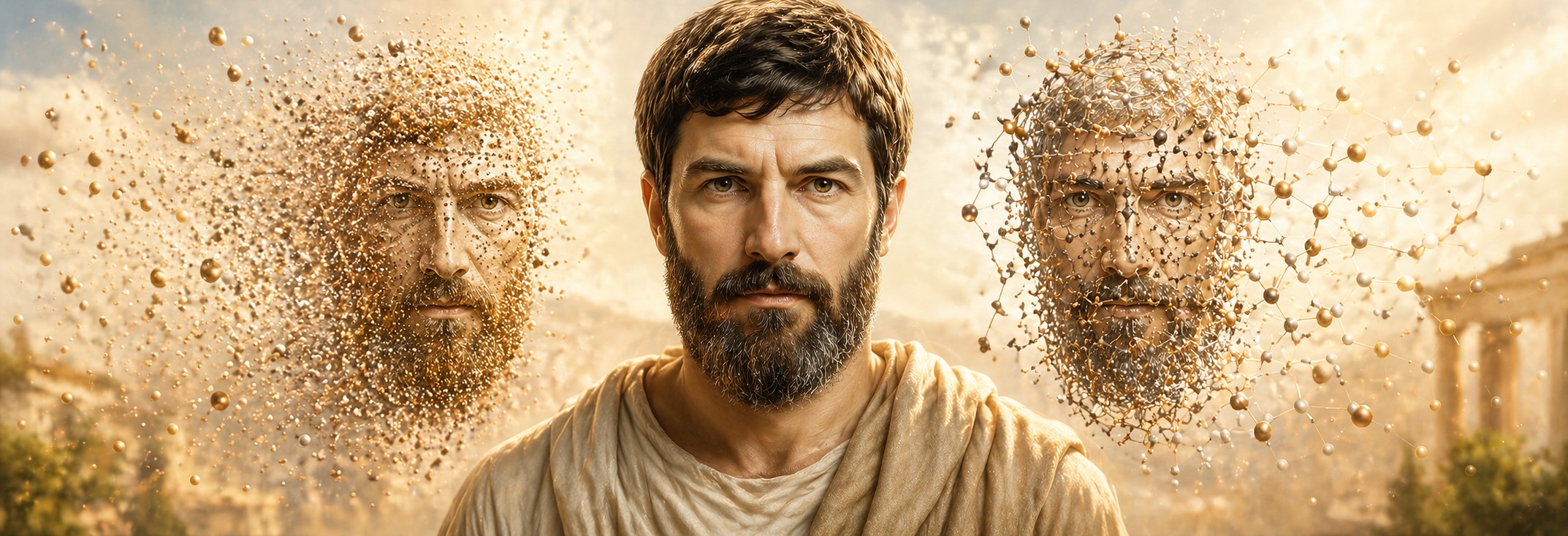
Introduction: A Story About the Sun That Is Really About Everything
Section titled “Introduction: A Story About the Sun That Is Really About Everything”In a recent scholarly essay, T.H.M. Gellar-Goad takes up one of the most ridiculed positions in the history of ancient philosophy: the Epicurean claim that the sun is the size it appears to be. Cicero mocked it. Stoic philosophers used it as evidence that Epicureans were intellectually unserious. Modern critics have repeated the mockery with updated vocabulary. And on the surface, the laughter seems justified — after all, we know that the sun is enormous, roughly a million times the volume of the earth, and it looks to the naked eye like a disk about the size of the full moon. Surely anyone who says the sun is “the size it appears to be” is either joking or confused.
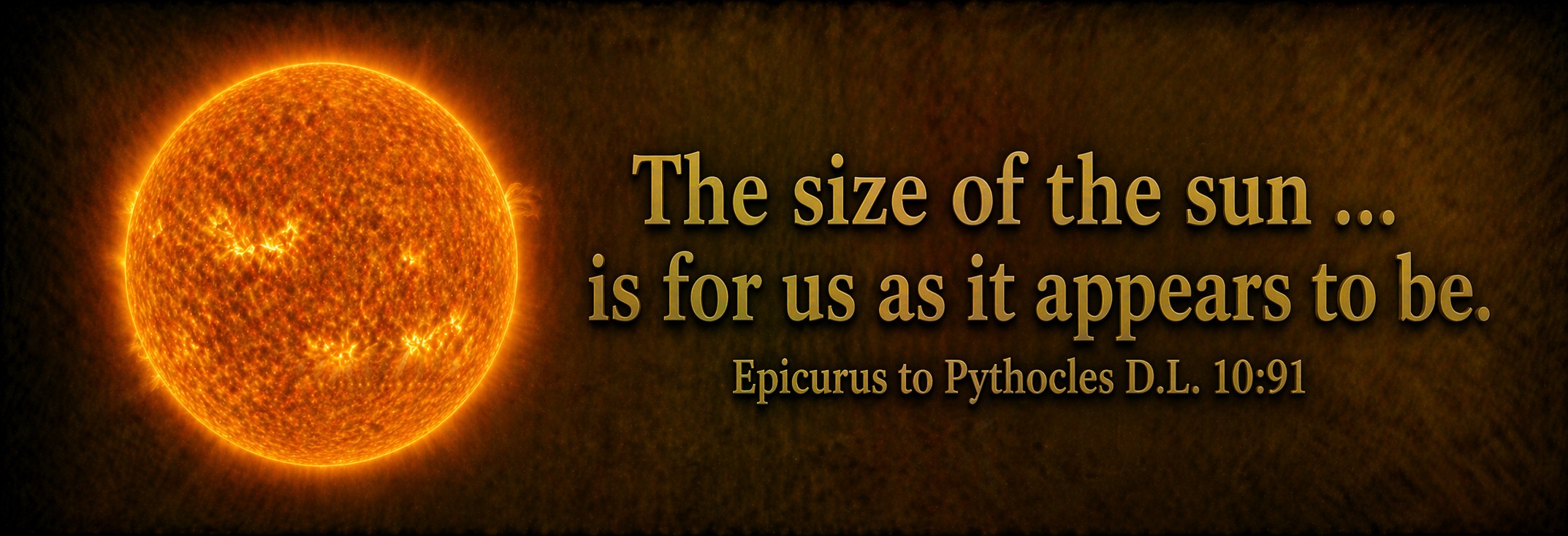
But Gellar-Goad’s analysis shows that the critics, ancient and modern, have consistently misread what Epicurus was actually doing. When Epicurus says the sun is “as big as it appears,” he is not asserting that the sun is the size of a dinner plate or, as Cicero mockingly claimed, “the size of a human foot.” He is making a precise epistemological point: that our knowledge of the sun’s true size is bounded by our perceptual access to it, that in the ancient world — before the age of advanced telescopes and space travel — no more advantageous vantage point was available from which to measure it, and that the honest philosophical position given those limitations was to remain in a state of reasoned uncertainty while trusting what the senses actually deliver rather than substituting mathematical speculation for sensory evidence.
The result, as Gellar-Goad shows, is that the Epicureans turned out to be less wrong than everyone who laughed at them. Every ancient astronomer who provided a specific measurement of the sun was wrong — dramatically, confidently, and precisely wrong. The Epicureans, by refusing to commit to a precise measurement they could not verify, avoided being concretely wrong. This was not timidity or evasion. It was good epistemology.
And this insight — that Epicurus was doing good epistemology rather than bad astronomy — is the key that unlocks the broader significance of Epicurean physics for us today. The purpose of this article is to develop that key and apply it to the four core propositions of Epicurean physics that remain most philosophically significant. We will argue that each of these propositions functions as a set of logical guardrails against specific kinds of error that have repeatedly distorted human understanding — and that modern science, far from superseding the Epicurean framework, has in crucial respects confirmed it.
Part One: What Kind of Enterprise Is Epicurean Physics?
Section titled “Part One: What Kind of Enterprise Is Epicurean Physics?”Not a Textbook to Be Superseded
Section titled “Not a Textbook to Be Superseded”The first thing to understand about Epicurean physics is what it is not. It is not a science textbook. It is not an attempt to track the most recent developments in Hellenistic astronomy or meteorology or biology. Epicurus was fully aware that specific questions about the natural world — the exact size of the sun, the cause of lightning, the mechanism of earthquakes — were subjects on which multiple explanations might be consistent with the evidence and none might be definitively provable with the means available. For such questions, he explicitly endorsed the method of offering multiple possible explanations rather than committing dogmatically to one.
What Epicurean physics is can be understood from Epicurus’ own statement of purpose in Principal Doctrine 12: “There is no way to dispel the fear about matters of supreme importance, for someone who does not know what the nature of the universe is but retains some of the fears based on mythology. Hence without natural philosophy there is no way of securing the purity of our pleasures.”
Natural philosophy is in the service of human wellbeing. It is required not because Epicurus was a scientist curious about the details of nature but because false beliefs about the nature of the universe generate the specific fears that poison human happiness — fear of divine punishment, fear of death, fear of cosmic fate. The physics exists to dissolve these fears by establishing, with the firmness of logical argument grounded in universal human experience, what the nature of things must be.
This means that Epicurean physics operates primarily at the level of necessary propositions — claims about what must be true, given what we observe, rather than claims about the specific mechanisms by which particular phenomena work. Specific mechanisms are uncertain and Epicurus says so openly. The necessary propositions are another matter. These are not provisional empirical hypotheses to be replaced when better instruments are developed. They are logical arguments from features of experience so universal that no future discovery could undermine them without undermining the experience itself.
The philosopher A.A. Long, in his landmark 1977 article “Chance and Natural Law in Epicureanism,” identifies exactly this dual character of Epicurean physics: it operates both at the level of foundational logical argument (about what the universe must consist of and how it must work) and at the level of specific explanatory hypothesis (about how particular phenomena occur). The foundational arguments are meant to be definitive. The specific hypotheses are tentative and revisable.
The article that follows addresses only the foundational level. We are not arguing that Epicurus was right about the size of the sun, the distance of the moon, or the mechanism of thunder. We are arguing that the five core propositions of his foundational physics — about the principle of conservation, the nature of matter, the extent of space, the eternity of the universe, and the exhaustiveness of the matter-void framework — remain philosophically sound, and that the history of science has not refuted them but rather, in important respects, confirmed them.
The Canonical Foundation
Section titled “The Canonical Foundation”Any discussion of Epicurean physics must begin with a reminder of the epistemological foundation on which it rests — the Canonics that we have analyzed in detail in the companion article on that subject. Epicurus established three and only three reliable criteria of truth: sensation, preconception, and feeling. These criteria are not arbitrary; they are the sources of all genuine knowledge, and any argument that leads to a conclusion contradicting what they plainly show must be suspected to contain a flaw.
This epistemological principle has a specific application to physics. When an argument in physics leads to a conclusion that contradicts universal human experience — that matter is nothing, that the universe came from nothing, that everything is necessarily determined, that nothing can be known — the Epicurean response is not to accept the conclusion as a sound discovery but to search for the error in the argument. As Epicurus stated directly in his Letter to Herodotus: we must “stick to our sensations” as the means of determining what needs confirmation and what is established.
This is the posture that generated both the Epicurean position on the sun and the four propositions we examine below. In each case, Epicurus is not claiming to have solved a specific empirical question that physics is still working on. He is establishing what any coherent account of the world must include, on pain of contradicting what observation and reason together plainly establish.
Part Two: Nothing Comes From Nothing — and Nothing Goes to Nothing
Section titled “Part Two: Nothing Comes From Nothing — and Nothing Goes to Nothing”The Most Fundamental Principle in Epicurean Physics
Section titled “The Most Fundamental Principle in Epicurean Physics”Before examining any of the specific propositions about atoms, infinite space, or the eternity of the universe, there is one principle that underlies all of them and without which none of them can be properly understood. It is the first principle Epicurus states in the Letter to Herodotus, and Lucretius places it at the very opening of De Rerum Natura as the foundation on which the entire system rests:
“Nothing is ever begotten of nothing by divine power.” — Lucretius, De Rerum Natura Book I
“Nothing comes into being out of what is not. For in that case everything would come into being out of everything, with no need for seeds. Also, if that which disappears were destroyed into what is not, all things would have perished, for lack of that into which they dissolved.” — Epicurus, Letter to Herodotus 38–39
The principle has two inseparable halves. First: nothing comes from nothing. Second: nothing passes away into nothing. Together they constitute what Epicurus calls the principle of conservation — the assertion that the total quantity of what exists neither increases nor decreases. Matter is neither created nor destroyed; it is only rearranged.
Why This Principle Is Logical, Not Empirical
Section titled “Why This Principle Is Logical, Not Empirical”It would be a mistake to read these as empirical claims of the kind that future scientific discoveries might revise. They are logical claims — arguments about what is possible, not merely what has so far been observed.
The argument for “nothing comes from nothing” proceeds as follows: if things could arise from nothing at all — from the complete absence of any prior condition — then there would be no reason why they should arise from this precondition rather than that one, at this time rather than that one, in this place rather than that one. Anything could arise anywhere at any time from nothing. But we observe that nature is not like that. Particular outcomes arise from particular prior conditions, reliably and consistently. Wheat grows from wheat seed, not from any random condition. Fire requires fuel and oxygen, not any arbitrary circumstance. The very orderliness of nature — the fact that it is governed by regularities we can observe and learn — is itself evidence that events have prior causes and that those causes have genuine causal power. If anything could arise from nothing, the orderliness we observe would itself have no explanation.
The argument for “nothing passes into nothing” is equally direct: if things could genuinely cease to exist — not merely change form, not merely disperse into smaller constituents, but become absolutely nothing — then over any sufficiently long time, everything would eventually disappear. Since things exist now, they have not disappeared into nothing. The matter of the universe persists.
The Guardrail This Provides
Section titled “The Guardrail This Provides”The practical significance of this principle in Epicurean philosophy is immense. It does two things simultaneously.
First, it eliminates supernatural creation from any coherent account of nature. If nothing can come from nothing, then the universe cannot have been created from nothing by a divine act. Either the divine creator existed within a prior universe (which then also needs explanation), or the universe has always existed and needed no creator. Both conclusions point toward the same result: the universe as a whole is eternal, and the attempt to explain its existence by positing a creator who created it from nothing is not an explanation at all — it is a restatement of the mystery with an additional entity added.
Second, it establishes the basis for natural science as such. If effects have prior material causes, and those causes have prior causes, then the world is in principle intelligible: we can trace the causes of phenomena back through chains of prior conditions, and we can understand what produces what. This is what science actually does. Without the principle that things come from prior things — that nothing arises from nothing — there would be no basis for the scientific investigation of causes, because any apparent cause might be irrelevant and the actual “cause” might be nothing at all.
Modern Science and Conservation
Section titled “Modern Science and Conservation”The modern scientific equivalents of Epicurus’ principle are the conservation laws that physics has established as the bedrock of the discipline: conservation of energy, conservation of mass-energy, conservation of momentum, conservation of charge. These laws state, in precise mathematical form, exactly what Epicurus stated in philosophical form: the total quantity of certain fundamental properties of physical systems does not change. It is rearranged, transferred, transformed — but not created from nothing or annihilated into nothing.
The physicist may observe that energy can be converted into mass (as in nuclear reactions) and mass into energy (as demonstrated by Einstein’s famous equation). This is not a violation of the Epicurean principle; it is a more precise statement of what “conservation” means. The total quantity of mass-energy is conserved even as the forms in which it exists change. What cannot happen — what modern physics agrees cannot happen — is the spontaneous appearance of energy or matter from a state of absolutely zero energy, absolutely zero everything. The quantum vacuum, which is sometimes described as “nothing,” is in fact something: it is a physical field with specific properties, a specific energy density, and it is governed by specific laws. It is emphatically not the Epicurean nothing — the absolute non-being from which Epicurus says nothing can arise.
This alignment between Epicurean first principles and the conservation laws of modern physics is not a coincidence. It reflects the fact that both Epicurus and modern physics are responding to the same underlying logical structure of the question: what must be true of any coherent account of a world in which events have causes and nature behaves with regularity?
Part Three: Matter Is Not Infinitely Divisible
Section titled “Part Three: Matter Is Not Infinitely Divisible”The Argument from Experience
Section titled “The Argument from Experience”Epicurus’ argument for the existence of atomic minima — for the proposition that matter is not infinitely divisible — begins not with a laboratory result but with a logical analysis of what infinite divisibility would mean. The key passage is from the Letter to Herodotus (56–59):
“Moreover, we must not suppose that in finite bodies there are infinitely many parts, however small. We must not only do away with division into smaller and smaller parts to infinity, so that we do not make all things weak, and in our conceiving of aggregates be forced to grind down things that exist and let them go off into the non-existent — but also we must not suppose in finite bodies there is to be an infinite traversal even of the smaller parts.”
The argument has two related strands. First: if any finite body were infinitely divisible, then dividing it completely would produce infinitely many parts — and an infinite sum of even the smallest finite quantities would be infinite, not finite. But we observe that finite bodies are finite in size. Therefore, the process of division must stop somewhere. There must be a smallest unit — not the smallest we have yet found with current instruments, but the smallest that can exist, such that dividing further would yield nothing at all.
Second: if you can always divide further, then “traversing” any finite body in thought requires traversing an infinite number of steps. But an infinite process has no end, and therefore you would never reach the other side of even the smallest pebble. The observable fact that finite distances can be traversed — that we can walk across a room, that light can travel from the sun to the earth — establishes that there must be a minimum unit of extension.
Epicurus’ Distinctive Contribution: Minima Within Atoms
Section titled “Epicurus’ Distinctive Contribution: Minima Within Atoms”David Sedley, in his authoritative analysis of Epicurean physics, has shown that Epicurus made a significant advance beyond Democritus at precisely this point. Where Democritus held simply that atoms are physically indivisible, Epicurus developed the more precise concept of minima — theoretical minimums of extension that are the smallest units of which atoms themselves are composed.
Atoms, for Epicurus, are the smallest physical units — the smallest units of matter that actually move independently through the void. But each atom contains a finite number of theoretical minima, the smallest conceivable units of extension. These minima are not themselves independent particles; they cannot be isolated from the atom of which they are parts. But their existence follows necessarily from the argument against infinite divisibility, and their number within any atom is finite.
As Sedley explains, Epicurus answered the Aristotelian objection that the concept of “smallest magnitude” is self-contradictory: how can something have size but no parts? The answer is the analogy to perceptual minima — the smallest visible unit, the unit that is just barely detectable by the human eye at the limit of its resolving power. That visible unit has no detectable parts smaller than itself, and yet it is a genuine unit of size, not a geometric point. The theoretical minimum is analogous: a unit of extension with no further parts, but with genuine spatial magnitude.
The Modern Confirmation
Section titled “The Modern Confirmation”The modern scientific history of atomism is the history of finding successively smaller components of matter — from the Daltonian atom, to the nucleus and electrons, to protons and neutrons, to quarks and leptons. Each layer of discovery seemed, at first, to threaten the atomist framework by showing that the previously supposed “atom” was in fact composite. But in each case, the discovery confirmed the structure of the argument: there are minimal units, and the task of physics is to find them.
Victor Stenger, physicist and author of God and the Atom (2013), traces this entire history and concludes that the Standard Model of particle physics represents the current best understanding of what those minimal units are. Quarks, leptons, and the bosons of the Standard Model appear to be genuinely elementary — that is, not composed of further sub-units detectable by any current or foreseeable experimental method. We do not know with certainty that these are the ultimate minima. Physics may discover further structure. But the logical argument that there must be some level at which division stops has been repeatedly vindicated as each successive “atom” turned out to be divisible — until we reach the level where present theory and experiment can find no further structure.
Stenger makes the case that, in the final analysis, atoms and the void are all that exists, and that the Standard Model represents, at our current level of investigation, the vindication of the Epicurean framework rather than its refutation. The framework predicted that there must be ultimate constituents of matter. Physics has been finding them, progressively, for two centuries.
There is a specific parallel to Epicurus’ theory of minima in the concept of the Planck length — approximately 1.616 × 10⁻³⁵ meters — below which the current frameworks of physics cannot meaningfully apply. Whether the Planck length represents a genuine minimum unit of space, an ultimate minimum of physical extension below which nothing can meaningfully exist, is a question current physics cannot definitively answer. But the existence of such a theoretical limit — the recognition that there is a scale below which the concepts of current physics break down — is entirely consistent with, and arguably supportive of, the Epicurean logical argument that division cannot proceed to infinity.
What Epicurus Was Actually Claiming
Section titled “What Epicurus Was Actually Claiming”It is important to be precise about what the Epicurean claim is and is not. Epicurus was not claiming that the specific particles known to fourth-century-BC Greeks are the ultimate constituents of matter. He was claiming that some level of ultimate constitution must exist, for logical reasons that no future empirical discovery can undermine. The logical argument is: if matter were infinitely divisible, finite bodies would be either infinite in size or would dissolve into nothing. Neither is observed. Therefore, division stops somewhere. That conclusion is not refuted by discovering that what we once thought was the stopping point turns out to be further divisible. Every such discovery simply relocates the stopping point. The logical argument remains intact.
Part Four: The Universe Has No Boundary in Space
Section titled “Part Four: The Universe Has No Boundary in Space”The Argument for Infinite Extent
Section titled “The Argument for Infinite Extent”Epicurus’ argument for the infinite extent of the universe is stated in the Letter to Herodotus (41–42):
“The universe is boundless. For that which is bounded has an extreme point; and the extreme point is seen against something else. So that as it has no extreme point, it has no boundary; and as it has no boundary, it must be boundless and not limited.”
This is an argument from the concept of a boundary itself. A boundary is a point at which something ends and something else — at minimum, empty space — begins. But that means a bounded universe would have an “outside” — something beyond its edge. If there is something beyond the edge of the universe, then the universe includes that something, and what we called the edge was not really the edge. And if there is nothing beyond the edge — not even empty space — then the boundary is the point at which the very concept of extension ceases to apply. But that is not a boundary in any ordinary sense; it is an incoherence.
The argument is purely logical. It does not depend on empirical measurements of the universe’s extent. It depends on the analysis of what “boundary” means when applied to the totality of what exists. Any coherent conception of the universe must either be infinite in extent, or it must explain what lies beyond the boundary — and that explanation will inevitably expand the universe to include whatever that something is.
Epicurus Versus the Bounded-Universe Traditions
Section titled “Epicurus Versus the Bounded-Universe Traditions”The major alternative traditions, ancient and modern, have consistently posited a bounded universe. In Aristotle’s cosmology, the universe is bounded by the outermost sphere, beyond which there is no space at all — not even empty space. In certain interpretations of modern cosmology influenced by the Big Bang model, the universe is described as “finite but unbounded” — the analogy being to the surface of a sphere, which is finite in extent but has no edge. In religious cosmology, the universe has a beginning in time (and often an implied boundary in space) created by divine act.
Epicurus’ argument applies with equal force to all of these positions. If there is no space beyond Aristotle’s outermost sphere, then the outermost sphere has no “outside” — but that means it has no boundary in the ordinary sense, because a boundary is defined by what it is a boundary between. The Aristotelian “bounded universe” is either incoherent (there is literally nothing beyond the edge, not even absence of things) or it is secretly infinite (what lies beyond the outermost sphere is the void, which is exactly what Epicurus says). In neither case does Aristotle’s bounded universe escape the Epicurean argument.
The modern cosmological models that describe the universe as “finite but unbounded” are more sophisticated, but they face a related difficulty: they apply differential geometry to describe the large-scale structure of space, and that geometry has an answer to the question “what is beyond the observable universe” — namely, more universe, whether or not that universe is currently accessible to observation. The observable universe is bounded by the limits of our observation, not by the limits of what exists. Epicurus would note the distinction.
Matter and Void Both Infinite
Section titled “Matter and Void Both Infinite”Epicurus further argued that not only space but also the quantity of matter in the universe must be infinite. The argument is simple: if the quantity of matter in the universe were finite, it would have edges — regions beyond which there is no matter but only void. On an infinite scale of time, the finite matter would disperse into the infinite void and never form stable combinations. Since we observe stable combinations (including ourselves), the amount of matter must be sufficient to produce and maintain them — which requires an infinite supply to counterbalance the infinite dispersal of void.
This argument, unlike the pure logical argument about the extent of space, is an empirical argument from the stability of the world we observe. It depends on the assumption that the world as we find it is sufficiently stable and persistent to require explanation — an assumption that seems undeniable.
Part Five: The Universe Has No Beginning and No End in Time
Section titled “Part Five: The Universe Has No Beginning and No End in Time”The Argument from Conservation
Section titled “The Argument from Conservation”The proposition that the universe as a whole has no beginning and will have no end is perhaps Epicurus’ most direct confrontation with religious cosmology, ancient and modern. Its basis is the principle that nothing can come from nothing and nothing can pass away into nothing — the twin conservation principles that Epicurus states at the very beginning of the Letter to Herodotus and that Lucretius develops at length in Book I of De Rerum Natura.
“Nothing comes into being out of what is not. For in that case everything would come into being out of everything, with no need for seeds… Also, if that which disappears were destroyed into what is not, all things would have perished, for lack of that into which they dissolved. Moreover, the totality of things was always such as it is now, and always will be the same.” — Letter to Herodotus 38–39
The argument is that creation from nothing — in the strict sense of literally nothing, not even void or vacuum fluctuations — is logically impossible. If things could arise from nothing at all, they would arise randomly, from any precondition, at any place and time. But we observe that nature is orderly: particular types of seeds produce particular types of plants, not random types; particular combinations of materials produce particular compounds, not arbitrary results. Order and regularity require prior causes. Prior causes require that something already exists. Therefore, at no point in the history of the universe was there literally nothing.
Similarly, if things could pass away into literal nothing — not into their constituent parts, but into non-existence — then over infinite time everything would eventually disappear. Since things exist now, they have not passed away into nothing. Therefore, the total quantity of what exists has been conserved throughout all past time and will continue to be conserved through all future time.
Against the Theological “Moment of Creation”
Section titled “Against the Theological “Moment of Creation””The theological alternative — that the universe was created by a divine act from nothing at some point in the past — is one of the oldest human ideas and one of the most resistant to philosophical examination. Epicurus examined it and found it incoherent on multiple grounds.
First, the logical problem: if the divine being existed before the universe, then the divine being existed in a universe that contained at least one entity — the divine being itself. That universe is not “nothing.” The creation story, if taken literally, requires that the creator existed in a context prior to creation, which means that context is itself part of what needs to be explained.
Second, the physical problem: what was the creator doing before creation? If the creator is perfectly happy and self-sufficient (as the Epicurean gods are), then no purpose or motive for creation is available. If the creator was moved by some purpose, then the creator had needs and was not perfectly self-sufficient. The Epicurean gods, precisely because they are genuinely blessed and undisturbed, have no reason to create anything and no reason to be troubled by the existence of a universe that runs itself by natural law.
Third, the empirical problem: the evidence of the world as we observe it — full of inefficiency, waste, catastrophe, and organisms that consume each other — does not suggest deliberate benevolent design. Lucretius makes this argument at length and with characteristic force in Book V of De Rerum Natura.
The Modern Context: Big Bang and Beyond
Section titled “The Modern Context: Big Bang and Beyond”The most direct modern challenge to the Epicurean proposition about the temporal infinitude of the universe comes from Big Bang cosmology. The standard model of cosmology describes the observable universe as having originated approximately 13.8 billion years ago from an extremely hot, dense state — a “beginning” that seems to contradict Epicurus directly.
Several responses are in order.
First, the “beginning” of the Big Bang is the beginning of the observable universe, not necessarily of all that exists. Current cosmological models cannot describe what preceded the initial singularity (or whether “preceded” even makes sense in that context) because the physics breaks down. This is not evidence that there was nothing before the Big Bang; it is evidence that we do not yet have the physics to describe what was there.
Second, many serious cosmologists — Fred Hoyle, who proposed the steady-state model; Roger Penrose, with his conformal cyclic cosmology; cosmologists working on eternal inflation and the multiverse — have questioned whether the Big Bang represents an absolute beginning or a phase transition within a larger, eternal cosmos. Victor Stenger was explicit on this point: the concept of the atom persisted for centuries, despite often running afoul of conventional thinking, and similarly the concept of an eternal universe need not be abandoned simply because the observable universe has a describable history. Stenger himself argued in God and the Multiverse (2014) that evidence and logic both favor the eternal existence of the total cosmos, of which our observable universe is one region or phase.
Third — and this is the crucial point for understanding Epicurus — the conservation principles he invokes are not cosmological assertions about what happened 13.8 billion years ago. They are logical claims about what is possible: that creation from absolute nothing is not possible, and that destruction into absolute nothing is not possible. These claims are not contradicted by Big Bang cosmology, which does not describe the universe as arising from nothing (in the strict logical sense of absolute non-being) but from an initial state whose nature is not yet fully understood.
The physicist Lawrence Krauss has written extensively about how quantum mechanics allows “something from nothing” — but what he means by “nothing” is the quantum vacuum, which has specific properties, contains energy, and is governed by physical laws. That is not the Epicurean “nothing.” The Epicurean argument is specifically about absolute non-being — the complete absence of everything, including space, time, laws, and vacuum. Nothing in modern physics posits creation from that kind of nothing, and nothing in modern physics could do so coherently.
Part Six: Everything That Exists Is Either Matter or Void
Section titled “Part Six: Everything That Exists Is Either Matter or Void”The Framework and Its Scope
Section titled “The Framework and Its Scope”Epicurus states the framework plainly in the Letter to Herodotus (39–40):
“The totality of things is bodies and void… Of bodies, some are composite, and some are those of which composites are formed… The universe consists of bodies and space: for that bodies exist is universally witnessed by sensation itself… And if there were not that which we name void and room and intangible substance, bodies would not have anywhere to be or to move through in the way in which they are seen to move.”
The division of all that exists into body (matter) and void (empty space) is not a primitive empirical guess about physics. It is a logical exhaustion of what it means for something to exist spatially. Either something occupies space — and then it is body, a material entity — or it is the absence of material occupancy — and then it is void, the place where body is not. The dichotomy is exhaustive by definition. There is no third option that is neither one nor the other.
Epicurus makes this explicit when he says that “outside matter and void, nothing else is even conceivable except as a property of one or the other.” This is the most philosophically confident statement in his entire physics — more confident than any specific claim about atoms or the sun — and it is confident precisely because it is based on analysis of what existence means, not on empirical hypothesis.
What “Matter” Means: Expanding the Category
Section titled “What “Matter” Means: Expanding the Category”The history of physics since Epicurus has enormously expanded our understanding of what counts as “body” — as the material content of the universe. Newton’s mechanics dealt with massive particles and forces acting between them. Maxwell’s electrodynamics introduced fields. Einstein’s relativity showed that energy and mass are interchangeable and that spacetime itself has properties. Quantum mechanics introduced wave-particle duality and the uncertainty principle. Quantum field theory describes particles as excitations of underlying fields that permeate all of space.
Each of these developments has been taken by some commentators to threaten the Epicurean framework — how can “atoms and void” describe a universe of fields, waves, curved spacetime, and quantum superpositions? But this concern rests on a misunderstanding of what the framework claims.
The framework claims only that everything that exists either has material effects — it can act on other things, be acted upon, produce observable consequences — or it is the spatial absence of such material things. It does not specify the form that material existence takes. Whether matter takes the form of classical particles, quantum fields, curved spacetime geometry, or some more fundamental structure not yet discovered, if it has effects on the observable world, it falls under the category of “body” in the Epicurean sense. If it has no effects on the observable world, it is not a part of this universe and the Epicurean framework is not responsible for accounting for it.
This is precisely the point Stenger makes when he describes the quantum field: far from demonstrating the existence of a holistic universe in which everything is intimately connected to everything else, relativity and quantum mechanics (and the standard model that was built upon their foundation) confirmed that the universe is reducible to discrete, separated parts. No continuous aether exists throughout the universe. Fields are not a new substance beyond matter and void; they are a description of how matter interacts across the void that separates it.
Why “Nothing Else Is Even Conceivable”
Section titled “Why “Nothing Else Is Even Conceivable””The power of Epicurus’ claim that nothing outside matter and void is even conceivable is its applicability to every proposed third substance. Consider the candidates:
“Energy” — Is energy a third substance beyond matter? No. Energy is a property of material systems — a measure of their capacity to do work, to produce changes in other material systems. It is not a substance that exists independently of the material systems that have it. When we say “energy is conserved,” we mean that the capacity for material systems to affect each other is conserved through transformations. This is entirely consistent with the matter-void framework.
“Fields” — Are quantum or classical fields a third substance? No. A field is a mathematical structure that assigns properties to points in space — but those properties are manifested as the behavior of material particles. The electromagnetic field is the description of how charged particles interact; the Higgs field is the description of how particles acquire mass. What the Large Hadron Collider detects are particles — the material quanta of these fields. The field is a theoretical tool for describing material interactions, not a third substance.
“Consciousness” or “mind” — Is consciousness a third substance beyond matter? This is the oldest and most persistent challenge to the matter-void framework. Epicurus addressed it directly by treating the soul as a material entity — a cluster of fine, mobile atoms — that disperses at death. Modern neuroscience has not resolved the hard problem of consciousness, but it has established overwhelming evidence that consciousness is causally dependent on physical brain states, which is consistent with, if not demonstrative of, the Epicurean position. The challenge of consciousness to the matter-void framework remains a live philosophical issue, but it is not resolved by positing a third substance; it is resolved either by showing how material processes give rise to conscious experience (the project of modern consciousness science) or by accepting some form of Epicurean anti-reductionism in which conscious experience is a genuine emergent property of material systems, real at its own level without requiring a non-material substrate.
“Dark matter” and “dark energy” — These are perhaps the most interesting cases from the standpoint of modern physics. Dark matter and dark energy have been inferred from their gravitational effects but have not been directly detected. Does their existence challenge the matter-void framework? On the contrary: their gravitational effects — the fact that they produce observable consequences in the behavior of matter we can detect — places them squarely within the “body” category of the Epicurean framework. Whatever dark matter and dark energy turn out to be, they are things that interact with the material world in ways we can, at least indirectly, observe. They are unknown forms of matter, not unknown substances beyond matter.
The Guardrail Function
Section titled “The Guardrail Function”Epicurus’ framework of matter and void functions as a guardrail against a specific and persistent form of philosophical error: the positing of entities that exist but have no material effects, no connection to observable reality, and no way of being verified or falsified. Plato’s Forms, Aristotle’s Prime Mover, Descartes’ res cogitans, Kant’s thing-in-itself, and various forms of supernaturalism all fall into this category. They posit entities that are not body (they have no spatial location and no physical effects of the normal kind) and not void (they are supposed to be something, not mere absence). They are, in Epicurean terms, conceivable only by confusion — by importing into the concept of “existing outside the material world” a positive content that it cannot coherently have.
The guardrail does not prevent physics from discovering new forms of matter or new ways in which matter behaves. It prevents philosophy from manufacturing pseudo-entities that have no connection to material reality and then elevating them to the status of fundamental explanations.
Part Seven: Natural Law, the Swerve, and the Rejection of Both Fate and Chaos
Section titled “Part Seven: Natural Law, the Swerve, and the Rejection of Both Fate and Chaos”The Problem That Long Addresses
Section titled “The Problem That Long Addresses”A.A. Long’s 1977 article “Chance and Natural Law in Epicureanism” addresses what has seemed to many commentators a tension at the heart of Epicurean physics: if atoms move according to fixed natural laws (weight, shape, size), how is there room for the swerve — the spontaneous, uncaused deviation that Epicurus introduces to break determinism? And if the swerve introduces genuine randomness into atomic motion, how can the orderly regularities of nature be explained?
Long’s resolution is subtle and important. He argues that Epicurus distinguishes sharply between what might be called nomological necessity — the regularities that govern how atoms of particular shapes and sizes interact — and total determinism — the claim that every event is the inevitable consequence of prior atomic configurations with no room for genuine indeterminacy. Epicurus accepts the former and rejects the latter.
The regularities of nature — that fire is hot, that seeds produce plants of the same species, that the movements of the heavens follow patterns — are grounded in the stable properties of atoms. This is what makes nature law-governed rather than chaotic. But the specific trajectory of any individual atom, at the sub-microscopic level, is not completely determined by its prior history. The swerve introduces an element of genuine indeterminacy that propagates upward through the system, making possible genuine freedom of choice for beings complex enough to exercise it.
This is a philosophically careful position, and Long shows it is the correct reading of the evidence. When Epicurus says atoms move “according to their own nature,” he means that their typical behavior reflects stable properties — but “typical” does not mean “without exception.” The exception — the swerve — is real and introduces the genuine agency that determinism would eliminate.
The Parallel with Quantum Mechanics
Section titled “The Parallel with Quantum Mechanics”The parallel between the Epicurean swerve and quantum indeterminacy has been noted by many scholars and is more than superficial. Quantum mechanics establishes that, at the level of individual particle events, there is genuine irreducible indeterminacy — not merely a gap in our knowledge, but a feature of reality itself. The decay of a radioactive nucleus, the path of an individual photon through a double slit, the spin of an electron — these are genuinely indeterminate in the sense that no prior information, however complete, would allow us to predict them with certainty. Only probabilities can be given.
This quantum indeterminacy is precisely what Stenger describes when he writes that with the rise of quantum mechanics and the Heisenberg uncertainty principle in the early twentieth century, the “true” randomness inherent in the motion of all bodies became built into the structure of physics. Physicists had (almost) no trouble giving up the determinism of the Newtonian world machine.
The Epicureans had done this over two thousand years earlier. And importantly, they did it not by abandoning natural law but by insisting that natural law and genuine indeterminacy are compatible — indeed, that any adequate account of the natural world must include both. Epicurus’ system maintains the reliability of natural processes (atoms of particular shapes consistently behave in particular ways) while refusing to accept that this reliability extends to complete mechanistic determination of every event.
This combination — natural regularity without complete determinism — is what modern quantum field theory also achieves. It is one of the most striking confirmations of the Epicurean framework by modern physics.
Part Eight: The Sun Revisited — On the Virtue of Honest Uncertainty
Section titled “Part Eight: The Sun Revisited — On the Virtue of Honest Uncertainty”What Gellar-Goad Establishes
Section titled “What Gellar-Goad Establishes”We return to Gellar-Goad’s analysis of the sun’s size to draw out its full philosophical significance. His central finding is that Epicurus’ position on the sun’s size was a position of principled, honest uncertainty — grounded in a clear-eyed recognition of the limits of what the available evidence could actually support. Epicurus was not saying the sun is small; he was saying that the data available to us, processed through the proper Epicurean methods, does not allow us to say with confidence how large the sun really is. The sun appears a certain size to our senses; our senses are reliable reporters of what they perceive; but the inference from the sun’s apparent size to its actual size requires a perspective adjustment that, before the development of advanced telescopes and spacecraft capable of direct solar measurement, ancient observers simply had no means to perform. There was, as Epicurus observed, no vantage point more suitable for measurement than the one all earthly observers shared.
Every ancient mathematician who provided a confident figure for the sun’s size was wrong. The Epicureans, by refusing to commit, were less wrong. But more importantly, the Epicureans were doing the right thing epistemologically — they were respecting the limits of what the evidence actually supports, rather than substituting the prestige of mathematical calculation for genuine observational grounding.
As Gellar-Goad shows through his close analysis of the Lucretian passage on the sun’s size, the text is saturated with hedging language — subordinate clauses, conditional statements, qualifications — precisely to underscore the conditioned and tentative character of any claim about a celestial body whose distance and size we cannot independently verify. The style enacts the epistemology.
The Shibboleth Argument
Section titled “The Shibboleth Argument”Gellar-Goad further argues that the Epicurean position on the sun functioned as a “shibboleth” — a marker that distinguished those who understood Epicurean epistemology from those who did not. The correct response to the sun question was not to provide a number but to recognize that providing a confident number with no observational grounding was itself the error. The philosopher who understood this had understood something important about the Epicurean theory of knowledge. The philosopher who mocked the Epicureans for failing to provide a number had missed the point entirely.
This is the structure that should govern our reading of Epicurean physics generally. The Epicurean “position” on any specific question of natural science is not necessarily a claim about the specific mechanism or specific measurement. It is a position about the epistemological status of that question — about what kind of claim can be made with confidence, what kind requires multiple hypotheses, and what kind cannot be resolved with available means. The four propositions we have examined in this article are in the first category: claims that can be made with logical confidence because they are grounded in analysis of what experience and reason together require, rather than in specific measurements that future instruments might revise.
Part Nine: Against the New Mystics — When Science Overreaches
Section titled “Part Nine: Against the New Mystics — When Science Overreaches”The Misuse of Quantum Mechanics
Section titled “The Misuse of Quantum Mechanics”Since the development of quantum mechanics in the early twentieth century, there has been a persistent tendency to use its seemingly paradoxical results as evidence for conclusions that would have struck Epicurus as exactly the kind of philosophical overreach he was most concerned to prevent. The idea that quantum mechanics shows consciousness causes collapse of the wave function, that everything is connected to everything else through quantum entanglement, that the observer and the observed are ultimately the same thing, that quantum uncertainty means anything is possible — these claims are simultaneously popular and, in the judgment of most physicists, wrong as interpretations of what the physics actually says.
Stenger devoted significant portions of his career to combating precisely these misreadings. Stenger sets the record straight: the quantum field, like all fields and everything else, is made up of particles and void. Fields are made up of points, each with its own value. They are not etheric or liquid or of some substance other than material particles interacting across void.
The Epicurean response to the misuse of quantum mechanics follows directly from the Canon. When an interpretation of physics leads to conclusions that contradict what our senses plainly show — that individual objects exist in definite locations, that effects have causes, that there is a distinction between the observer and the observed world — the Canon instructs us to suspect the interpretation, not to abandon the senses. The claim that quantum mechanics proves the observer and observed are the same thing is not established by quantum mechanics; it is a philosophical interpretation of quantum mechanics that contradicts what observation consistently shows and that serves primarily to resuscitate, in scientific language, the kind of idealist metaphysics that Epicurus had already refuted.
The Misuse of Big Bang Cosmology
Section titled “The Misuse of Big Bang Cosmology”Similarly, the use of Big Bang cosmology to argue for divine creation from nothing — “see, even scientists now admit the universe had a beginning!” — is a philosophical overreach that Epicurus would have identified immediately. The Big Bang describes the early history of the observable universe; it does not describe absolute creation from nothing, and it does not establish that nothing existed before the initial singularity. The singularity itself is a mathematical artifact indicating where the current theory breaks down, not a description of a boundary between something and nothing.
As we noted above, even within mainstream cosmology there are serious theoretical reasons — eternal inflation, cyclic models, string landscape theories — to think that the observable universe is not the whole of what exists, and that “what came before the Big Bang” is a question with an answer, even if we do not yet know what that answer is. The Epicurean principle — the universe as a whole had no beginning and will have no end — is not refuted by Big Bang cosmology. It simply cannot be verified or falsified by the subset of reality that Big Bang cosmology describes.
The Misuse of Complexity and Emergence
Section titled “The Misuse of Complexity and Emergence”A third area of philosophical overreach is the use of complexity and emergence — the undeniable fact that complex systems have properties not predictable from the properties of their parts — to argue for something beyond the material world. If consciousness, or life, or meaning cannot be “reduced to” physics and chemistry, the argument goes, then there must be something more than matter.
Epicurus anticipated this argument in his anti-reductionism, which Sedley has analyzed in detail. The Epicurean response is not to deny that complex systems have genuine properties that are not apparent at the atomic level. On the contrary: Epicurus insists that phenomenal properties — colors, pleasures, mental states — are genuinely real at the phenomenal level and cannot be dismissed as “mere appearances” without also dismissing the evidence on which all knowledge rests. But genuine emergence does not require a non-material substrate. The emergence of new properties at higher levels of organization is compatible with a material universe in which those properties are causally produced by, though not identical with, the material substrate. The mist that rises from a river is not itself water — but it is produced by water, it consists of water, and its existence is fully consistent with a universe of matter and void.
Part Ten: The Guardrails Are Not a Cage
Section titled “Part Ten: The Guardrails Are Not a Cage”What the Framework Permits
Section titled “What the Framework Permits”It would be a serious misreading of Epicurean physics to conclude that its framework of necessary propositions is meant to constrain scientific inquiry. Epicurus was entirely open to the discovery of new phenomena and new mechanisms. He explicitly endorsed the method of multiple explanations for phenomena whose specific mechanism was uncertain — a method that is, in essence, the hypothetico-deductive method of modern science in its most cautious form.
What the framework constrains is not inquiry but philosophical overreach: the use of specific empirical results to establish conclusions that go beyond what the evidence actually supports, particularly when those conclusions involve positing entities or processes that contradict universal human experience. The guardrails mark the boundaries of what any coherent account of nature must include (the conservation principle, matter, void, natural regularity, no infinite divisibility, no spatial boundary) and what any honest account of nature must avoid claiming (creation from nothing, total mechanistic determinism, entities beyond matter and void, claims about unmeasurable quantities stated as measurements).
Within those boundaries, everything is open. And the history of physics has been, in large part, the systematic exploration of what those boundaries contain — an exploration that has found them to be both more complex and more wonderful than Epicurus could have imagined, but not different in kind from what his framework predicted.
The Role of Technology as Extended Sensation
Section titled “The Role of Technology as Extended Sensation”One of the most important points for connecting Epicurean canonics to modern science is the status of scientific instruments. Microscopes, telescopes, particle accelerators, gravitational wave detectors — these are extensions of the senses, not replacements for them. They allow us to observe phenomena that are beyond the reach of the naked eye or ear, but the results they produce are ultimately presented as observations: an image, a number on a display, a detection event that is registered and recorded.
The Epicurean criterion of sensation — the reliability of what the senses report — applies to the deliverances of instruments precisely because those deliverances are ultimately sensory: the astronomer looks through the eyepiece, the physicist reads the detector, the chemist measures the spectrum. The chain from the phenomenon to the human observer always ends in a sensory event. This is why Epicurus says that “extensions of the senses that we create” are, in principle, fully consistent with his epistemological framework. The microscope does not challenge the reliability of sensation; it extends it. The telescope does not invalidate the sun’s appearance; it enriches our ability to observe the sun. The particle accelerator does not refute the existence of matter and void; it allows us to probe matter at scales inaccessible to unaided sense.
Whether we call what instruments detect “energy” or “waves” or “fields” or “particles,” if the detection is real — if it produces consistent, reproducible results that can be confirmed by multiple observers using multiple methods — then it falls within the “body” category of the Epicurean framework. Whatever produces consistent, reproducible sensory evidence has a material basis, whether or not we yet understand the form that material basis takes.
Conclusion: The Sun, the Shibboleth, and the Science That Confirms the Philosophy
Section titled “Conclusion: The Sun, the Shibboleth, and the Science That Confirms the Philosophy”We began with Gellar-Goad’s analysis of the Epicurean position on the size of the sun — a position laughed at for two thousand years, and which turned out to be less wrong than everyone who laughed at it. The reason it was less wrong is that it was grounded in a clear-eyed recognition of the limits of what the available evidence could establish, combined with a commitment to the logical guardrails that any coherent account of nature must respect.
Those same guardrails — nothing comes from nothing and nothing goes to nothing, matter is not infinitely divisible, the universe has no spatial boundary, the universe has no beginning or end in time, everything that exists is either body or void — have not been overturned by modern physics. They have been, in important respects, confirmed by it. The Standard Model of particle physics is, at the current frontier of our knowledge, an atomist theory. Quantum indeterminacy is, in crucial respects, the modern version of the Epicurean swerve. The best current cosmological thinking treats the universe as eternal in the sense that Epicurus required. And every proposal for entities beyond matter and void — whether divine, ideal, or merely philosophical — continues to founder on the simple Epicurean question: if it exists but has no material effects, what entitles it to the name “existence”?
Epicurus was not attempting to write the final chapter of physics. He was doing what any good philosopher does when confronting a field of inquiry whose specific results are uncertain and contested: identifying the principles that any adequate account must respect, and building the logical guardrails that prevent the specific uncertainties from being exploited for philosophical misdirection. The specific results of physics will continue to develop. The guardrails remain.
The sun is the size it appears to be — or a little larger, or a little smaller. We still cannot say with certainty, even with our modern instruments that have measured it with extraordinary precision, because the question of the sun’s “true” size is entangled with questions about the physical definition of the sun’s boundary that even twenty-first-century solar physics has not fully resolved. Epicurus did not know the number. Neither, in some sense, do we. But Epicurus understood why he didn’t know it, and what kind of honesty that not-knowing required. That understanding — that principled, philosophically grounded epistemic humility combined with confident logical commitment to what must be true — is the continuing gift of Epicurean physics to anyone willing to receive it.
Appendix: Lucretius on Magnetism, Le Sage on Gravity, and the Implications of Particle-Stream Theories
Section titled “Appendix: Lucretius on Magnetism, Le Sage on Gravity, and the Implications of Particle-Stream Theories”Particle-Stream Explanations: Magnetism, Gravity, and the Ongoing Investigation
Section titled “Particle-Stream Explanations: Magnetism, Gravity, and the Ongoing Investigation”The main body of this article has argued that the core propositions of Epicurean physics function as logical guardrails that any coherent account of nature must respect, and that Epicurus explicitly endorsed the method of multiple competing explanations for specific natural phenomena whose mechanism cannot be definitively resolved by available evidence. Both of these principles are illustrated, in an unusually rich and historically extended way, by a single class of explanation that has been proposed and debated across more than two millennia: the explanation of apparent attractions between bodies by streams of particles flowing through the void.
The case involves two apparently distinct phenomena — magnetism and gravity — and a recurring and philosophically serious attempt to explain both within the same materialist framework. That framework traces directly to Lucretius (and therefore likely to Epicurus), was taken up with explicit acknowledgment of that debt by scientists of the Enlightenment, and continues to bear on questions that modern physics has not yet fully resolved. It is a case study in the proper method of holding a serious hypothesis: carefully, without dogmatic commitment, and with a clear-eyed account of what the hypothesis still needs to demonstrate before it can be accepted as confirmed.
Lucretius on the Magnet: The Original Particle-Stream Theory
Section titled “Lucretius on the Magnet: The Original Particle-Stream Theory”Lucretius devotes a substantial passage in Book VI of De Rerum Natura (lines 906—1089 in the standard numbering) to explaining the attraction of iron to a lodestone — the most dramatic example of apparent action at a distance known to the ancient world. What drives iron toward a magnet when nothing visible connects them? The Epicurean answer is characteristically materialist and, in its broad outlines, surprisingly sophisticated.
Lucretius’s explanation proceeds through several linked steps. First, the lodestone continuously emits a stream of atomic seeds — a flow of minute particles outward in all directions from the stone:
“First, stream there must from off the lode-stone seeds innumerable, a very tide, which smites by blows that air asunder lying betwixt the stone and the iron.”
Second, this outward stream displaces and thins the air between the stone and the iron, creating a region of relative void between them.
Third, because the iron is being struck by air and atomic particles from all directions, this displacement produces an imbalance: the iron is pushed more strongly from the side away from the stone (where the full pressure of the surrounding air still acts) than from the side facing the stone (where the stream from the lodestone has thinned the air and begun to create the void). The iron therefore moves toward the stone — not because the stone “pulls” it by any mysterious action at a distance, but because it is pushed by the greater pressure from behind.
Fourth — Lucretius notes that the atomic structure of iron makes it peculiarly responsive to this mechanism. The pores of iron have an atomic geometry that permits the lodestone’s seed-streams to penetrate and disturb the iron’s own atomic bonds, setting the iron’s constituent atoms in motion toward the stone. The iron moves as a body because its atoms move together:
“…the primal germs of iron, headlong slipping, fall conjoined into the vacuum, dragging the body of the iron with them.”
Lucretius further notes that he has himself observed repulsive effects when a lodestone is placed beneath a brass bowl containing iron filings, which “seethe furiously.” He attempts to account for this too: depending on the orientation and the specific pore geometry, the streams from the lodestone can in some configurations push the air against the iron from the near side rather than thinning it, reversing the net pressure and producing repulsion.
Two points deserve emphasis before proceeding. First, Lucretius is doing exactly what Epicurus prescribed for phenomena of uncertain mechanism: he is proposing a plausible material explanation consistent with the foundational principles of the system (atoms, void, no action at a distance, all motion by contact) without claiming certainty about the specific details. He explicitly offers a multiple-explanation framework for associated puzzles — why some materials respond to the magnet and others do not — by noting that different pore geometries will respond differently to the lodestone’s streams. Second, the basic intuition — that magnetic effects are produced by something flowing through space between the magnet and the object, and that the geometry of matter at small scales determines which materials respond — is not without genuine merit. The language of “field lines,” “flux,” and “permeability” in modern electromagnetism echoes, however distantly, the Lucretian vocabulary of streams, seeds, and pores.
Le Sage and the “Newtonian Lucretius”: Extending the Stream Theory to Gravity
Section titled “Le Sage and the “Newtonian Lucretius”: Extending the Stream Theory to Gravity”The intellectual distance from Lucretius’s theory of magnetism to Georges-Louis Le Sage’s eighteenth-century theory of gravitation is shorter than it might appear — and Le Sage himself was fully aware of this. He had been introduced to Lucretius by his father at the age of thirteen, and his reading of De Rerum Natura was, by his own account, the primary inspiration for his lifelong project of providing a mechanical, corpuscular explanation for Newtonian gravity. The work in which he offered the most complete and publicly accessible version of his theory he titled, explicitly and deliberately, Lucrèce Newtonien — “The Newtonian Lucretius” — published in 1784.
The problem Le Sage set out to solve was one that Newton himself had deliberately left unresolved. Newton’s law of universal gravitation described how gravity behaves with extraordinary mathematical precision. It did not explain what gravity is — what mechanism causes two bodies separated by empty space to attract each other with a force proportional to their masses and inversely proportional to the square of their distance. Newton famously refused to speculate: “I feign no hypotheses.” But the absence of a mechanical explanation left a philosophical vacuum that troubled many of Newton’s contemporaries and successors.
Le Sage’s proposal was elegant in its basic structure. The universe, he argued, is filled with an isotropic flux of extremely small, extremely fast-moving particles that he called “ultramundane corpuscles” — originating, he supposed, from beyond the observable universe and therefore streaming in from all directions with equal intensity. An isolated body is struck equally from all sides by this flux and experiences no net directional force — it is simply under uniform pressure from all directions. But when a second body is present, each body partially shields the other from the corpuscular flux arriving from the direction of the other. The result is that each body receives slightly fewer impacts from the direction of the other body than from all other directions combined. The imbalance of momentum produces a net push toward the other body — what we observe as gravitational attraction is, in this account, the result of diminished bombardment from one direction.
This “push gravity” or “shadow gravity” mechanism reproduces the inverse-square law geometrically: because the shielding effect depends on the solid angle subtended by one body as seen from the other, and because that solid angle decreases in proportion to the square of the distance, the gravitational force naturally falls off as the inverse square. To make mass-proportionality work, Le Sage further proposed that gross matter consists mostly of empty space — cage-like atomic structures so open that the corpuscles pass through almost entirely unimpeded, with only a tiny fraction actually intercepted. The fraction intercepted, and therefore the shielding effect, is then proportional to the number of constituent particles in the body, which is proportional to its mass.
The connection to Lucretius’s magnetism theory is unmistakable. Both propose that apparent attraction between bodies is in fact a net push produced by asymmetric particle bombardment. Both require that gross matter be predominantly void — extremely permeable to the operative particles. Both explain why the force is proportional to the amount of matter rather than merely to the surface area by positing that particles penetrate through the full depth of the body. And both are fully materialist: no action at a distance, no occult forces, nothing but particles and void.
Le Sage was not the only, or even the first, thinker to arrive at this picture. The Swiss mathematician Nicolas Fatio de Duillier had proposed essentially the same mechanism in 1690, in an unpublished manuscript of which Newton himself was aware and which he described, in a private note, as “the unique hypothesis by which gravity can be explained.” Fatio even submitted a version of his theory to the Paris Academy in 1731 as a Latin poem explicitly in the style of Lucretius — a gesture that underscores how deeply the Epicurean framework shaped this entire tradition. Gabriel Cramer published a similar theory in 1731, and Le Sage later learned of Fatio’s work through Cramer.
The Objections Raised: Where the Current Theory Falls Short of Observable Confirmation
Section titled “The Objections Raised: Where the Current Theory Falls Short of Observable Confirmation”The Le Sage tradition attracted serious engagement from some of the greatest scientists of the eighteenth and nineteenth centuries. Leonhard Euler initially praised the model as “infinitely better” than competing proposals. Lord Kelvin (William Thomson) took it up with enthusiasm in the 1860s and 1870s, proposing refinements involving internal energy modes of the corpuscles to address some of its difficulties. James Clerk Maxwell reviewed the theory at length for the Encyclopædia Britannica in 1875. Henri Poincaré analyzed it in detail at the turn of the twentieth century. Richard Feynman discussed it in the twentieth century as an instructive example of the enduring challenges of mechanical explanations of gravity. That this constellation of thinkers engaged seriously with the theory rather than dismissing it is itself evidence that the particle-stream approach to gravity is not a naive or philosophically disreputable idea — it is a genuine scientific hypothesis of the first order.
The objections that have been raised against the theory in its current form, however, are substantial and cannot be set aside. They deserve to be understood clearly — not as refutations of the particle-stream idea as such, but as specifications of what any future version of the theory must be able to address before it can be accepted as consistent with what we observe.
The most serious objection is thermodynamic. Maxwell argued that for the inelastic collisions required to produce a net gravitational force — rather than the zero net force that results if collisions are perfectly elastic and reflected particles fully compensate the shielding effect — the energy deposited in ordinary matter by the corpuscle flux would be enormous. By his calculation, the flux required to generate observed gravitational forces would be sufficient to heat ordinary matter to incandescence almost instantaneously. Poincaré later deepened this criticism, arguing that the thermodynamic problem persists across different versions of the theory: any mechanism that produces the required net momentum transfer also produces an energy transfer that, at the scales required, appears to exceed what we observe in the thermal behavior of ordinary matter. This difficulty presents a conflict between the theory’s predicted consequences and what sensation plainly shows about the temperature of the world around us.
A related objection involves the required speeds of the corpuscles. To reduce the drag that the corpuscle flux would otherwise exert on moving bodies — an effect that would cause the orbital motions of planets to decay detectably over time, which we do not currently observe — the corpuscles must move at speeds enormously greater than the velocities of ordinary matter. Calculations within the framework of classical mechanics appear to push this requirement to many orders of magnitude above the speed of light. Under the current constraints of special relativity, no material particle or wave can exceed the speed of light. The theory as currently formulated thus requires either a revision of special relativity or an explanation of how particles moving at superluminal speeds could exist and behave as the theory requires — neither of which has yet been supplied.
A third concern is explanatory: the corpuscles in their current formulation are not independently detectable. Their existence is inferred entirely from the gravitational phenomenon they are supposed to explain, and their other predicted properties — the heating effect, the orbital drag — appear to contradict observation. This does not prove the corpuscles do not exist. But it does mean the theory, in its present form, cannot meet the condition that any legitimate natural-philosophical hypothesis must satisfy: that it be consistent with the full range of what we observe, not merely with the one phenomenon it was specifically designed to explain.
None of this is unusual in the history of science. Dozens of productive theories have required substantial modification — sometimes radical revision of their initial parameters — before they became consistent with the full body of observable evidence. What the objections establish is not that the particle-stream approach to gravity is wrong in principle, but that it is not yet right in its specific formulation. The mechanism is plausible; the quantitative details, as currently specified, generate predictions that contradict observation. That is precisely a situation that calls for further inquiry and modification, not for abandonment of the underlying idea.
The Epicurean Verdict: A Hypothesis Worth Considering, but Not Yet Confirmed
Section titled “The Epicurean Verdict: A Hypothesis Worth Considering, but Not Yet Confirmed”The Epicurean evaluation of a situation such as this is not difficult to frame. For phenomena of uncertain mechanism — phenomena that admit of more than one plausible material explanation — Epicurus explicitly endorsed holding multiple candidate explanations simultaneously rather than committing dogmatically to any one of them. The correct posture is neither to embrace the particle-stream theory as established nor to dismiss it as refuted, but to hold it as what it currently is: a plausible, genuinely materialist hypothesis that has not yet been brought into full conformity with all observable facts, and that therefore cannot yet be accepted in its present form.
This is not a verdict of failure. It is exactly the situation Epicurus described when he said that for phenomena whose mechanism we cannot yet resolve with available means, the honest philosophical position is to maintain multiple possible explanations and to continue the investigation. The particle-stream tradition — from Lucretius’s account of the magnet to Le Sage’s cosmic corpuscles — represents a sustained attempt, over more than two thousand years, to explain some of the most puzzling phenomena in nature by strictly material means, without gods, without occult forces, and without action at a distance. That project is fully consistent with the Epicurean framework, and its continuation is exactly what the framework recommends.
What the framework does require is that any version of the theory that is to be taken seriously must resolve the conflicts with observation that have been identified. A particle-stream account of gravity that generates thermodynamic predictions contradicting observable temperatures cannot be accepted as it stands, any more than Epicurus would have accepted a specific explanation for thunder that required the sky to be made of bronze. The mechanism may well be correct in its broad outlines. However the specific quantitative parameters — the speeds, the masses, the collision properties, the energy budget of the corpuscle flux — must be brought into line with what sensation actually shows before the theory can advance from plausible hypothesis to confirmed explanation.
It is also worth noting that the mechanistic challenge the particle-stream tradition attempted to meet remains genuinely unresolved. General relativity describes how gravity behaves with extraordinary precision; it tells us that gravity is the curvature of spacetime in the presence of mass-energy. But it does not provide a mechanical account of how matter curves spacetime, or what spacetime is made of at the smallest scales, or how gravity is to be reconciled with quantum field theory — the great unfinished project of twenty-first-century physics. The particle-stream tradition addresses a real gap in our understanding, a gap that remains open. Future physics may produce a quantum theory of gravity in which the mediating entity — whether called a graviton, a quantum of spacetime, or something yet unnamed — bears a family resemblance to Le Sage’s corpuscles. Or it may not. The Epicurean framework does not require us to predict the outcome; it requires only that we hold the hypothesis honestly, test it against what we can observe, and revise it wherever it conflicts with the evidence.
The Deeper Connection: Two Phenomena, One Framework
Section titled “The Deeper Connection: Two Phenomena, One Framework”What the comparison of Lucretius’s magnetism account and Le Sage’s gravitational theory ultimately reveals is a single coherent research program pursued across two millennia — the program of explaining the apparent attractions and repulsions of matter by the differential pressure of particle streams flowing through void. Lucretius saw that a lodestone does something: it draws iron without touching it. He proposed that the mechanism must be material, that particles must be involved, and that the geometry of matter at small scales must determine which materials respond and how. Le Sage saw that masses do something: they draw each other across empty space without touching. He proposed the same class of mechanism for the same class of reason.
Both are doing natural philosophy in the Epicurean spirit. Both are insisting that the phenomenon has a material cause. Both are working within the framework of atoms, void, and motion by contact. The fact that Le Sage’s specific version of the mechanism encounters thermodynamic and kinematic difficulties that Lucretius’s version of the mechanism does not face — because the scale and energy requirements for a cosmic gravitational flux appear vastly greater than those for a magnetic effect between objects one can hold in hand — does not disqualify the approach. It specifies the problem that the approach must solve in order to succeed.
The Epicurean guardrails do not demand that every plausible material hypothesis be immediately verifiable by available means. They demand that hypotheses remain genuinely answerable to observation — that they generate predictions which could in principle be tested, and that where their current predictions conflict with observation, the conflict be acknowledged honestly and the theory be modified accordingly rather than explained away. By that standard, the particle-stream tradition remains a philosophically legitimate research program. It is not yet confirmed; it is not yet refuted; it is, in the precise Epicurean sense, a serious hypothesis for which the investigation continues.
Key Sources Referenced
Section titled “Key Sources Referenced”-
Epicurus, Letter to Herodotus, Letter to Menoeceus, Principal Doctrines; all in Bailey, Epicurus: The Extant Remains (Oxford, 1926)
-
Lucretius, De Rerum Natura, Bailey translation; Book VI, lines 906—1089 (on the magnet)
-
T.H.M. Gellar-Goad, “Lucretius on the Size of the Sun,” in Brill’s Companion to the Reception of Lucretius (2020)
-
Victor J. Stenger, God and the Atom (Prometheus Books, 2013)
-
Victor J. Stenger, God and the Multiverse (Prometheus Books, 2014)
-
A.A. Long, “Chance and Natural Law in Epicureanism,” Phronesis 22 (1977), pp. 63–88
-
A.A. Long and D.N. Sedley, The Hellenistic Philosophers, 2 vols. (Cambridge, 1987)
-
David Sedley, “Epicureanism,” Routledge Encyclopedia of Philosophy (section on Minima)
-
David Sedley, “Epicurean Anti-Reductionism,” in Barnes and Mignucci (eds.), Matter and Metaphysics (Naples, 1988)
-
Norman DeWitt, Epicurus and His Philosophy (Minnesota, 1954)
-
Nicolas Fatio de Duillier, De la Cause de la Pesanteur (manuscript, c. 1690; ed. Bopp 1929; ed. Gagnebin 1949)
-
Georges-Louis Le Sage, Lucrèce Newtonien (Geneva, 1784)
-
William Thomson (Lord Kelvin), “On the Ultramundane Corpuscles of Le Sage,” Proceedings of the Royal Society of Edinburgh VII (1872), pp. 577—589
-
James Clerk Maxwell, “Atom,” Encyclopædia Britannica, 9th edition (1875)
-
Matthew R. Edwards (ed.), Pushing Gravity: New Perspectives on Le Sage’s Theory of Gravitation (Apeiron, 2002)
-
James Evans, “Gravity in the Century of Light: The Gravitation Theory of Georges-Louis Le Sage,” in Edwards (ed.), Pushing Gravity (2002)