
The Completeness Argument, Cicero's Knowledge Of It, And The Epicurean Response
The Completeness Argument
Section titled “The Completeness Argument”One of the oldest objections to placing the highest good in anything other than virtue runs like this: the good must be complete — whole, finished, lacking nothing — and cannot be a process, a becoming, or anything that admits of growth or degree. A thing that is still developing toward some end is not yet that end; it is only on the way to it. Plato gives this argument its classic statement, distinguishing genesis (becoming, a process aimed at something beyond itself) from ousia (being, which is complete in itself) — and it recurs in Seneca, most sharply in his insistence that virtue cannot be increased and that one person cannot be “more happy” than another, since happiness is either wholly present or not present at all.
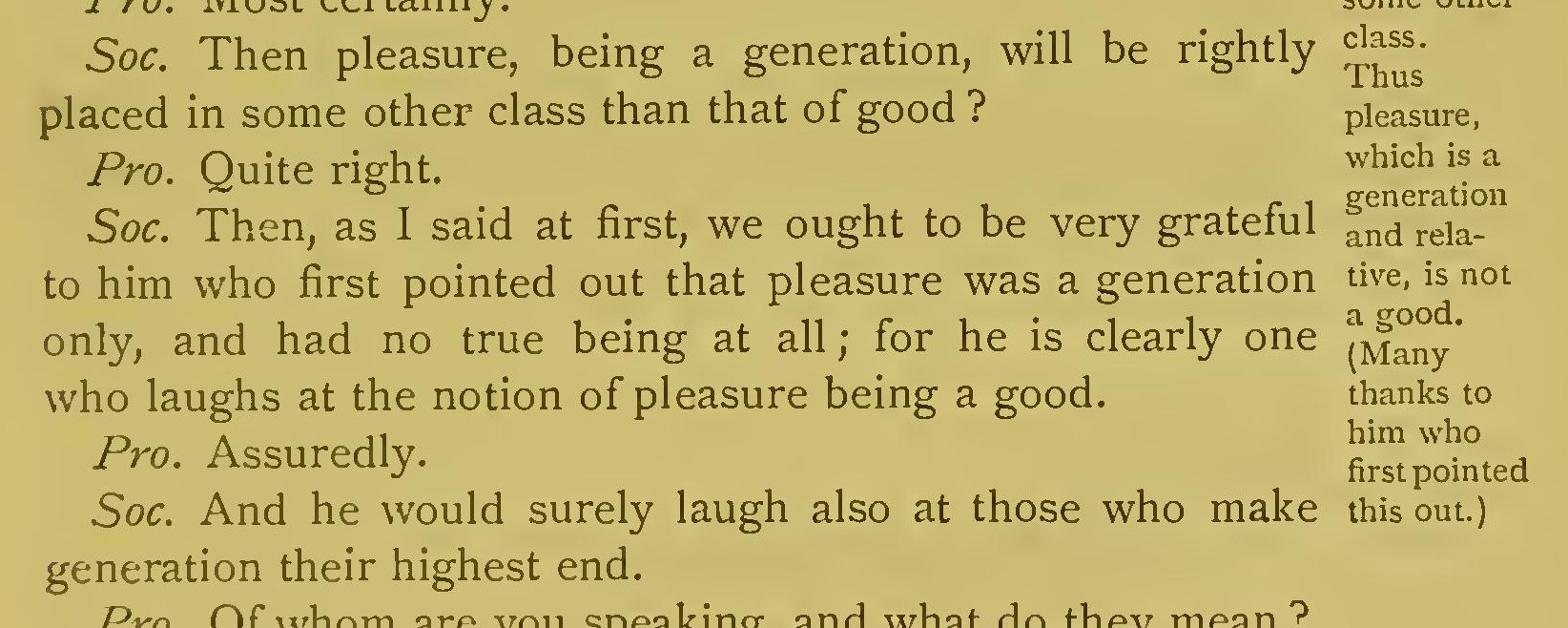
Plato makes the argument directly in the Philebus, where Socrates argues that pleasure is a genesis — a “generation,” a process undertaken for the sake of something beyond itself — and for that reason cannot itself be the good, which must instead be a settled ousia, a “being” or “essence” complete in itself:
“Then, as I said at first, we ought to be very grateful to him who first pointed out that pleasure was a generation only, and had no true being at all; for he is clearly one who laughs at the notion of pleasure being a good.”
— Plato, Philebus 53c-55a (tr. Jowett)
Seneca states the completeness criterion itself more directly than anyone else surveyed here, in a letter devoted largely to the question of whether virtue admits of degrees:
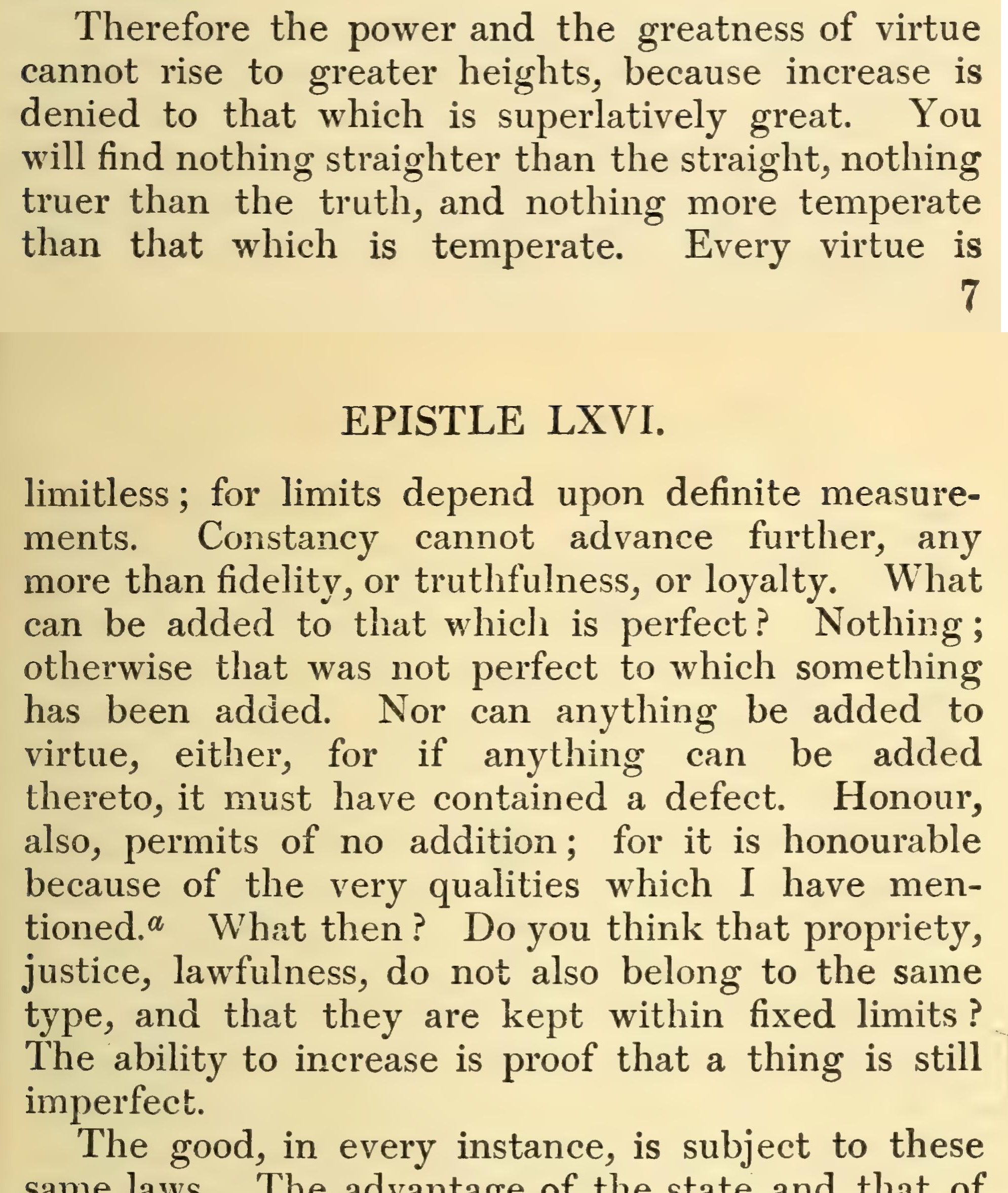
“What can be added to that which is perfect? Nothing; otherwise that was not perfect to which something has been added. Nor can anything be added to virtue, either, for if anything can be added thereto, it must have contained a defect… The ability to increase is proof that a thing is still imperfect.”
— Seneca, Epistulae Morales 66.8-9 (tr. Gummere)
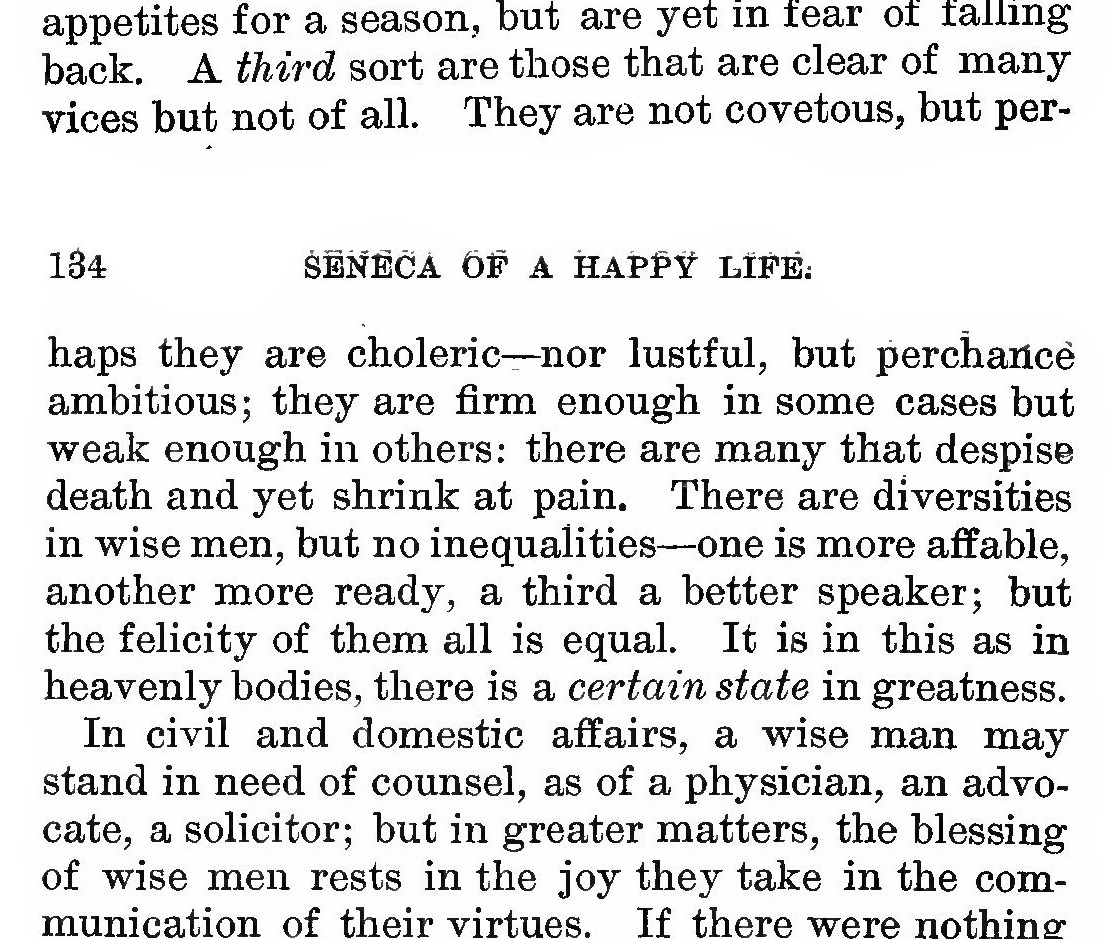
He makes the same case from another direction elsewhere, arguing that virtue — and the happiness inseparable from it — cannot come in degrees, because it is already whole:
“There are diversities in wise men, but no inequalities — one is more affable, another more ready, a third a better speaker; but the felicity of them all is equal. It is in this as in heavenly bodies, there is a certain state in greatness.”
— Seneca, De Vita Beata ch. II (tr. L’Estrange)
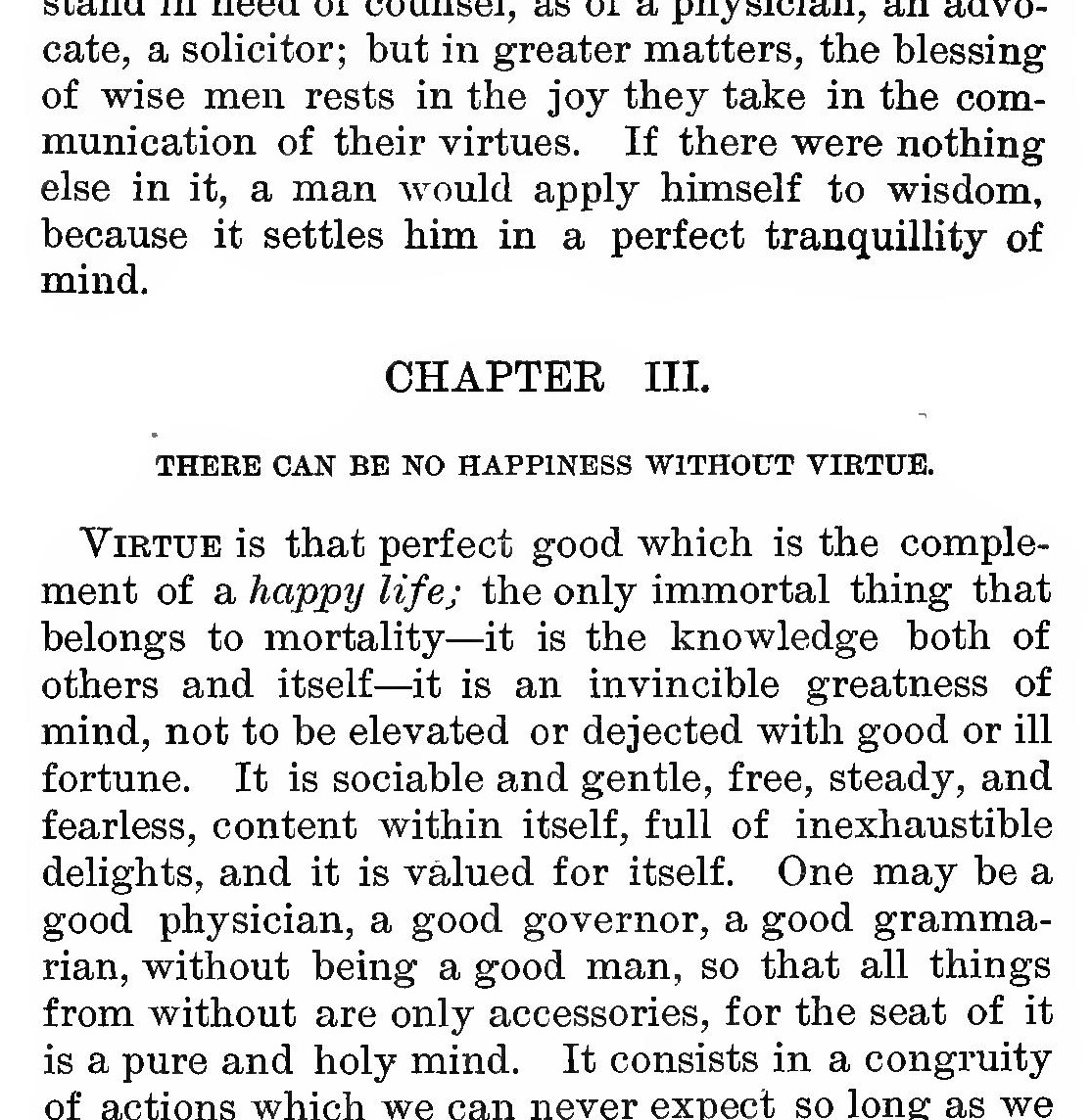
And Seneca opens the very next chapter of that same work with the completeness criterion stated as a definition of virtue itself:
“Virtue is that perfect good which is the complement of a happy life; the only immortal thing that belongs to mortality…”
— Seneca, De Vita Beata ch. III (tr. L’Estrange)
Cicero, whose commentary on Epicurus is a source of much knowledge and much confusion, was well aware of the completeness argument, and reports it directly in at least two places. The clearest statement is in the Tusculan Disputations, where he traces the doctrine explicitly to Plato. The second is in De Finibus (On Ends), where he reports the Stoic version of the same argument — and calls it “worthy of Socrates, or even of Plato.”
Tusculan Disputations, Book V — “From Plato, Therefore…”
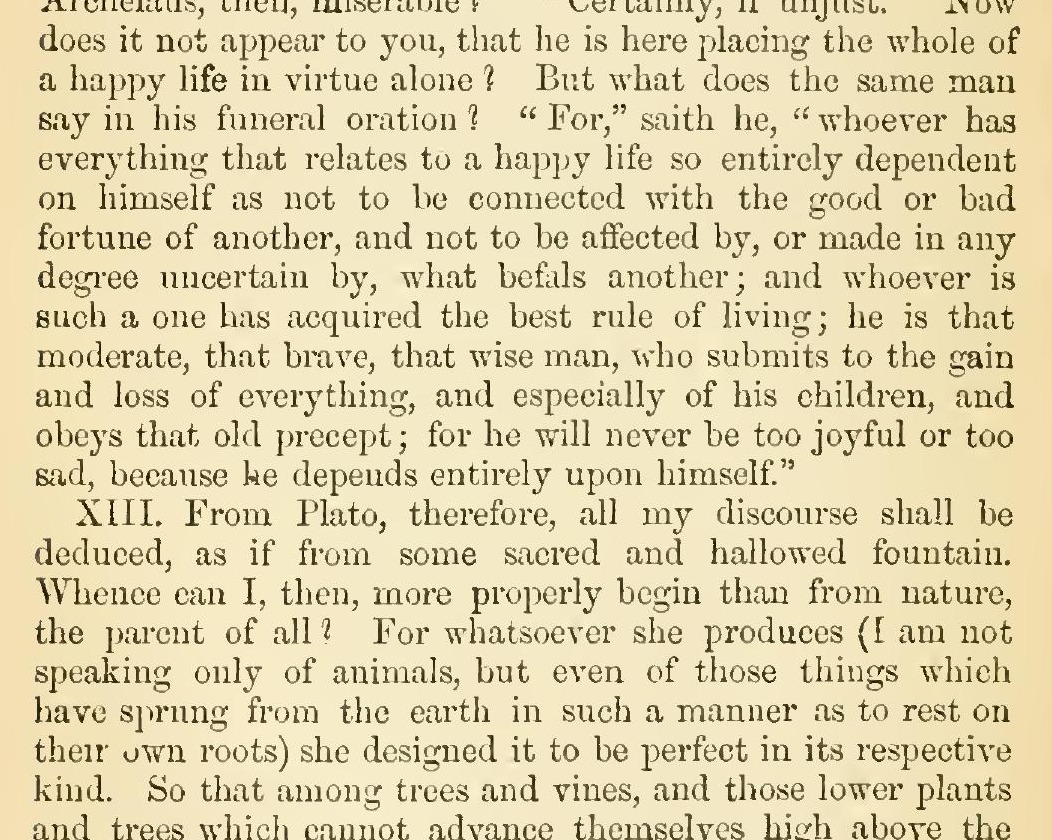
Section titled “Tusculan Disputations, Book V — “From Plato, Therefore…””Book V of the Tusculan Disputations is devoted to the question “Whether Virtue Alone Be Sufficient for a Happy Life.” At the start of chapter XIII, Cicero announces that what follows is Plato’s own doctrine:
“From Plato, therefore, all my discourse shall be deduced, as if from some sacred and hallowed fountain.”
— Cicero, Tusculan Disputations V.13 (tr. Yonge)
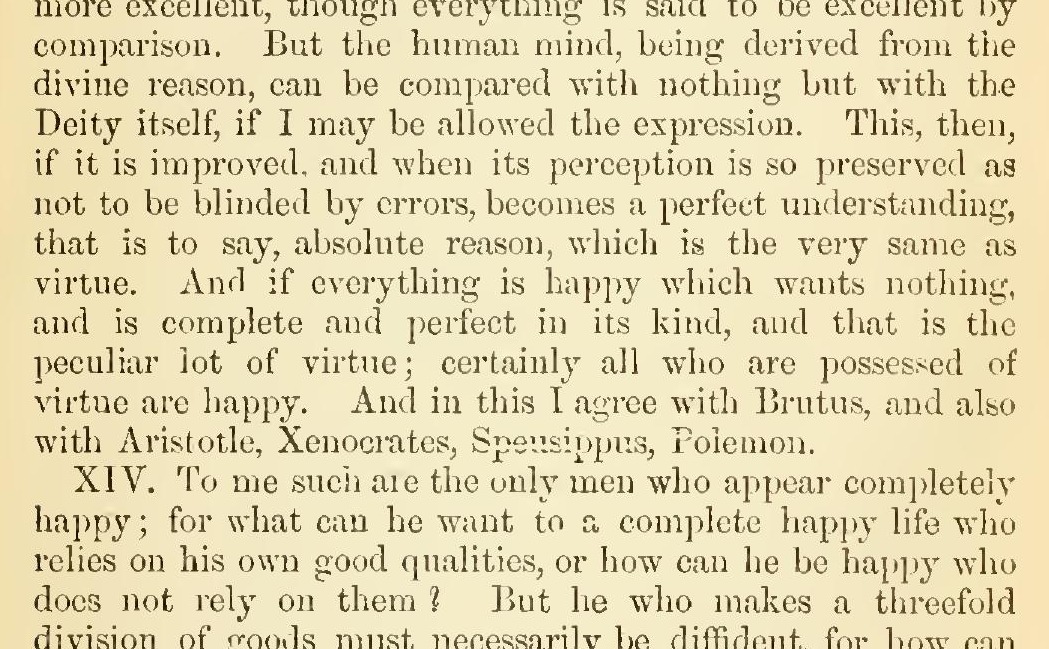
Cicero then gives the completeness criterion itself, applying it to virtue:
“And if everything is happy which wants nothing, and is complete and perfect in its kind, and that is the peculiar lot of virtue; certainly all who are possessed of virtue are happy.”
— Cicero, Tusculan Disputations V.13 (tr. Yonge)
The following chapter (XIV) makes the being/becoming contrast explicit by ruling out anything subject to change, decay, or process from counting as the good at all:
“…of all that constitutes a happy life, nothing will admit of withering, or growing old, or wearing out, or decaying; for whoever is apprehensive of any loss of these things cannot be happy.”
— Cicero, Tusculan Disputations V.14 (tr. Yonge)
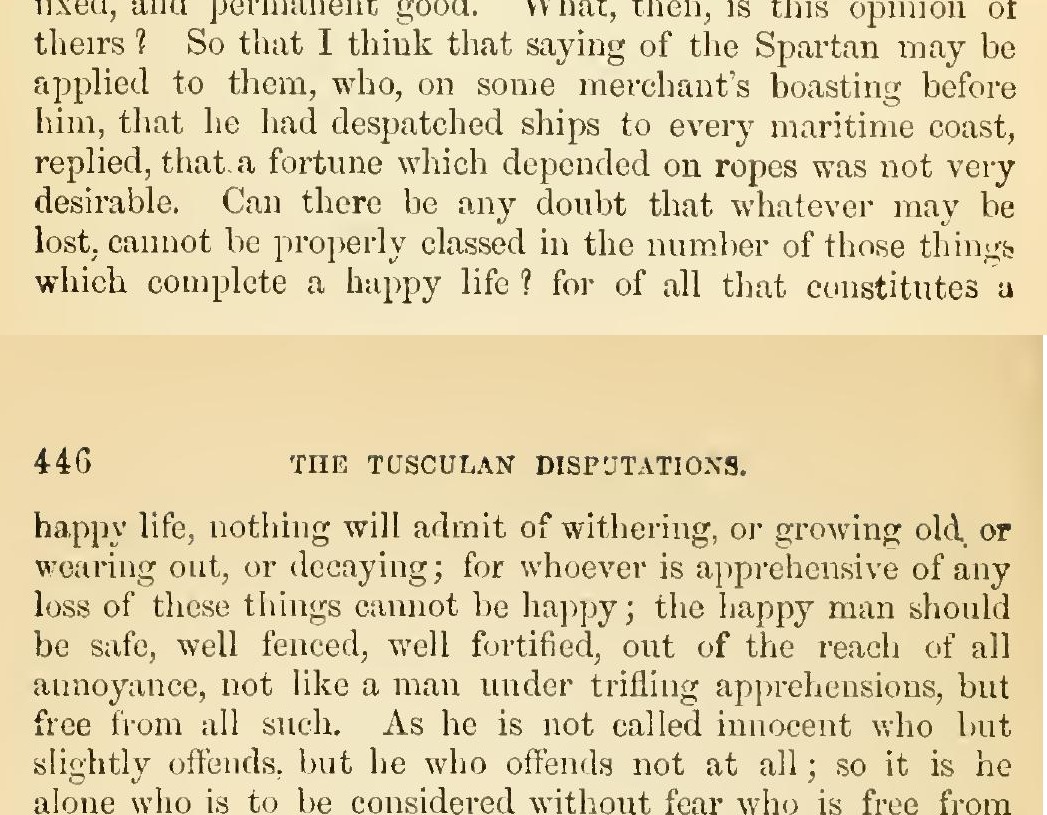
This is the argument in its purest form: the good must be an immovable, fixed, and permanent possession, not a process that could still be added to, subtracted from, or undone.
De Finibus, Book IV — The Stoic Version, Credited to Socrates and Plato
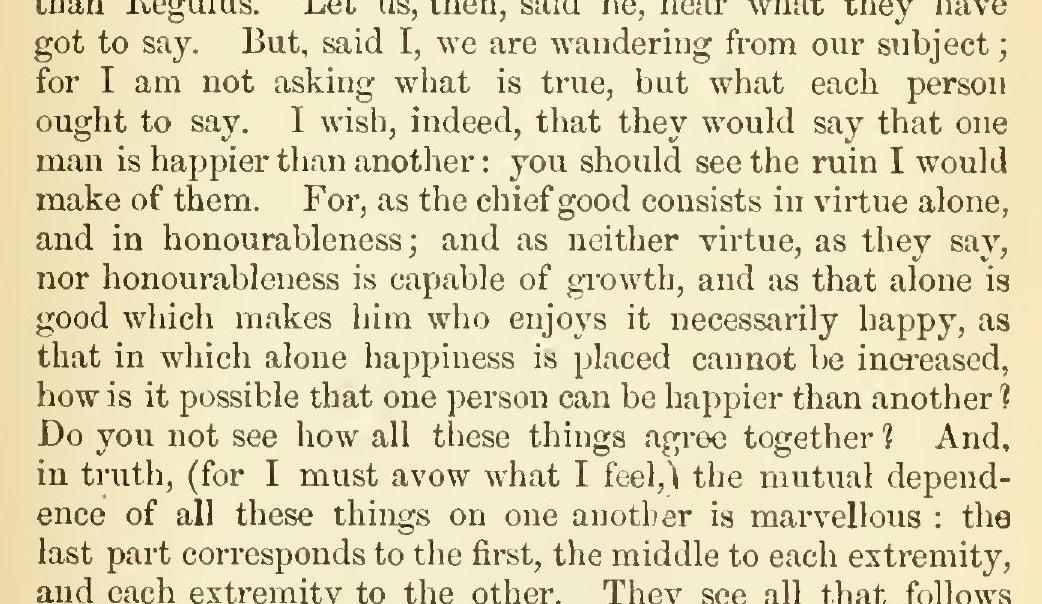
Section titled “De Finibus, Book IV — The Stoic Version, Credited to Socrates and Plato”De Finibus IV is Cicero’s critique of Cato’s exposition of Stoic ethics (delivered in Book III). Reporting on the Stoic position, Cicero states the same completeness criterion, this time framed as incapacity for growth or increase:
“As the chief good consists in virtue alone, and in honourableness; and as neither virtue, as they say, nor honourableness is capable of growth, and as that alone is good which makes him who enjoys it necessarily happy, as that in which alone happiness is placed cannot be increased, how is it possible that one person can be happier than another?”
— Cicero, De Finibus IV.27 (tr. Yonge)
Cicero then names the argument’s philosophical lineage directly:
“…he wishes to say, that nothing can be wanting to a wise man to complete his happiness — a very honourable sentiment, one worthy of Socrates, or even of Plato.”
— Cicero, De Finibus IV.27 (tr. Yonge)
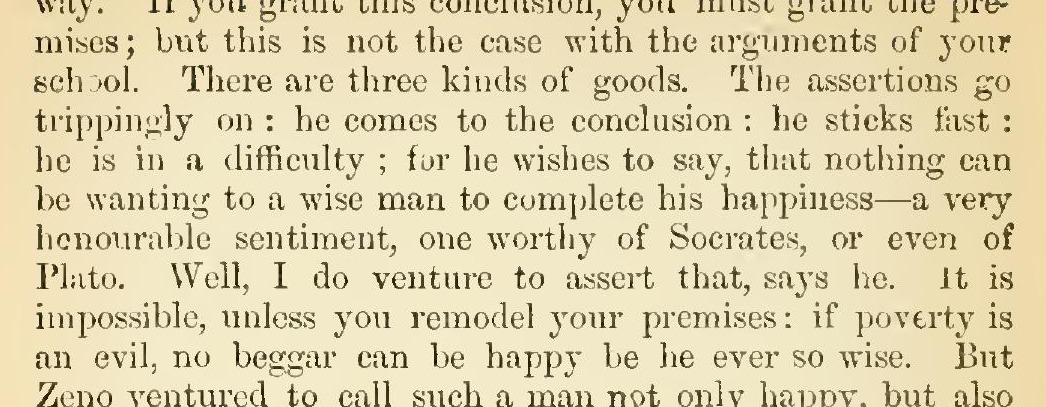
A page later, the principle is stated flatly — happiness, like virtue, is not a matter of degree:
“…happiness does not admit of degrees any more than virtue, the mere possession of which makes him happy.”
— Cicero, De Finibus IV.28 (tr. Yonge)
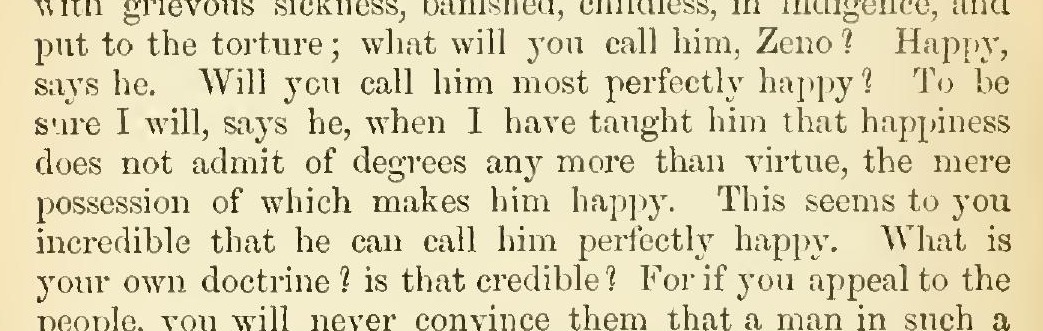
De Finibus, Book II — Applying The Argument To Pleasure
Section titled “De Finibus, Book II — Applying The Argument To Pleasure”Book II of De Finibus is Cicero’s critique of Epicurus in which he replies to Torquatus’s presentation of Epicurean ethics in Book I. Here the same being/becoming distinction resurfaces, applied specifically to pleasure rather than virtue. Cicero is setting up the Greek distinction between kinesis (motion, process) and a settled state as a weapon to accuse Epicurus of inconsistency by calling pleasure both a process and a state:
“…this agreeable pleasure is pleasure in motion, but the pleasure of him who is free from pain is a state of pleasure…”
— Cicero, De Finibus II (tr. Yonge)
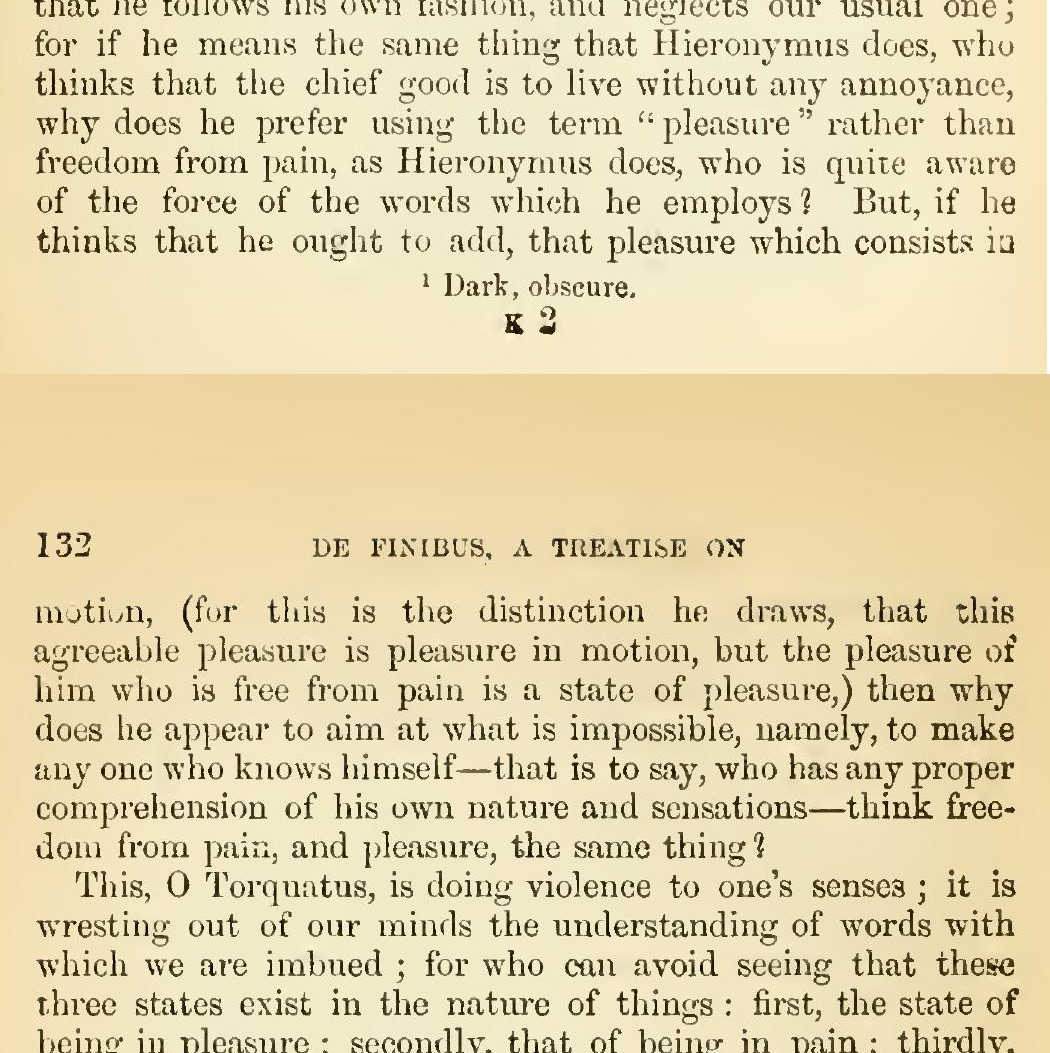
Cicero is reporting Epicurus’s own distinction between kinetic and katastematic pleasure in order to attack it as incoherent; Cicero is not endorsing the distinction or saying that Epicurus holds to one to the exclusion of the other. What Cicero is doing is incorporating Plato’s question as if the answer must be one or the other: is pleasure a process (a motion toward something) OR is pleasure a state (something already complete)? Plato’s premise is that pleasure cannot be both, and if pleasure is a process then it is disqualified from being considered the supreme good, or even a good at all.
Epicurus, on Cicero’s own testimony, held the opposite: that pleasure, which can be referred to interchangeably as the absence of pain since there are only two possibilities, is a term that in fact embraces both a motion and a complete state. Cicero wants us to believe that Epicurus cannot consistently hold both that pleasure is a motion and that the painless state constitutes a complete and highest pleasure. But Cicero is wrong, because Epicurus is right that pleasure can be viewed both as a journey and a destination — which go hand in hand, and are not inconsistent. Whether we are choosing to look at a specific part of our experience at a particular time, or whether we are choosing to look at the totality of our life in sum, where we look and find pleasure, that pleasure is complete, and Epicurus explicitly joins the perspectives in the words of PD03: The limit of quantity in pleasures is the removal of all that is painful. Wherever pleasure is present, as long as it is there, there is neither pain of body, nor of mind, nor of both at once.
Completeness vs. Fullness
Section titled “Completeness vs. Fullness”Seneca himself, in the same letter quoted above, points the completeness test directly at Epicurus’s own formula for the highest good — freedom from bodily pain plus freedom from mental disturbance — and argues that, being complete, it cannot increase:
“…we find mentioned in the works of Epicurus two goods, of which his Supreme Good, or blessedness, is composed, namely, a body free from pain and a soul free from disturbance. These goods, if they are complete, do not increase; for how can that which is complete increase?… Whatever delights fall to his lot over and above these two things do not increase his Supreme Good; they merely season it, so to speak, and add spice to it.”
— Seneca, Epistulae Morales 66.45-46 (tr. Gummere)
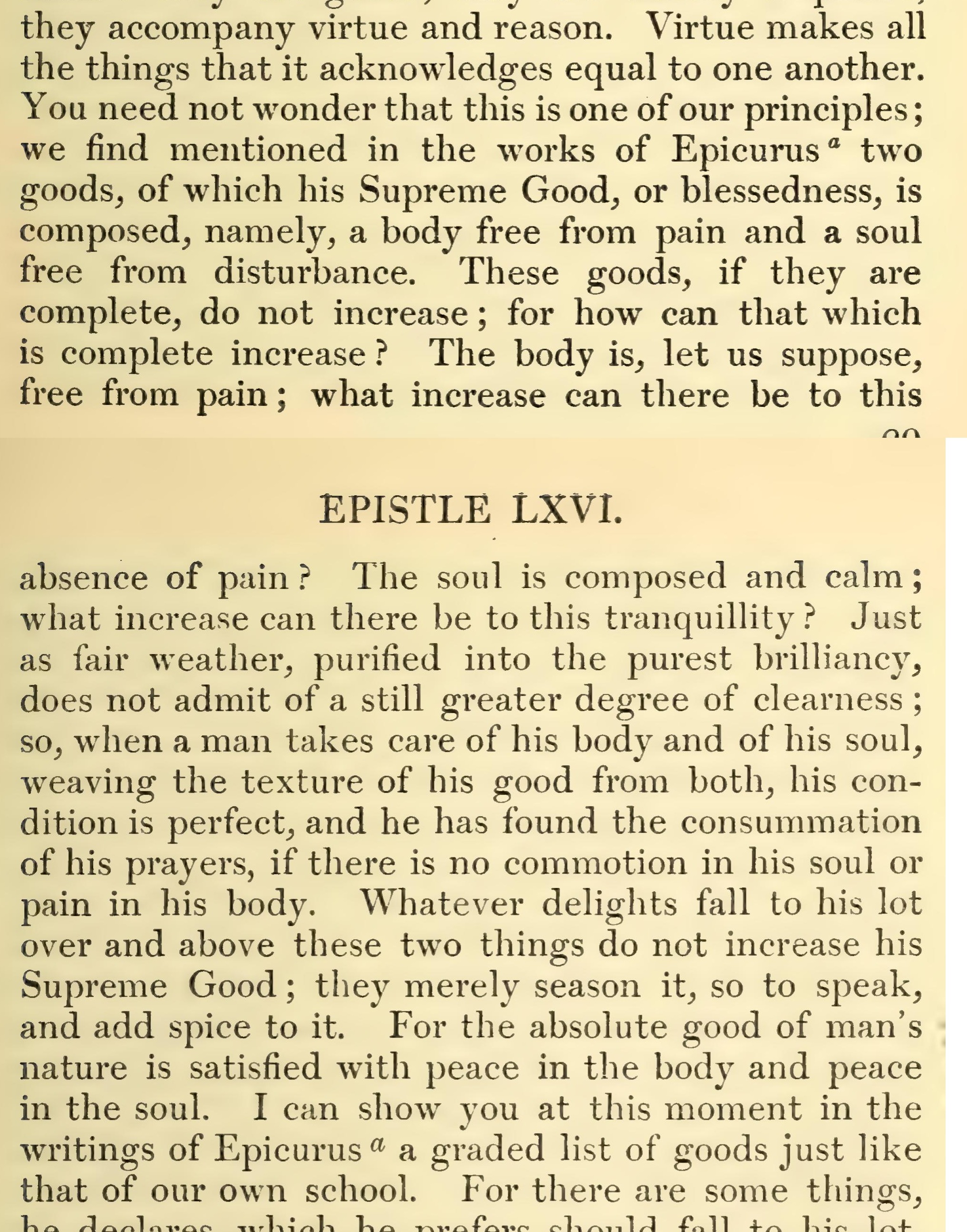
Seneca means this as a concession that damns with faint praise. He is saying fine, Epicurus’s two goods pass the completeness test, but only because they are so thin that nothing else (taste, sight, companionship) is allowed to count as part of the Supreme Good, merely as “seasoning.” That is a begrudging and Stoic reading.
The Epicureans themselves state the other side of the same coin: Diogenes of Oinoanda and Lucretius, writing as Epicureans, describe that same “complete, cannot increase” state not as a thin veneer but as fullness.
Diogenes of Oinoanda opens the Physics section of his inscription by explaining why he built it:
“…with a fine paean on behalf of the fullness of pleasant things, we wished, lest we be overtaken [by death], to help now those of suitable disposition.”
— Diogenes of Oinoanda, Fr. 3.III (trad. Fr. 2, Col. 3) (tr. Smith)
The Greek word translated “fullness” is πλήρωμα (plērōma, genitive plērōmatos) — from plēroō, “to fill up, make full.” That is a different word from Plato’s τέλεον (teleon, “complete,” from telos, “end, goal”) at Philebus 20d, the term he used to argue that the good must be complete. Plato’s image is a journey reaching its destination while Diogenes’ image is a container reaching its capacity, but both are perspectives on completeness.
The same filling/vessel image opens Book VI of Lucretius, in a passage that uses strikingly similar language. Lucretius says that Epicurus, surveying a humanity that had every material advantage and was still miserable, diagnosed the problem as the vessel itself:
“…he then perceived that the vessel itself did cause the corruption and that by its corruption all the things that came into it and were gathered from abroad, however salutary were spoilt within it; partly because he saw it to be leaky and full of holes so that it could never by any means be filled full…”
— Lucretius, De Rerum Natura VI.17-21 (tr. Munro)
Lucretius and Diogenes both point to humanity’s complaint as a problem that Epicurus resolves: a mind operating on false principles is a leaking vessel that can never be filled, no matter how much goodness is poured into it. Epicurean philosophy repairs the vessel so that it can be filled. PD03’s “limit of quantity in pleasures” is exactly the claim that, once repaired, the vessel has a definite capacity, reachable and complete.
Conclusion
Section titled “Conclusion”Plato’s challenge, in its sharpest form, was that pleasure is a process (genesis), not a settled being (ousia) — and the wider argument surveyed above, that the good must be complete (teleon), rules out anything still in process from counting as the good at all. Epicurus answers with a real-world analogy that is tangible and quantitative rather than abstract and otherworldly: once you repair the leaking vessel that, due to poor decision-making, can never be filled with pleasure, the life of pleasure can become full as pleasures accumulate up to the capacity of the vessel.
Epicurus thereby refutes the false claim that pleasure can never be complete, and in so doing shows how the life of pleasure is properly identified as the best life possible — the supreme good.
Summary of Citations
Section titled “Summary of Citations”| Locus | Argument | Attribution |
|---|---|---|
| Philebus (Plato) | Pleasure is a generation (process), not a being, and so cannot be the good | Socrates, in dialogue with Protarchus |
| Ep. 66.8-9 (Seneca) | “What can be added to that which is perfect? Nothing” — the ability to increase proves imperfection | Seneca’s own doctrine |
| De Vita Beata (Seneca) | Wise men differ, but their felicity is equal — happiness admits no degrees | Seneca’s own doctrine |
| De Vita Beata (Seneca) | Virtue is “that perfect good which is the complement of a happy life” | Seneca’s own doctrine, opening Ch. III |
| Tusc. V.13 | The good must be complete, perfect in its kind, wanting nothing | Explicitly “from Plato” |
| Tusc. V.14 | The good admits no withering, growth, aging, or decay | Continuation of the Platonic argument |
| Fin. IV.27 | Virtue/happiness is not capable of growth or increase | Stoic (Zeno), reported by Cicero |
| Fin. IV.27 | Nothing can be wanting to complete a wise man’s happiness | Cicero: “worthy of Socrates, or even of Plato” |
| Fin. IV.28 | Happiness does not admit of degrees, any more than virtue | Stoic (Zeno) |
| Fin. II | Pleasure as motion (process) vs. pleasure as a state | Epicurus’s own kinetic/katastematic distinction, reported (and attacked) by Cicero |
| Ep. 66.45-46 (Seneca) | Epicurus’s own two goods, “if they are complete, do not increase” — everything else is mere “seasoning” | Seneca applying the completeness test to Epicurus by name |
| Diogenes of Oinoanda, Fr. 3.III (trad. Fr. 2, Col. 3) | An anthem to the fullness (plērōma) of pleasant things — a quantitative image, not a being/becoming one | Diogenes’ own words — tentative, needs further investigation |
| Lucretius, DRN VI.17-21 | The untreated mind as a leaking vessel that can never be filled full (explerier) | Lucretius on Epicurus — tentative, needs further investigation |
Sources:
- Plato, Philebus, in The Dialogues of Plato, vol. 4, trans. Benjamin Jowett (Oxford: Clarendon Press, 3rd ed., 1892). Full running text also available on this site: Plato — Philebus.
- Seneca, Ad Lucilium Epistulae Morales, vol. 2, Letter 66, trans. Richard M. Gummere (Loeb Classical Library; London: William Heinemann / New York: G. P. Putnam’s Sons, 1920).
- Seneca, “Of a Happy Life” (De Vita Beata), in Seneca’s Morals of a Happy Life, Benefits, Anger and Clemency, trans. Sir Roger L’Estrange (Chicago: Belford, Clarke & Co., 1882).
- Cicero, The Academic Questions, Treatise De Finibus, and Tusculan Disputations, trans. C. D. Yonge (London: Bohn, 1853) — digitized edition in the EpicureanFriends library. Full text also available on this site: Tusculan Disputations and On Ends — Yonge.
- Diogenes of Oinoanda, Fr. 3.III (trad. Fr. 2, Col. 3), Greek text per DCLP/Trismegistos no. 865216 (papyri.info), based on M. F. Smith’s editions; English translation from M. F. Smith, Urbi et Orbi: The Epicurean Inscription and Prescription of Diogenes of Oinoanda (Rome: Tab edizioni, 2026) — digitized edition in the EpicureanFriends library.
- Lucretius, De Rerum Natura VI.1-23, Latin text and trans. H. A. J. Munro. Full running text also available on this site: Lucretius — Munro Translation and Lucretius — Latin Original.