
Too Long Unpraised And Unappreciated - Aulus Gellius And The Clearest Ancient Testimony That Absence of Pain Means Nothing More Than Pleasure
“The removal of all pain is the limit of the magnitude of pleasures.” — Epicurus, Principal Doctrine 3
Centuries of commentators have treated this and similar statements as an invitation to make something other than pleasure the real goal of Epicurean philosophy — a neutral resting state, a merely negative condition, a “tranquility” or “static pleasure” standing above and apart from pleasure as ordinarily understood. The clearest evidence against that reading does not come from an Epicurean apologist. It comes from a Roman grammarian with no stake whatsoever in Epicurean ethics, writing roughly four and a half centuries after Epicurus’s death, in the middle of a technical argument about a poet’s word choice. Aulus Gellius, in Book Two, chapter six of his Attic Nights, quotes Epicurus’s own definition of pleasure as one example among several of a single, well-understood rhetorical and logical principle: that the total negation of a bad thing is not a weak, middling, or merely empty condition, but the strongest possible affirmation of the good thing that is its opposite. Applied to Epicurus, that principle admits only one reading. “Absence of all pain” does not gesture toward something other than pleasure. It names pleasure, at its highest possible degree.
Who Was Aulus Gellius?
Section titled “Who Was Aulus Gellius?”Aulus Gellius (c. 125 — after 180 AD) was a Roman author on general topics, not a philosopher of any school. According to Wikipedia’s entry on Gellius, he studied rhetoric in Rome under Titus Castricius and Sulpicius Apollinaris and philosophy under the Platonist Calvisius Taurus, and he “enjoyed also the friendship and instruction of Favorinus, Herodes Atticus, and Fronto.” Out of his reading and note-taking, much of it begun during time spent in Attica, he compiled the Attic Nights (Noctes Atticae), a twenty-book collection covering grammar, law, history, philosophy, and other issues, arranged with no system other than the order in which he happened to make his notes.
That lack of system is exactly what makes Gellius valuable here. He is not writing to defend or attack any ethical school. In Book Two, chapter six, he is defending the poet Virgil against grammarians who had criticized three of Virgil’s word choices in the Aeneid and Georgics as careless or too weak for their subject matter. Epicurus enters the chapter only because his definition of pleasure happens to be a convenient, well-known illustration of the same rhetorical technique Gellius is defending in Virgil. Gellius has no reason to bias his analysis in any direction. He is settling a vocabulary and rhetorical dispute, and Epicurus’s own words are simply evidence, cited in passing, the way a grammarian cites Homer or Cicero for good writing style.
The Dispute Gellius Is Settling
Section titled “The Dispute Gellius Is Settling”Gellius’s own chapter heading states his subject directly: “On some words which Virgil is asserted to have used carelessly and negligently; and the answer to be made to those who bring this false charge.” Gellius takes up three separate criticisms in turn.
The first criticism concerns the word vexasse, used of Scylla “battering” Ulysses’ ships (Eclogues 6). Critics called it too mild a word for a monster tearing sailors apart. Gellius traces the root of the word to vehere (“to carry off by force”) and shows through parallel usage in Cato and Cicero that it in fact carries a strong, violent sense. The third concerns squalentem, describing a tunic “rough” with gold (Aeneid 10). Gellius shows the word properly describes a dense, scale-like overlay, not filth, and so is entirely apt for gold armor.
It is the second criticism that matters for our purposes. Virgil, in the Georgics (III.4-5), calls the mythical Egyptian king Busiris — who murdered every foreign guest who came to his shores — inlaudati, “the unpraised.” The critics objected that this was far too weak a word. A man who ritually slaughtered his guests deserved to be called monstrous, execrable, accursed — not merely “unpraised,” as though his only fault were an unremarkable one.
Total Negation Is Total Affirmation
Section titled “Total Negation Is Total Affirmation”Gellius’s answer to this objection is the heart of the chapter, and it rests on a single logical observation. Almost no one, however base, goes through life without saying or doing at least one thing that could be called praiseworthy. Therefore, Gellius says, sayings arise such as the old proverb that “oft-times even a fool expresses himself to the purpose.” It is almost always possible to find reason to praise something, in however small a degree.
It follows that to describe a man as inlaudatus — praiseworthy in nothing, at any time, in any respect, without a single exception — is not describing someone mild or lackluster. The phrase is describing the total absence of a nearly universal quality, and total absence of a nearly universal good quality is not a lack in some minor degree; it is the extreme of the corresponding vice. Gellius states the logic explicitly: freedom from every fault (inculpatus) simply is the same thing as perfect goodness — not a weaker, adjacent, or different condition, but the very definition of it. By the same reasoning applied in reverse, inlaudatus, complete and total absence of praise, is the very definition of the extreme of wickedness.
Gellius then shows this is not an isolated grammatical usage but a recognized technique, citing Homer as its most famous practitioner: “Homer usually bestows high praise, not by enumerating virtues, but by denying faults.” When Homer writes that the Greeks charged “not unwillingly,” he is not reporting a modest, lukewarm willingness — he means they charged with the utmost eagerness. When he writes that Agamemnon was seen “not confused, inactive, nor yet loath to fight,” he is not describing a merely adequate composure — he means the king was the very picture of readiness and courage. In each case, the total negation of a fault expresses, without exception, the maximum degree of the corresponding virtue. Nothing is held back in reserve, and nothing separate or lesser is being described. The negative statement and the positive superlative are two ways of naming one and the same condition.
Epicurus’s Own Words, As Gellius Records Them
Section titled “Epicurus’s Own Words, As Gellius Records Them”Having established the principle through inculpatus and through Homer, Gellius adds a third instance, presented as simply one more example of the same well-known device:
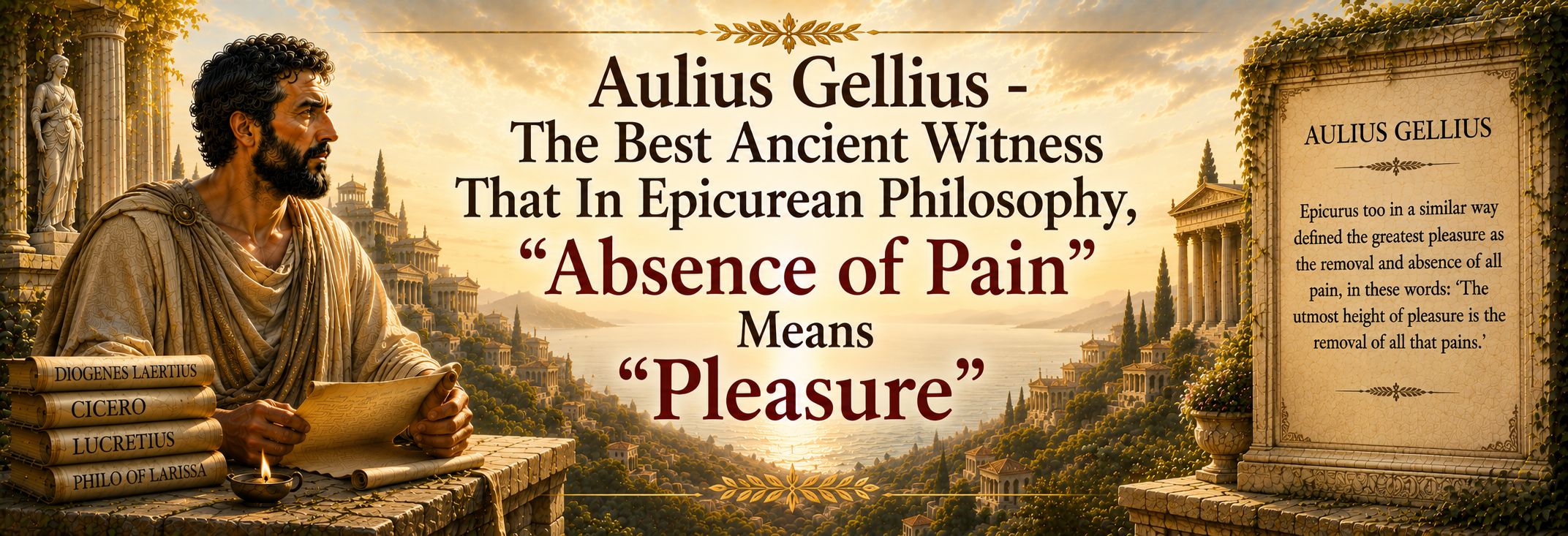
“Epicurus too in a similar way defined the greatest pleasure as the removal and absence of all pain, in these words: ‘The utmost height of pleasure is the removal of all that pains.’”
Gellius places this sentence in exactly the same logical category as the examples that precede it. He is not reporting that Epicurus identified some third, intermediate, or merely negative condition standing apart from pleasure. He is reporting that Epicurus used the identical rhetorical structure Homer used for courage and the Latin language used for goodness: total negation of the bad thing (pain), applied without exception or remainder, expresses the maximum possible degree of the good thing (pleasure) — not a different thing, and not a lesser one. “The utmost height of pleasure” is Gellius’s own phrase for what Epicurus meant, stated as plainly as can be. Gellius’s claim closely tracks what survives independently as Epicurus’s own Principal Doctrine 3, that “the removal of all pain is the limit of the magnitude of pleasures.” The same meaning is confirmed through an entirely separate and neutral source.
A Fourth Confirming Example
Section titled “A Fourth Confirming Example”Gellius is not finished. He immediately adds a fourth instance of the same device, this time returning to Virgil: “Again Virgil on the same principle called the Stygian pool ‘unlovely’” (Georgics IV.479). Just as inlaudatus expresses the extreme of wickedness by denying praise, and Epicurus’s formula expresses the height of pleasure by denying pain, so Virgil’s “unlovely” expresses the extreme of ugliness and repulsiveness by denying that anything about the infernal pool could be loved. Gellius states the parallel explicitly: “For just as he expressed abhorrence of the ‘unpraised’ man by the denial of praise, so he abhorred the ‘unlovable’ by the denial of love.” This gives us four examples — Homer twice, Latin usage generally, and Epicurus — that are treated by Gellius as instances of one and the same, entirely uncontroversial and un-mysterious, rule of language and logic.
Why Gellius’s Testimony Matters
Section titled “Why Gellius’s Testimony Matters”Gellius has no philosophical investment in Epicurean ethics one way or the other. He is not defending Epicurus against Stoic or Academic critics, and he is not championing pleasure as a way of life. He cites Epicurus’s definition of pleasure the same way he cites a line of Homer: as a convenient, well-known example of a grammatical and rhetorical pattern that any educated reader of his day would recognize on sight. That is exactly what makes this testimony so valuable. It shows that in the second century AD, among the literate Roman public Gellius wrote for, Epicurus’s formula “the removal of all pain is the height of pleasure” was understood as a straightforward instance of a common figure of speech — not as a piece of specialized doctrine requiring philosophical training to understand, and certainly not as a formula that pointed toward some separate, non-sensory, or merely tranquil condition distinct from pleasure. The plain, unforced, contemporary reading of Epicurus’s words was total identity: complete absence of pain simply is pleasure, carried to its highest possible degree.
Confirmed by Epicurus’s Own Spokesman: Torquatus in Cicero’s On Ends
Section titled “Confirmed by Epicurus’s Own Spokesman: Torquatus in Cicero’s On Ends”Gellius’s testimony does not stand alone. Cicero’s On Ends preserves an extended exchange in which Torquatus, the dialogue’s Epicurean spokesman, defends exactly the same identity between pleasure and absence of pain under repeated, hostile questioning from Cicero himself.
Torquatus first states the position in Book One, 38:
“Therefore Epicurus refused to allow that there is any middle term between pain and pleasure; what was thought by some to be a middle term, the absence of all pain, was not only itself pleasure, but the highest pleasure possible. Surely any one who is conscious of his own condition must needs be either in a state of pleasure or in a state of pain. Epicurus thinks that the highest degree of pleasure is defined by the removal of all pain, so that pleasure may afterwards exhibit diversities and differences but is incapable of increase or extension.”
This is the same claim Gellius records, stated in the same terms: no middle state, and the removal of pain named directly as the highest pleasure, a ceiling that cannot be exceeded.
In Book Two, Cicero takes up the argument to attack it, and returns to this single point three separate times. First, in section 9, he demands that Torquatus concede a distinction between the two terms:
Cicero: ”…[B]ut unless you are extraordinarily obstinate you are bound to admit that ‘freedom from pain’ does not mean the same thing as ‘pleasure.’” Torquatus: “Well but on this point you will find me obstinate, for it is as true as any proposition can be.”
Two sections later, in 11, Cicero tries again, granting Torquatus everything he can and asking only for the narrower point:
Cicero: “Still, I replied, granting that there is nothing better (that point I waive for the moment), surely it does not therefore follow that what I may call the negation of pain is the same thing as pleasure?” Torquatus: “Clearly the same, and indeed the greatest, beyond which none greater can possibly be.” (Plane idem, et maxima quidem, qua fieri nulla maior potest. Cic. Fin. 2.11)
Cicero returns a third time in section 16, now arguing from ordinary usage — that everyday language recognizes a third, intermediate condition, neither pleasure nor pain, and that Torquatus is doing violence to that usage by denying it exists:
“This, O Torquatus, is doing violence to one’s senses; it is wresting out of our minds the understanding of words with which we are imbued; for who can avoid seeing that these three states exist in the nature of things: first, the state of being in pleasure; secondly, that of being in pain; thirdly, that of being in such a condition as we are at this moment, and you too, I imagine, that is to say, neither in pleasure nor in pain… Do you not see a vast multitude of men who are neither rejoicing nor suffering, but in an intermediate state between these two conditions?”
“No, indeed,” said he; “I say that all men who are free from pain are in pleasure, and in the greatest pleasure too.”
Three separate attempts, from three separate directions — a direct demand for concession, a narrower fallback position, and an appeal to ordinary usage. Torquatus vigorously defends the position and gives the same answer every time. Absence of pain is not similar to pleasure, not a step toward pleasure, not related to pleasure, not better than pleasure. It is pleasure, and the greatest degree of it, a ceiling that leaves nothing further to be added.
These two witnesses could hardly be more different in their relationship to Epicurean philosophy. One was a grammarian with no stake in the ethical debate at all. The other was an ardent defender of Epicurus, insisting on the same identity through three rounds of hostile questioning from Rome’s greatest orator. They arrive at the identical conclusion: the term absence of pain does not describe anything other than pleasure itself. It is exactly pleasure, at the greatest degree pleasure can possibly reach.
When even a neutral third party talking through a grammar exercise can clearly understand Epicurus as advocating pleasure rather than something else, can we who seek to understand and apply Epicurus’s philosophy do less?