
Epicurus and the Pleasure of Rebelling Against Plato
Plato as the Mainstream
Section titled “Plato as the Mainstream”Say the word “pleasure” in connection with Epicurus and many people picture the same narrow thing: If they have a positive outlook on pleasure, they think of a good meal, a warm bath, a moment of bodily comfort. If they have a negative outlook on pleasure, they think of conspicuous consumption, self-indulgence, and luxurious pampering. Rarely today is “pleasure” the first word associated with art, science, literature, exploration, or human achievement.
This bipolar tendency is not the result of innocent simplification. It has served, since antiquity, as a convenient way to dismiss what Epicurus actually claimed about the meaning of life. Joking about pigs in a sty or claims for the overwhelming pleasure of bread and water are much easier than dealing with what Epicurus actually taught. Epicurus never confined pleasure either to small, passing comforts or to exuberant luxury. Instead, he taught pleasure as something much larger and far more serious: pleasure is the fully-felt impact of what actually matters to you. Pleasure is measured by how deeply you value and cherish the people, the convictions, and the confidence that make your life worth living.
When the feeling of pleasure is placed at the center of our attention we see that the meaning of life is not dry intellectual assent to a correct proposition about the good. “Meaning” is what we feel when a physical or mental experience matters positively to us and we know it. That distinction — between assenting to an abstraction and actually feeling the difference it makes — is the thread running under everything that follows in this article about Epicurus’ rebellion against Platonism.
Epicurus’s quarrel with Plato was never a disagreement over different tastes or the relative value of bread and water or geometry. It was a quarrel over whether a life’s meaning is to be found in an otherworldly “Good” that we must labor to reach through ruthless logic and devotion to otherworldly idealism, or whether life’s true meaning is to be found in the immediate, felt reality of what you actually care about.
To call Epicurus a rebel against Plato is to identify the one clean break from what was, at the time Epicurus was born in 341 BC, the mainstream orthodoxy of Greek philosophy. Socrates supplied the dialectic method and the claim of moral superiority on which Plato built the system. Some later philosophers such as Aristotle pushed back against particular claims, but they kept the central framework standing.
Aristotle rejected Plato’s realm of Forms, but he kept the idea that there is a master plan, he kept the primacy of reason over sensation, he kept ethics tied to good of the state rather than the individual, and he kept a divine prime mover behind the motion of the world. Zeno’s Stoics absorbed Plato’s identification of Nature with a divine, rational order and built its whole ethics on conformity to it. All roads in Greek philosophy — physics, epistemology, or ethics — run through the Academy of Plato.
Epicurus stands far above all others who rejected that road. At EpicureanFriends I speak regularly about Norman DeWitt’s 1954 book Epicurus and His Philosophy, which puts the point bluntly: Epicurus must be recognized “also as a moral reformer,” and the historians who miss this “fail to discern that reformers are rebels.” DeWitt goes further, identifying the animating hostility by name:
As a man of science Epicurus returned to the tradition of the Ionian thinkers, which had been interrupted by Socrates and Plato. The chief positive influence on his thinking was Ionian, the chief negative influence Platonic. The error in this instance consists in the failure to recognize Epicurus as an Antiplatonist and a penetrating critic of Platonism. — DeWitt, Epicurus and His Philosophy, Ch. I, “A Synoptic View of Epicureanism”
And again, more specifically:
[Epicurus] exalted Nature as the norm of truth, revolting against Plato, who regarded Reason as the norm and hypostatized it as a divine existence. — DeWitt, Ch. I
DeWitt returns to the theme again and again throughout his book because the evidence keeps producing examples of it. The relationship between Epicurus and Plato is not incidental to understanding Epicurus — it is the key without which Epicurus is bound to be totally misunderstood, because it is in many ways the negative image of Plato’s.
A Long Ignored Thesis Returning To Prominence
Section titled “A Long Ignored Thesis Returning To Prominence”DeWitt’s 1954 book is far from the only mention of this thesis for how best to understand Epicurus. Paul Shorey, writing in the Harvard Studies in Classical Philology half a century before DeWitt’s book appeared, had in 1901 traced a series of specific Epicurean “polemic[s] against the Timaeus” — against Plato’s craftsman-god, against his treatment of time as “a moving image of eternity,” against the Philebus — scattered like buckshot across the Epicurean and Lucretian corpus.
By 1976, David Sedley could refer to “Epicurus’ reaction against Platonism” as “already a well-worked topic” among specialists and move on without further comment, confident his readers would already grant the point. Unfortunately, comments like these were largely confined to the academic press, and it was DeWitt alone who insisted on the fuller recognition that the friction between Epicurus and Plato was not incidental but total. Epicurean references to Platonism are not polemical asides here and mocking nicknames there, but the organizing principle behind Epicurus’s physics, canonics, and ethics all at once.
DeWitt’s book is now closing in on its hundredth year of existence, but for most of that stretch professional commentary has treated Epicurus as a minor figure working out variations on themes set by others. Aside from Epicurus’ always-praised advice about prudent use of common sense in pursuing pleasure, his other views were treated as those of an eccentric physicist patching up Democritus, an unpersuasive commentator on the senses and empiricism, or an unsystematic moralist offering little more than folk wisdom about simple living. The idea that his entire system was constructed, point by point, as a deliberate demolition of Plato’s mainstream philosophy did not fit that picture or interest those whose primary objective was to use Epicurus to endorse their own morality, so his deeper views have largely been set aside by popular writers.
There are signs that this is changing, however. Kelly Arenson’s Health and Hedonism in Plato and Epicurus reconstructs, in careful detail, exactly the opposition DeWitt had already sketched: Plato’s devaluation of bodily pleasure as beneath the philosopher’s attention against Epicurus’s insistence that pleasure, rightly understood, is the very thing philosophy exists to secure. Emily Austin’s Living for Pleasure: An Epicurean Guide to Life makes a version of the same case for a popular readership, presenting Epicurean ethics as a considered alternative to — not a lesser cousin of — the specious “eudaimonism” that Plato and Aristotle built into the DNA of Greek moral philosophy.
The remainder of this article will pick up the major threads of Epicurus’ rejection of Platonism and set them out one by one so that more attention can be focused on them in the future.
Physics: The Rebellion Against the Unseen
Section titled “Physics: The Rebellion Against the Unseen”Before Plato can describe how the cosmos was built, he lays down a prior distinction on which everything else in the Timaeus depends. He sorts everything that exists into two separate kinds, one fully real and one that never quite is:
First then, in my judgment, we must make a distinction and ask, What is that which always is and has no becoming; and what is that which is always becoming and never is? That which is apprehended by intelligence and reason is always in the same state; but that which is conceived by opinion with the help of sensation and without reason, is always in a process of becoming and perishing and never really is. — Plato, Timaeus 27d–28a
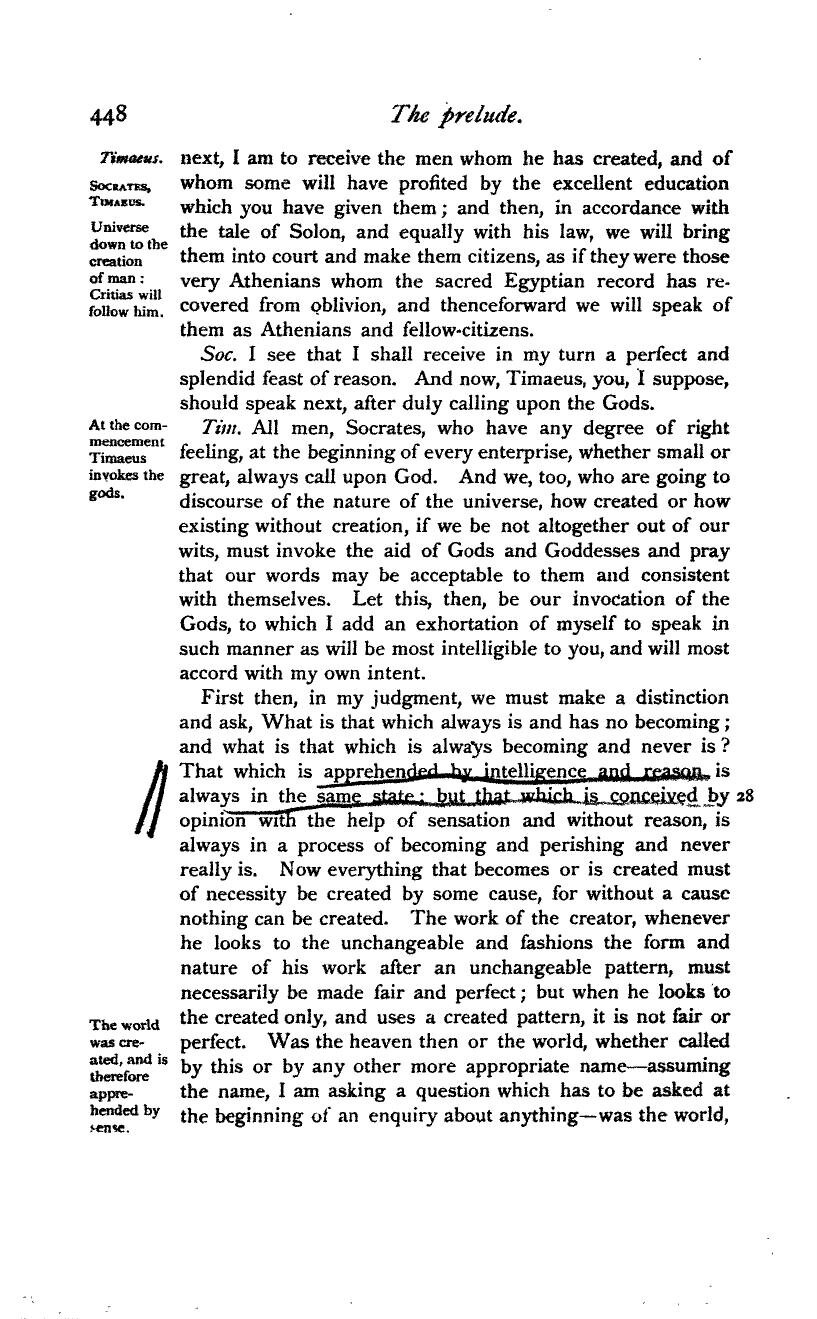
Everything the senses touch — every object in the visible, changing world — falls on the second side of that line, and so counts, on Plato’s own terms, as something that “never really is.” Full reality belongs only to what reason alone can grasp: the eternal, unchanging Forms. This distinction is not a side point - it is the premise that makes a benevolent craftsman-god necessary in the first place, to explain why a world that is always only “becoming” exists at all. This is the creator Plato calls the demiurge, who imposes mathematical order on a chaotic, pre-existing material and orients the whole toward the good:
He was good, and one who is good can never have any grudge against anything. And being free from jealousy, he desired that all things should come as near as possible to being like himself. — Plato, Timaeus 29e
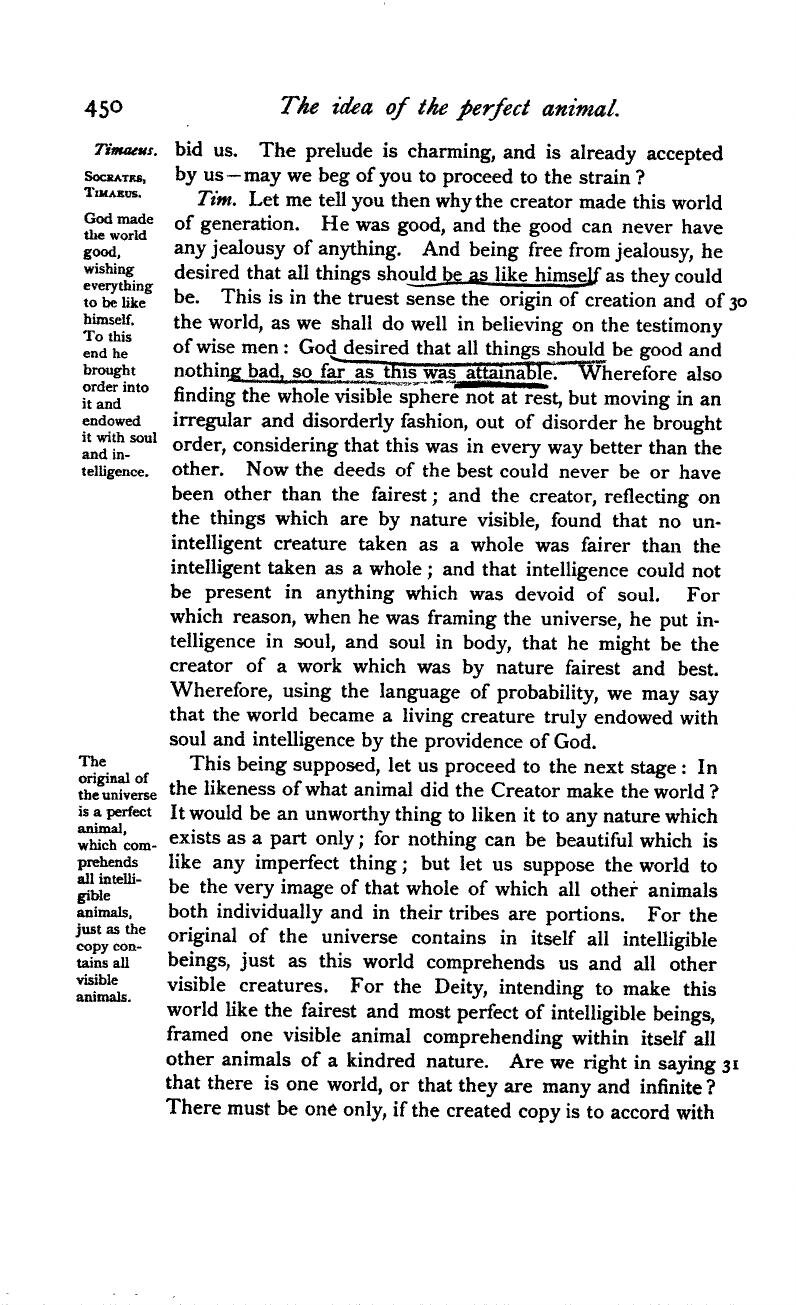
Matter, in this account, is inert stuff waiting on an external, intelligent cause to move and shape it. The visible world of change is a copy — an imperfect, secondary reflection of an eternal, unchanging realm of Forms, which alone counts as fully real.
Epicurus rejects every piece of this. His first two Elementary Principles state that matter can neither be created nor destroyed; his third, that the universe consists of nothing but atoms and void. There is no room in that inventory for an incorporeal Form, an incorporeal soul, or an incorporeal, world-ordering mind. As DeWitt puts it, tracing the logic through:
If there is nothing incorporeal except void, the eternal ideas and the divine incorporeal reason are alike absurdities… Consequently there was no need of the ordering mind (nous) according to Anaxagoras or of the divine demiurge of Plato. Both of these become absurdities. — DeWitt, Ch. VII, “The Canon, Reason and Nature”
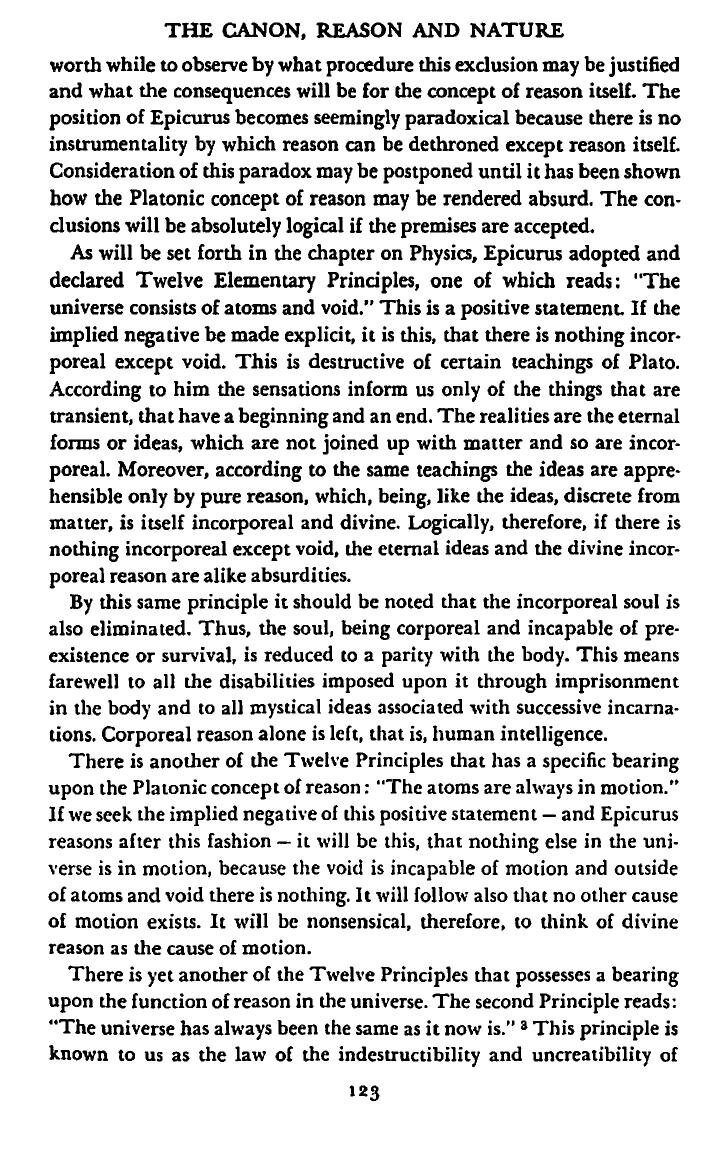
Epicurus does not simply delete Plato’s “Being” and leave nothing behind in its place. He relocates permanence into the physical world itself, in the atoms. Compounds arise and perish constantly — that much is “becoming,” and Epicurus grants it freely — but the atoms that make them up do not:
Moreover, we must suppose that the atoms do not possess any of the qualities belonging to perceptible things, except shape, weight, and size, and all that necessarily goes with shape. For every quality changes; but the atoms do not change at all, since there must needs be something which remains solid and indissoluble at the dissolution of compounds, which can cause changes… For this reason it is essential that the bodies which shift their position should be imperishable and should not possess the nature of what changes, but parts and configuration of their own. — Epicurus, Letter to Herodotus §54 (tr. Bailey)
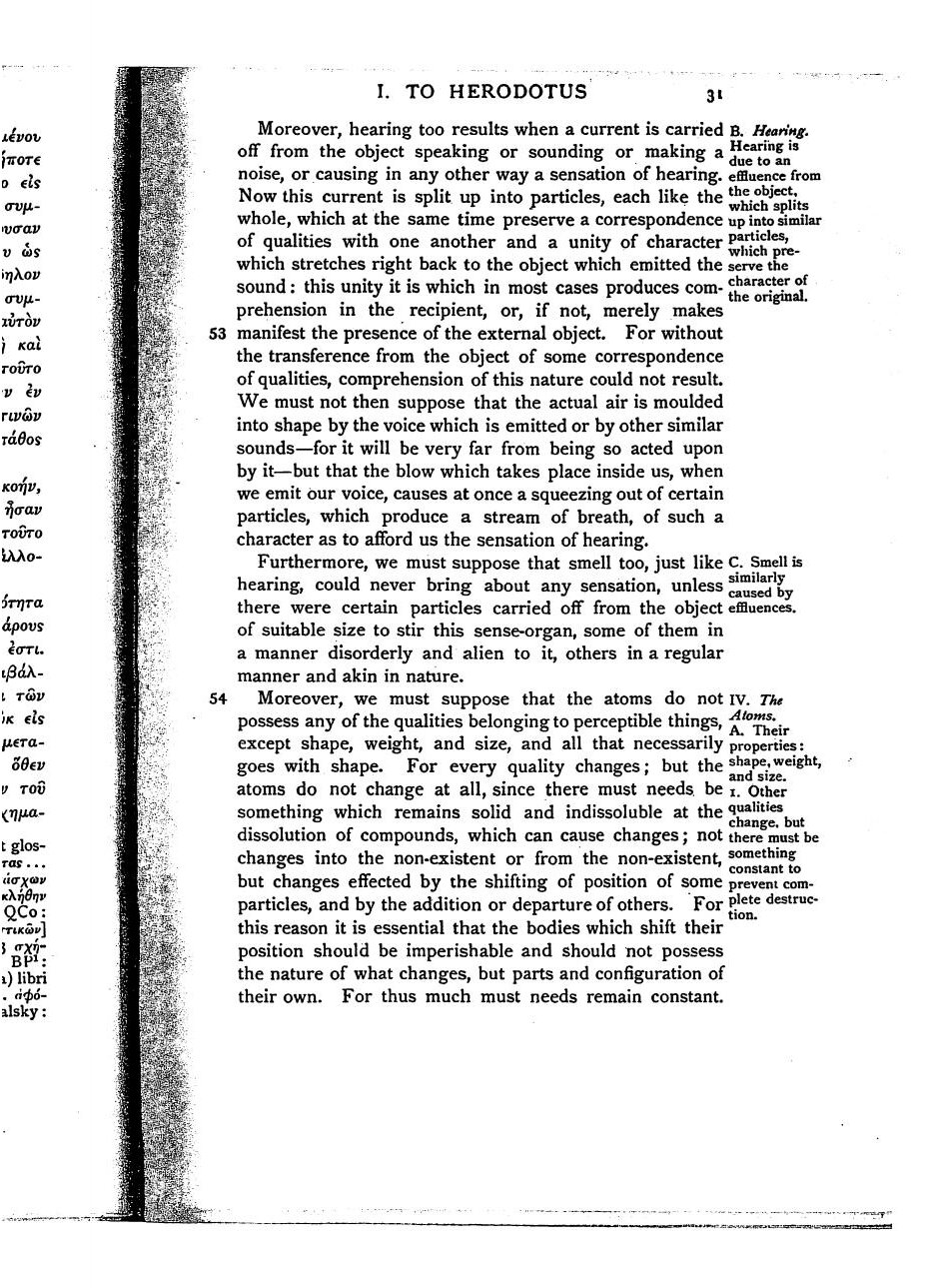
Plato needed two separate levels of existence, one lower than the other, because he had already decided that only the unchanging fully deserves to be called real. Epicurus needs only one level: nature, which runs without a break from imperishable atom to perishable compound, and the senses can reach out toward every part of it. Nothing is held back in some higher, untouchable order of being that only reason — without assistance from the senses — can enter.
Where Plato’s world requires a mind to set it moving, Epicurus’s atoms move on their own, ceaselessly, by their own power of weight — no mover needed, divine or otherwise:
His argument, however, was no worse than that of Aristotle… So with volition, and apart from it the sole causes in the universe were the blind motions of the atoms… Thus to him motion was inherent in matter and no external cause of motion existed, while to Plato matter was inert and the cause of motion was external to it. — DeWitt, Ch. IX, “The New Physics”
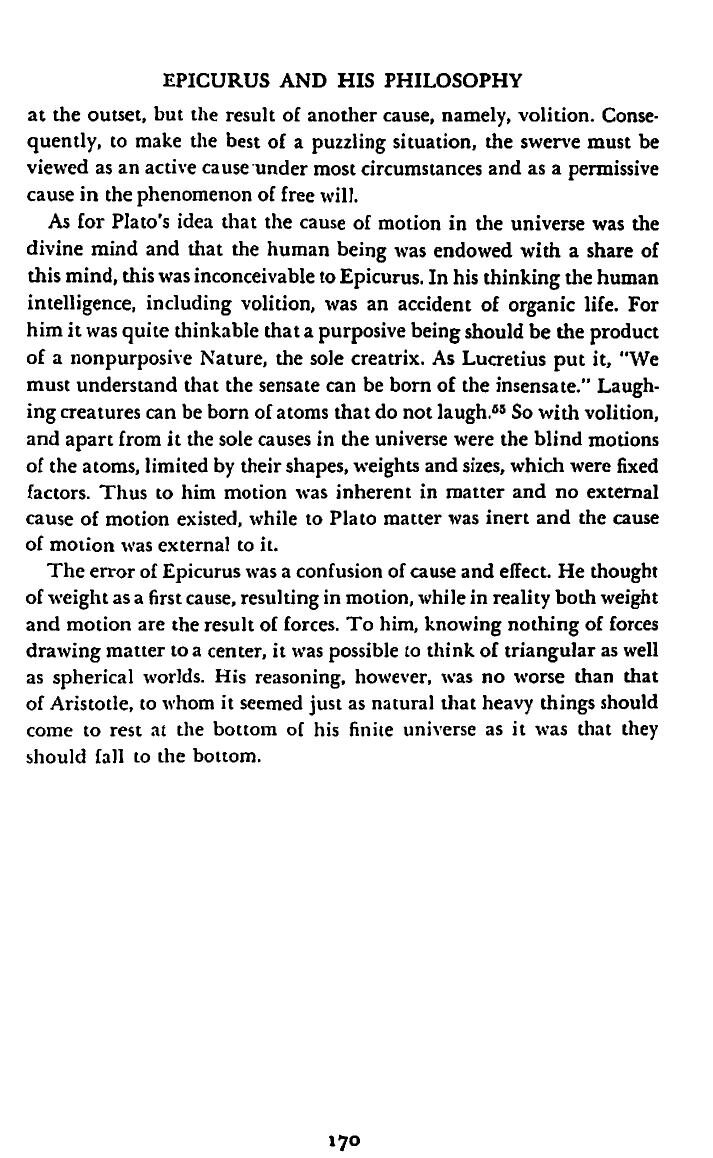
The two maps of the nature of the universe disagree just as sharply on scale. Plato’s cosmos in the Timaeus is a single finite sphere, deliberately shaped, with no “outside” and therefore no meaningful up or down. Epicurus’s universe is infinite in every direction, stocked with an infinite supply of atoms in infinite void, so that — as his letter to Herodotus puts it — “there are infinite worlds both like and unlike this world of ours.” DeWitt notes that Epicurus took direct aim at Plato’s finitism on exactly this point, refusing even to grant the terms of the argument:
Plato flouted this theory on the ground that the universe was spherical, which implied that it was finite… Epicurus in a single paragraph essays to immunize the minds of his disciples against certain views propounded by Plato and by Aristotle. — DeWitt, Ch. IX
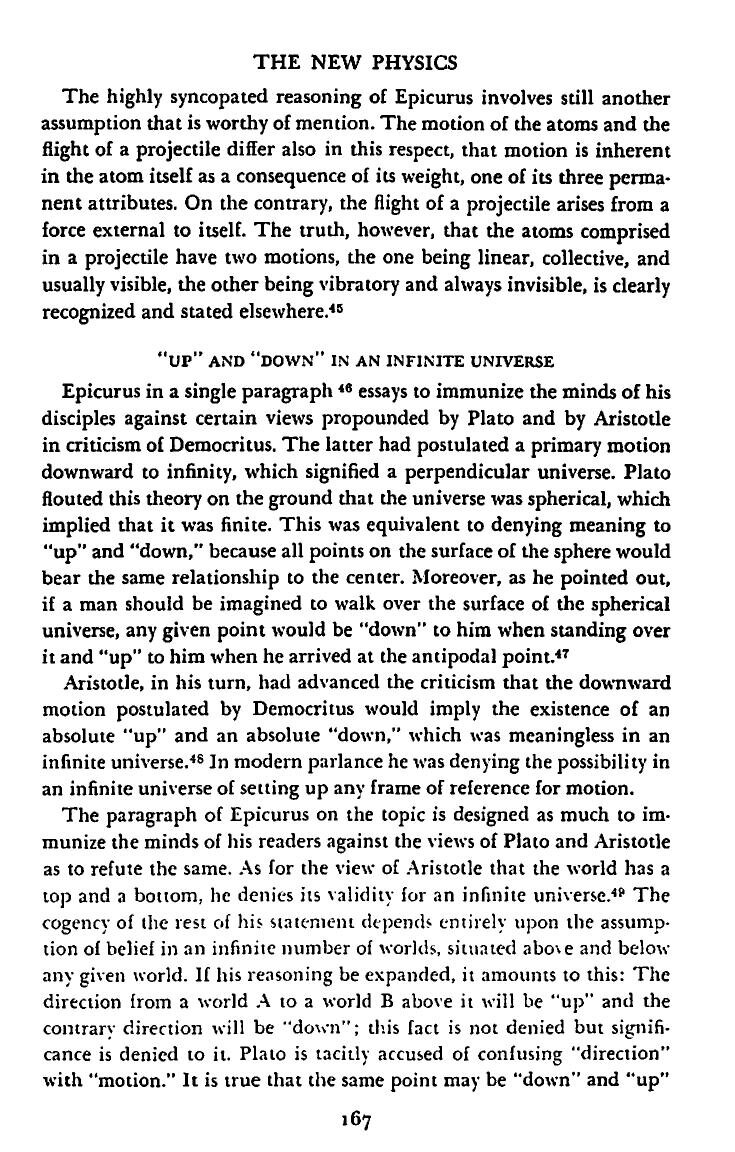
Even Plato’s account of the atom’s own physical durability came in for a direct hit. Plato, in the Timaeus, imagined the smallest particles of the elements as geometric solids with edges that could wear down over time — a mechanism he used to explain the decay of old age. Epicurus, whose atoms are by definition “uncuttable,” found this absurd enough to devote a whole treatise to it, titled The Corner in the Atom — a title that only makes sense, DeWitt infers, once you know “that Plato had accounted for the phenomena of old age by postulating the detrition of the sharp edges of his angular atoms.” Where Plato’s atoms could be worn away like river stones, Epicurus’s could not be touched at all.
DeWitt makes the point elsewhere that this was never an isolated quirk of Plato’s physics — it was the seed of the whole theory of Forms. Plato took his geometric solids as the ultimate constituents of matter and then, by simple analogy, extended the same reasoning to ethics and politics: if perfect spheres and perfect cubes exist as eternal realities behind the imperfect shapes we see, why should perfect Justice not exist the same way, behind every imperfect just act? On this reasoning the whole apparatus of the Republic — a work DeWitt describes as recording “only part of” Plato’s search for that perfect, otherworldly Justice — grows directly out of the geometric style of atomism Epicurus had already rejected on physical grounds. Deny that atoms are perfect, unchanging geometric solids, and the analogy that carries the argument from geometry to ethics collapses with it.
And behind all of this stands a rejection not just of Plato’s specific conclusions but of his entire mathematical method for reaching them. Plato’s curriculum in the Academy ran through geometry and astronomy as the disciplines that trained the mind to grasp eternal, unchanging truth. These same faculties, on his account, were what let the philosopher glimpse the Forms themselves. Epicurus threw the whole apparatus out of his own curriculum:
In his rejection of dialectic and mathematics Epicurus was motivated partly by his animosity toward Platonism… Geometry was repudiated as having no bearing upon the happy life. — DeWitt, Ch. VI, “The New Education”
The function of the demiurge was not simply a mechanical curiosity to be dismissed on physical grounds; it also assigned the gods a job Epicurus refused to let them keep. As David Sedley has written, Plato gave god two distinct roles, and Epicurus accepted only one of them:
Plato had assigned god a double role: world governor and object of human emulation. Epicurus argued vehemently against the first role, but endorsed the second. — David Sedley, “Epicurus: Theological Innatism”
Epicurus’s gods are worth contemplating and emulating precisely because they are blessed and untroubled — models of the pleasant life at its most complete. But they never govern anything, and Epicurus was equally firm that even our very ability to conceive of them owes nothing to a Platonist mechanism. Sedley is explicit that the natural, inborn preconception of the gods which Epicureans trace to Nature herself is not to be confused with Plato’s theory that the soul is born already carrying latent, recollected knowledge of the Forms:
Are we born already possessing some kind of awareness of the gods, albeit in a suppressed form, in the way that Platonists believe us to be born with latent knowledge of the Forms? That idea can be quickly eliminated as unacceptable to Epicureans: notoriously, the Platonist version of innatism relies on the hypothesis that the soul pre-existed its present incarnation … a doctrine which cannot fail to be anathema to any Epicurean. — Sedley, “Epicurus: Theological Innatism”
Two systems can use the same word, “innate,” and mean the opposite thing by it: for Plato, an inheritance from a prior, disembodied existence; for Epicurus, a natural imprint acquired by every mortal soul precisely because it has no such prior existence to draw on.
None of this was academic fighting for the sake of fighting. Each rejection cleared away a piece of the apparatus — the demiurge, the Forms, the geometrically ordered heavens — that Epicurus regarded as machinery built to manufacture oppression and the fear that sustains it. Taking that machinery apart cleared the ground for something better: confidence that the universe is fully within reach of the senses we actually have, and that a pleasant life is available now, not contingent on anyone else’s cosmic plan.
Canonics: The Rebellion Against Reason Enthroned
Section titled “Canonics: The Rebellion Against Reason Enthroned”Plato’s theory of knowledge is built around a hierarchy that runs, in the image of the Divided Line in Book VI of the Republic, from illusion and belief about the visible world up to true knowledge, which belongs to reason alone, contemplating the Forms. Sense-perception sits at the bottom of this hierarchy, capable at best of doxa, opinion, never of episteme, knowledge. The Allegory of the Cave in Book VII drives the same point home as a story: the senses show us only shadows on a wall, and only the philosopher who turns away from them toward the intelligible world — a strenuous and rare achievement — ever sees the truth.
Epicurus’s Canon rejects this wholesale and turns it completely on its head. Sensations, anticipations, and feelings — not reason — are the tests of truth, and DeWitt is explicit that this was a targeted response, not an accidental parallel:
The institution of the Canon reflects a contemporary striving for an increase of precision in all the arts… but the immediate provocation is to be found in the teachings of Pyrrho the skeptic and of Plato. … In the judgment of Epicurus Plato also ranked as a skeptic, because he belittled the sensations as undependable and phenomena as deceptive, the only real and eternal existences being the ideas. — DeWitt, Ch. VII
Reason, for Plato, is what makes contact with reality possible at all; for Epicurus, reason has no such standing on its own:
Not even reason can refute the sensations, for reason depends wholly upon them. — Epicurus, quoted in DeWitt, Ch. VII
DeWitt sums up the resulting split this way, noting that the Epicurean view is much closer to that of Protagoras than of Plato:
In the terrestrial sphere Epicurus approximates to the position of Protagoras, who said “Man is the measure,” while Plato said “God is the measure.” — DeWitt, Ch. VII
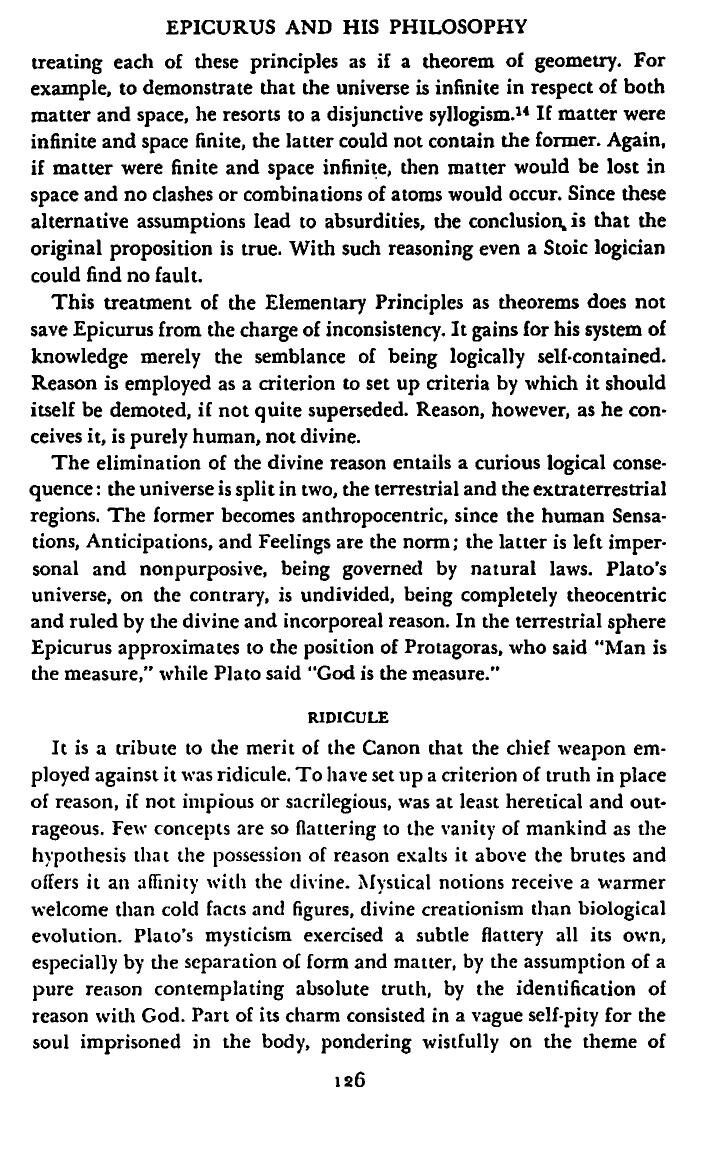
This is not a small technical dispute - it is a wholesale transfer of authority from an eternal, incorporeal, divine Reason that only the trained philosopher or priest can access, to the sensations, anticipations, and feelings that every human being who is “not yet perverted” is equipped with at birth. It is also, not incidentally, an empowering of the individual: a Canon built out of universal human faculties needs no philosopher-king to certify it.
Even Martha Nussbaum, who generally favors Stoicism in her writing, reads Epicurus’s insistence on this point as a conscious mirror-image of Plato’s own position:
Epicurus’ insistence on this point amounts to an (probably deliberate) inversion of Plato, according to whom the only reliable witness to the end or good is the philosophical reason, purified of its bodily attachments by years of mathematical and dialectical training. — Martha C. Nussbaum, The Therapy of Desire: Theory and Practice in Hellenistic Ethics (Princeton, 1994), Ch. 4
Nussbaum goes on to say:
Epicurus finds truth in the body, whereas for Plato the body is the primary source of delusion and bewitchment, and clarity comes only from separating oneself, through intellect, from its influence. — Nussbaum, The Therapy of Desire, Ch. 4
Plato’s wise man reaches truth by training the intellect to distrust the body’s reports; Epicurus’s ordinary person reaches truth by trusting them. Where one system asks for years of purification before the mind is fit to judge, the other asks only that a person pay honest attention to what he already feels.
The subject and use of Dialectic fits squarely within the Forms it was built to reach. If there is no eternal realm of Ideas to define and divide (the method of diaeresis that Plato practices at length in dialogues like the Sophist and the Statesman), then the entire apparatus of definition-by-division becomes motion without a destination:
Dialectic they reject as superfluous, for it should suffice physicists to get along with the names of things as they find them. — Diogenes Laertius, quoted in DeWitt, Ch. VII
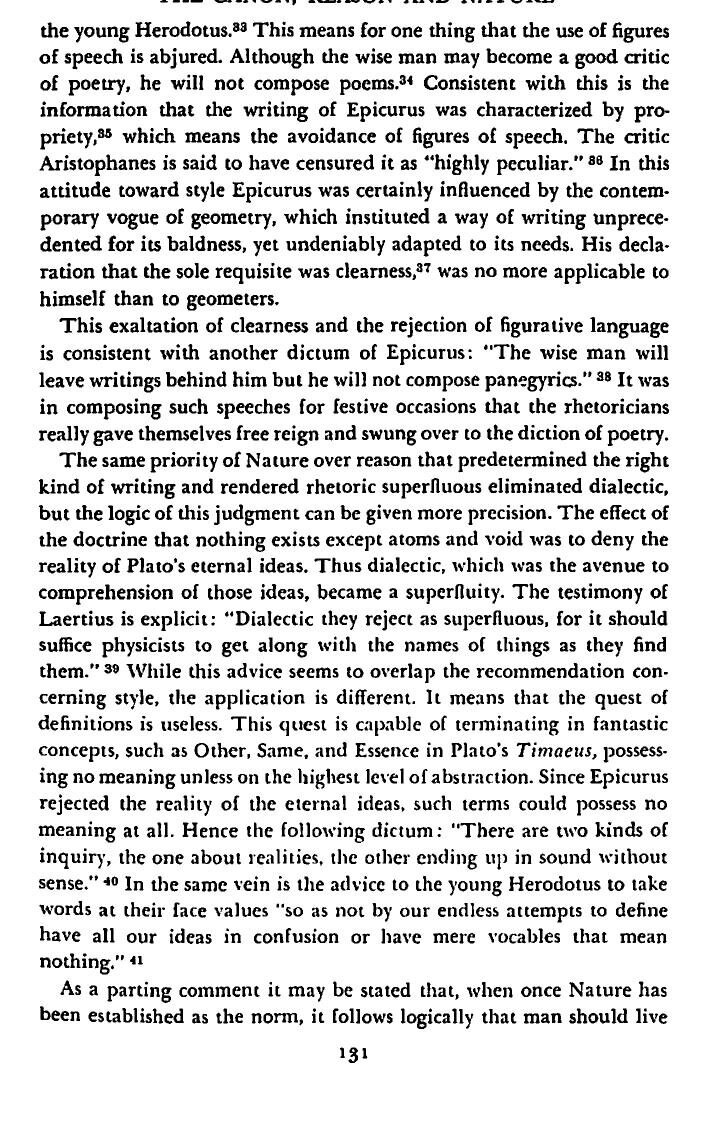
DeWitt points specifically to Plato’s Timaeus, where categories like “Same,” “Other,” and “Essence” are elevated to the status of fundamental realities, as exactly the kind of abstraction Epicurus considered “sound without sense” once the Ideas behind them were denied. Cicero, no friend of Epicureanism, nonetheless preserved the proud epithet Epicurus used for his own Canon, calling it diopetes — “fallen from heaven” — the one standard that, unlike Plato’s dialectic, requires no special initiation to use. As DeWitt wrote:
With the leisurely meanderings of dialectic he had no patience. Truth, he believed, must possess immediate relevance to living. — DeWitt, “Epicurus: Philosophy for the Millions,” The Classical Journal 42 (1947)
Dialectic, on this reckoning, is not simply built on an error about the nature of the universe. It is a method through which one can wander for a lifetime — as Plato’s dialogues themselves do, for example circling a definition of justice or piety without ever quite landing on one — without ever touching the question that actually matters to the people discussing the question. For Epicurus, the question for discussion is not “what is the correct abstract definition of the good,” but “does this get me any closer to living well?” The contest is between dry intellectual assent (all too often enforced at the point of a gun or spear) versus the immediate impact of what your own feelings tell you to value. Epicurus comes down decisively on the side of the latter.
Ethics: The Rebellion Against the Political Good
Section titled “Ethics: The Rebellion Against the Political Good”The field of ethics is where Plato most vigorously insists that we should assent to something we cannot feel. The Form of the Good, in Plato’s system, is grasped by reason alone, at the summit of a long philosophical education most people will never complete and could not complete even if they tried. A carpenter, a farmer, a slave, or any person of ordinary means kept from philosophical training, whether by accident of birth or by central planning of the state — none have access to the Good on Plato’s terms, only to opinions about it.
Epicurus starts from the opposite premise: whatever the good life is, it has to be something that nature communicates to us directly, beginning at birth when we are “not yet perverted” by false ideas, and not something reserved only for the philosophically credentialed. This is the difference between an abstract Good you must be taught to intellectually accept on someone else’s authority, versus a good you already recognize because you feel its presence or its absence in your own life.
Plato’s ethics cannot be separated from his politics. The Republic builds its account of the virtuous soul directly out of the structure of the ideal city, and both rest on division: reason, spirit, and appetite in the soul, mirrored by guardians, auxiliaries, and producers in the state, with the guardians further divided by the myth of metals into men of gold, silver, and iron. Appetite — the part of the soul responsible for bodily pleasure — is vividly denounced in Book IX:
Model in words a kind of multifarious and many-headed beast that has, in a circle, all sorts of heads of tame and wild beasts and is able to change and produce out of itself all such growths. — Plato, Republic 588c–d
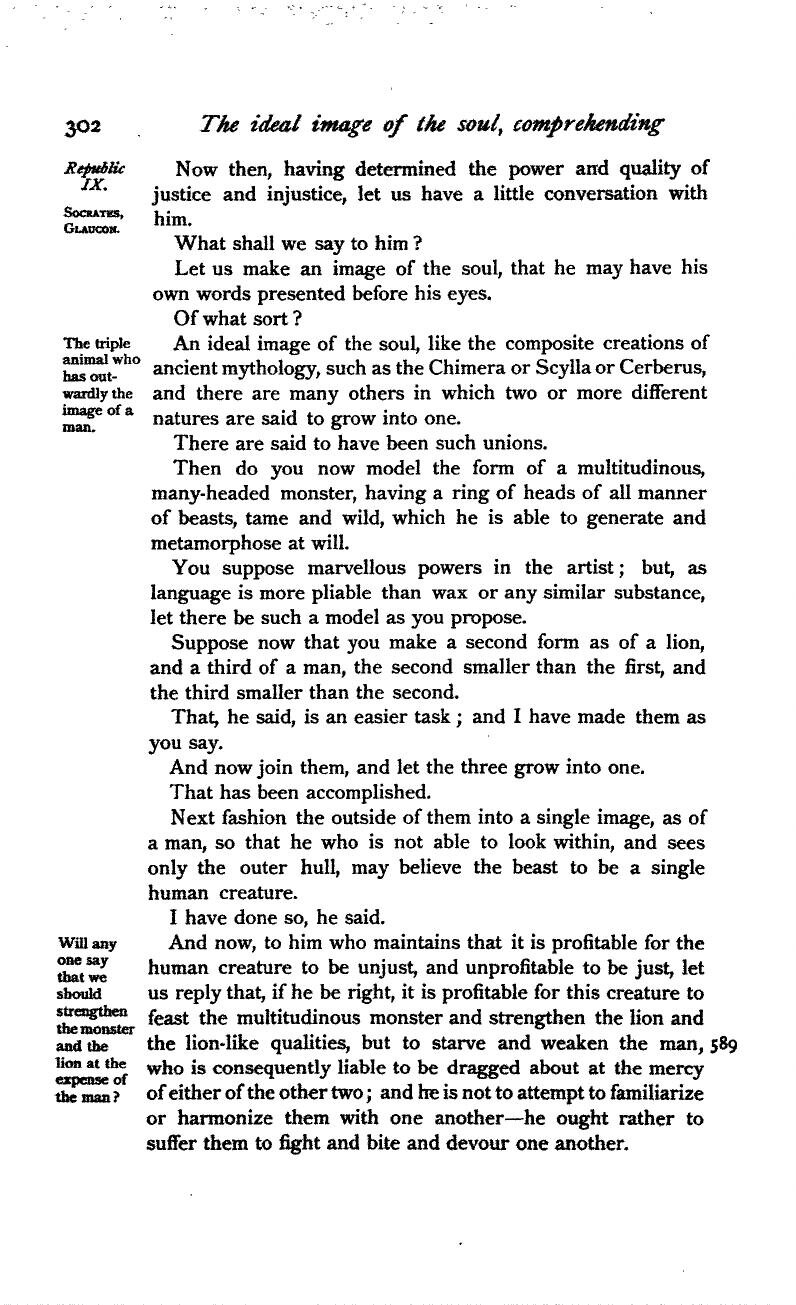
For Plato, this many-headed appetite is precisely what reason must rule and restrain. The desire for pleasure, left unchecked, increases without limit, which is one reason Plato denies that pleasure can serve as any kind of stable, self-limiting good. Wisdom, Courage, Temperance, and Justice, Plato’s four cardinal virtues, are all defined within this political and psychological context. DeWitt notes that this way of looking at virtue is inseparable from that context, “meshed alike with the division of citizens into men of gold, silver, and iron and with the tripartite division of the soul.”
Plato and Aristotle explain why desire runs to excess by pointing to upbringing: a soul trained from youth in the right habits keeps its passions moderate, while an undisciplined one produces the avarice or ambition of Plato’s “timocratic man” in Book VIII of the Republic. Epicurus locates the same runaway desire somewhere else entirely — not in a failure of comprehensive training but in false ideas about the nature of things that leave a person without real confidence in how to secure a pleasant life.
If Plato is right that limitless desire comes from bad habituation, the fix is indeed a lifetime of supervision: the right training under the right teachers. These are available mainly to those with the leisure and station to receive it, or else imposed by force.
If the pain of limitless desire comes from false ideas about the nature of things, as Epicurus holds, the fix is available to anyone capable of trusting that the universe is fully natural, and who can use the same ordinary common sense that is all that is needed to learn to pursue pleasure prudently.
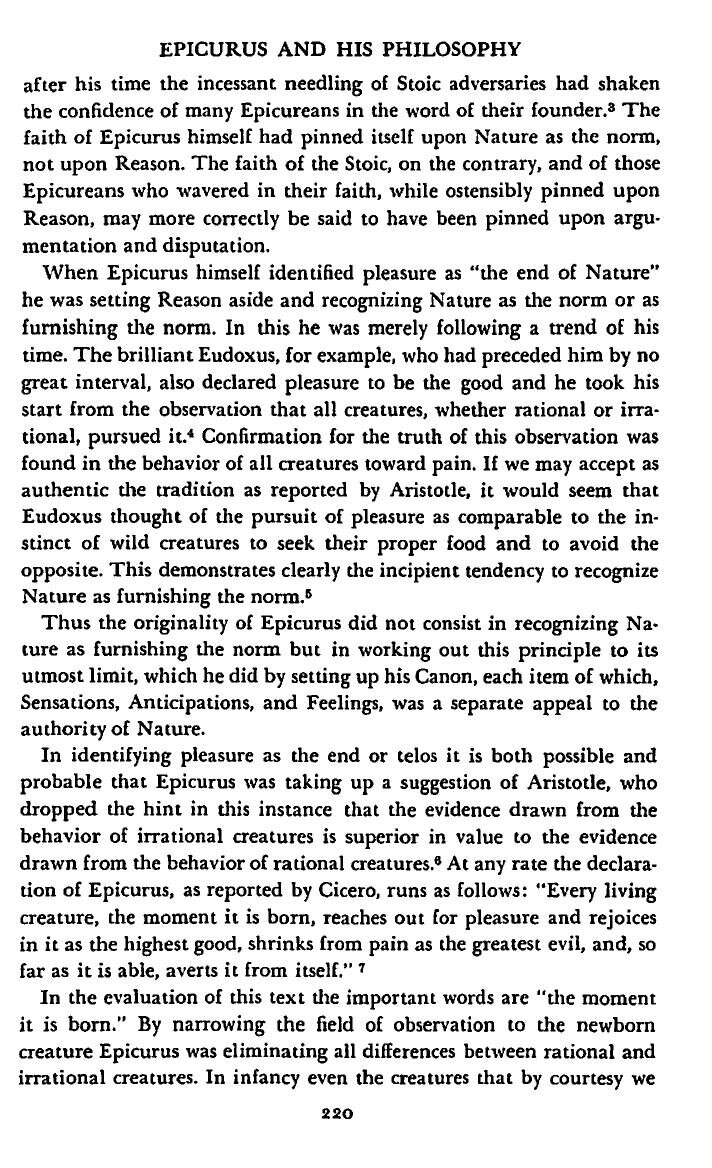
Epicurus takes a knife to the whole centralized enforcement structure. Pleasure is not the unruly appetite of Plato’s beast but the goal itself — the single, unified end toward which every choice and avoidance is aimed, a point that is established not by philosophical argument but by watching what every newborn creature does before it has acquired any opinions at all:
Every living creature, the moment it is born, reaches out for pleasure and rejoices in it as the highest good, shrinks from pain as the greatest evil. — Epicurus, quoted by Cicero, in DeWitt, Ch. XII, “The New Hedonism”
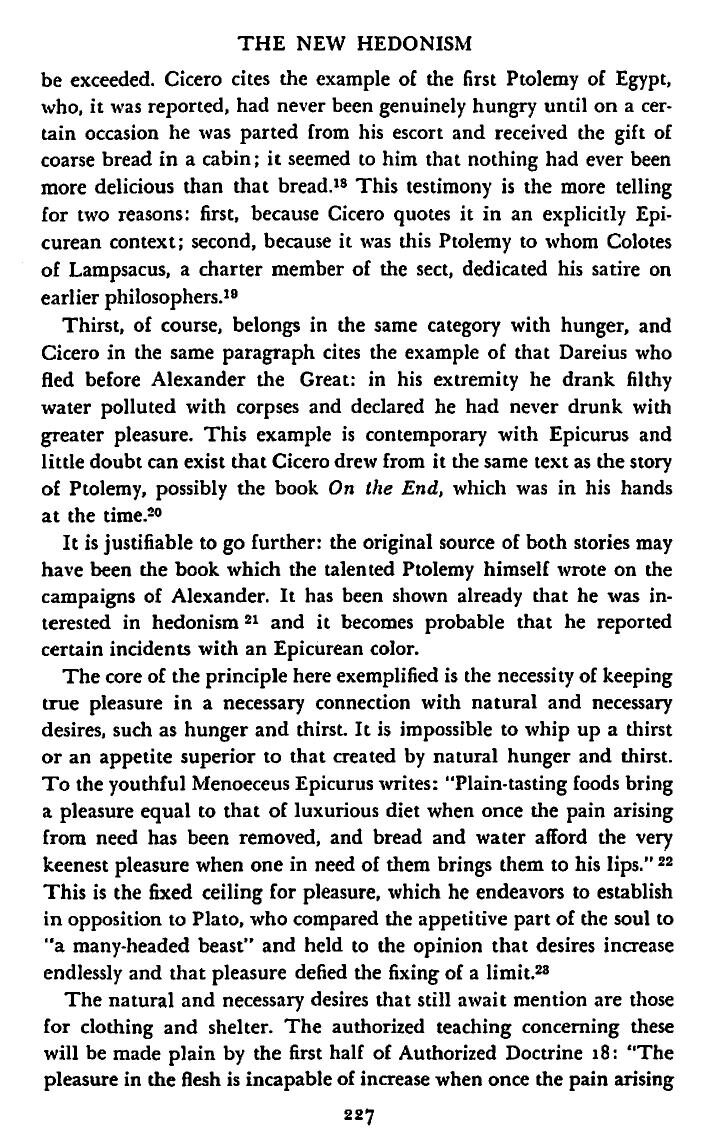
And where Plato’s appetite craves more and more without limit, Epicurus insists pleasure has a natural ceiling, fixed by Nature herself and reachable by anyone regardless of wealth or station. DeWitt makes the target explicit:
This was the fixed ceiling for pleasure, which he endeavors to establish in opposition to Plato, who compared the appetitive part of the soul to “a many-headed beast” and held to the opinion that desires increase endlessly and that pleasure defied the fixing of a limit. — DeWitt, Ch. XII
The rebellion goes deeper than the question of a ceiling; it reaches the very definition of what pleasure is. Plato, in the Timaeus and the Philebus, treats pleasure as a process of restoration — the motion back toward a natural state after some disturbance — and carefully separates that process from the neutral state of rest it restores, a state in which, on his account, neither pleasure nor pain is present. As Boris Nikolsky writes, this position lets Plato treat pleasure as always secondary to, and less real than, the settled state it merely leads toward:
Plato and his followers meant by this only the process of restoration, separating this process from its result and believing that it leads to a neutral state, a state of rest, when both pleasure and pain are absent. — Boris Nikolsky, “Epicurus on Pleasure,” Phronesis 46 (2001)
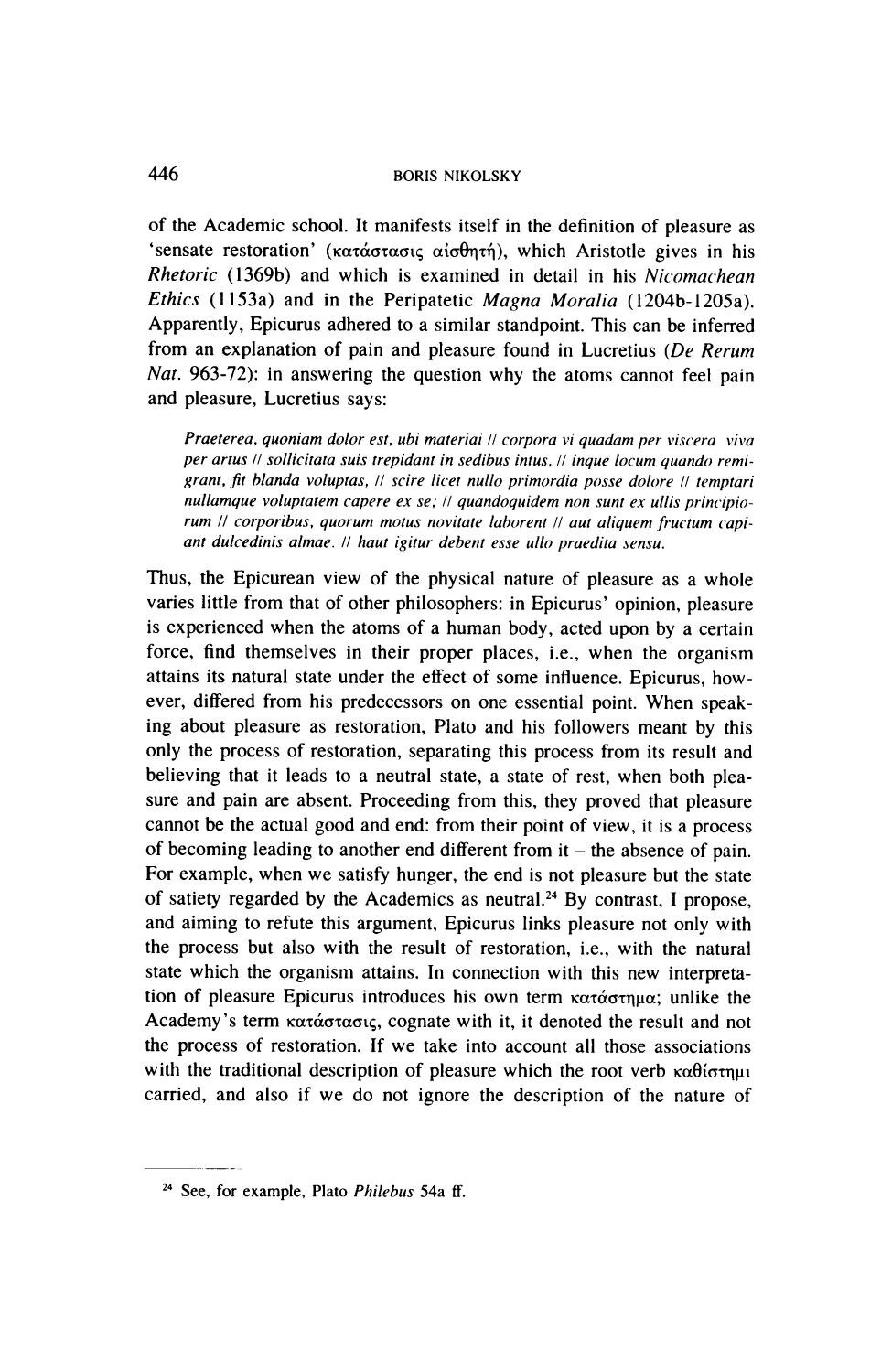
Epicurus collapses that separation on purpose. He takes the very state Plato calls neutral — the absence of disturbance — and names it pleasure at its highest degree (because it is accompanied by no pain), not a third thing standing apart from pleasure and pain. There is no resting point left over for Plato’s “neutral state” to occupy, because Epicurus has already claimed it for pleasure itself:
The removal of all pain is the limit of the magnitude of pleasures, and wherever a pleasant feeling is present, for as long as it is present, there is no feeling of pain. — Epicurus, Principal Doctrine 3 (fuller text)
Plato needed to claim that the resting state is exempt from pleasure so that he could demote pleasure to a mere means, rather than an end worthy of a philosopher. Epicurus’s whole ethics rejects that contention at its core.
Plato pushes the same demotion of pleasure one step further, into a claim about what actually deserves to be called real at all. Pleasure, he argues in the Philebus, is a genesis — a “generation,” a process aimed at something beyond itself — and for that reason cannot be ousia, real “being”:
Then, as I said at first, we ought to be very grateful to him who first pointed out that pleasure was a generation only, and had no true being at all; for he is clearly one who laughs at the notion of pleasure being a good. — Plato, Philebus 53c–55a (tr. Jowett)
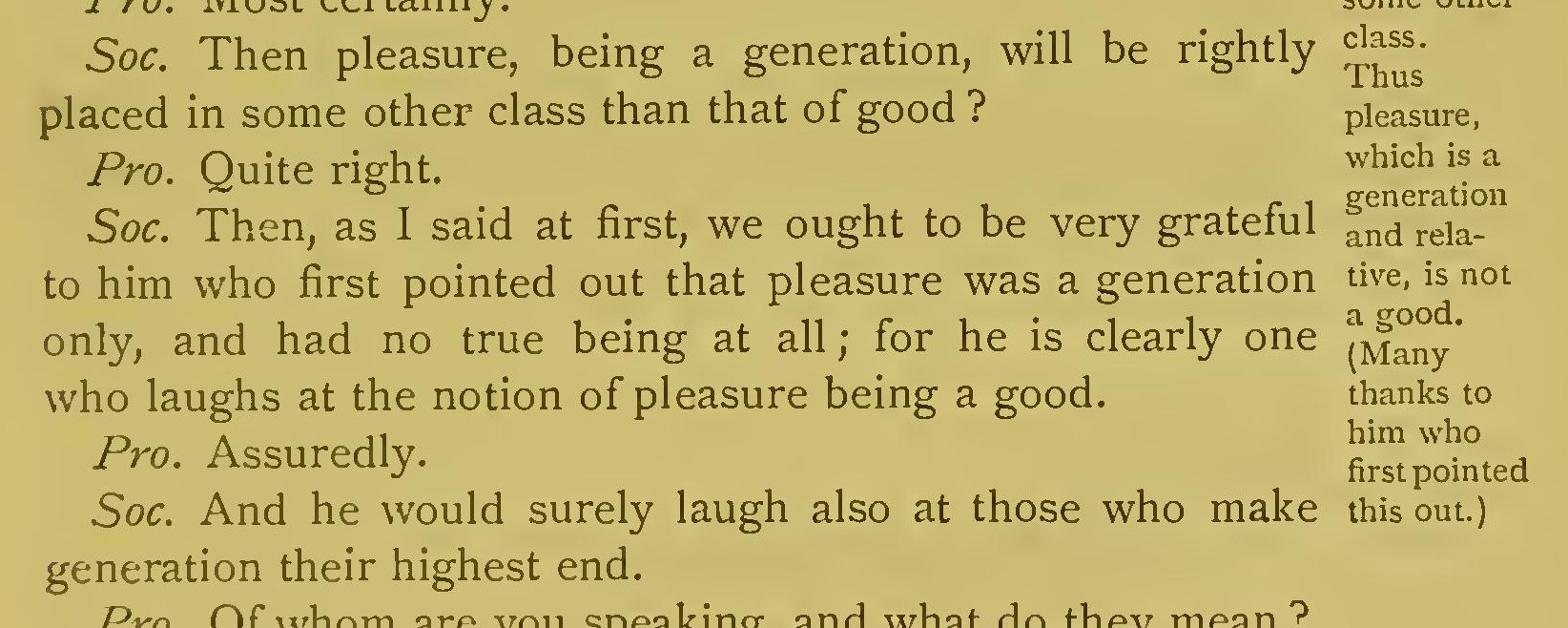
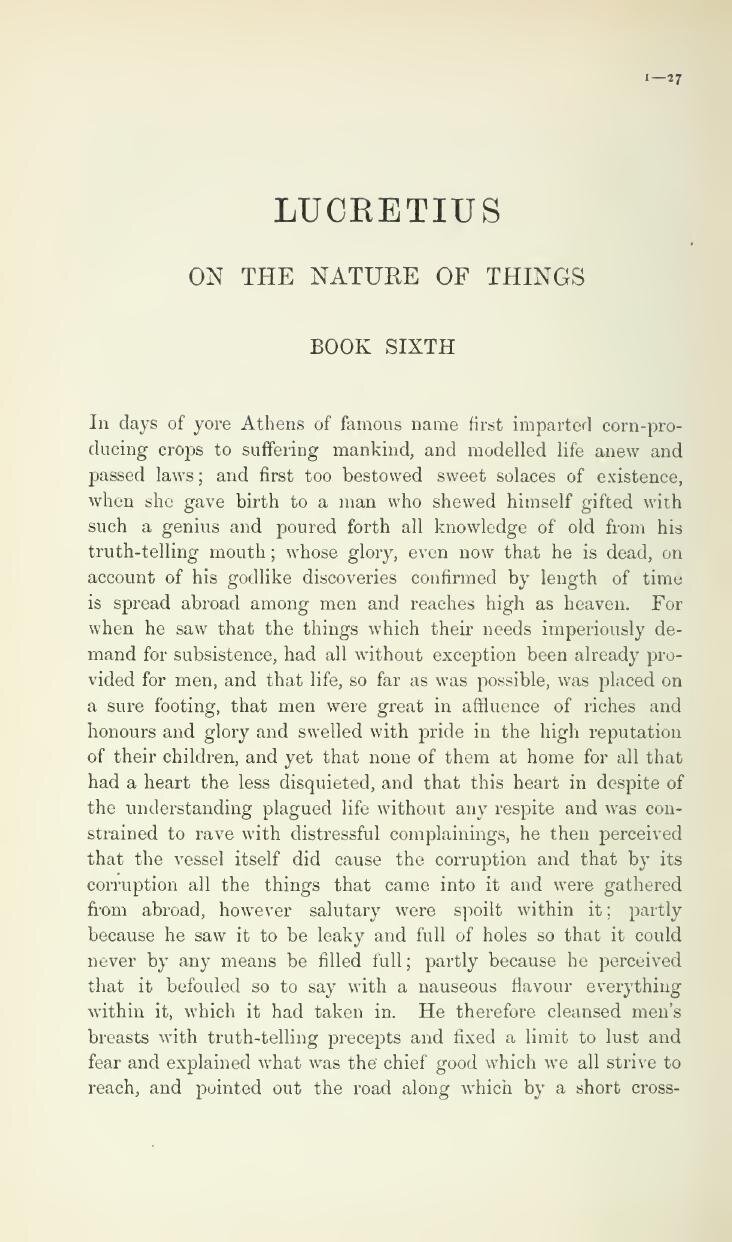
This is the same being/becoming distinction that drives Plato’s physics, now aimed at ethics: whatever is merely “becoming” cannot be the good, because only what fully is qualifies. Cicero later turns the same weapon on Epicurus by name, casting pleasure as caught between being a motion (a process) and a state (something complete), as though Epicurus had to choose one and abandon the other. Epicurus holds both without contradiction: a pleasure is a motion when looked at as it unfolds, and a complete state when the whole of a life is in view, and Principal Doctrine 3 fixes the point at which it counts as complete — the removal of all pain. The Epicureans’ own image for that completeness was never Plato’s static “being,” but a filled vessel: Lucretius diagnosed the ordinary complaint about life as a “leaking” vessel that “could never by any means be filled full,” and Diogenes of Oinoanda wrote that he wanted, before death overtook him, “to compose a fine anthem to celebrate the fullness of pleasure.” Where Plato needed pleasure to fall short of being in order to disqualify it from the good, Epicurus just asks whether the vessel is full — a question anyone can answer from his own felt experience, without first settling a dispute about the metaphysics of Being.
The ancient commentator Damascius, writing on Plato’s Philebus, recognized Principal Doctrine 3 as a direct rejoinder to Plato on a related point: whether pleasure and pain can occur mixed together at once. As David Wolfsdorf notes in his survey, Damascius reads the two positions as flatly opposed:
Epicurus thinks that pain cannot [simultaneously] mix with pleasure … Plato, on the contrary, holds that this does occur, both in the soul and in the body and in combination. — Damascius, In Philebum 197, quoted in David Wolfsdorf, Pleasure in Ancient Greek Philosophy (Cambridge, 2013)
![David Wolfsdorf, Pleasure in Ancient Greek Philosophy (Cambridge, 2013), quoting Damascius: "Epicurus thinks that pain cannot [simultaneously] mix with pleasure...Plato, on the contrary, holds that this does occur."](/citationclips/wolfsdorf-pleasureinancientgreekphilosophy-damasciusmixedpleasure.jpg)
Plato’s Philebus builds an entire class of “mixed” pleasures — the itch that is pleasant because it is also painful to scratch, grief mixed with the pleasure of a sad story — because on his view pleasure and pain can genuinely coincide. Epicurus’s ceiling in Principal Doctrine 3 leaves no logical room for that coincidence: wherever pleasure is present in full, pain, by definition, is simply not there to be mixed in.
Virtue itself changes shape under this pressure. For Plato, the virtues are intrinsically good, participating in and reflecting the eternal Form of the Good itself — the highest object of philosophical knowledge. For Epicurus, virtue is stripped of any such metaphysical backing and judged purely by what it does for a life. Virtue is not an end but an instrument, valuable exactly to the degree that it secures a pleasant life and worthless the moment it fails to. This is not a diminishment of virtue so much as a relocation of virtue — out of an eternal, otherworldly world of ideals and into the one life a person actually has to live.
Even Plato’s belief that the soul exists before birth and might be recalling truths seen in a prior, disembodied state — the doctrine of anamnesis worked out in the Phaedo and the Meno — is answered point for point. For Plato this life in the body is itself a kind of confinement, a doctrine DeWitt traces to Pythagoras and never softened:
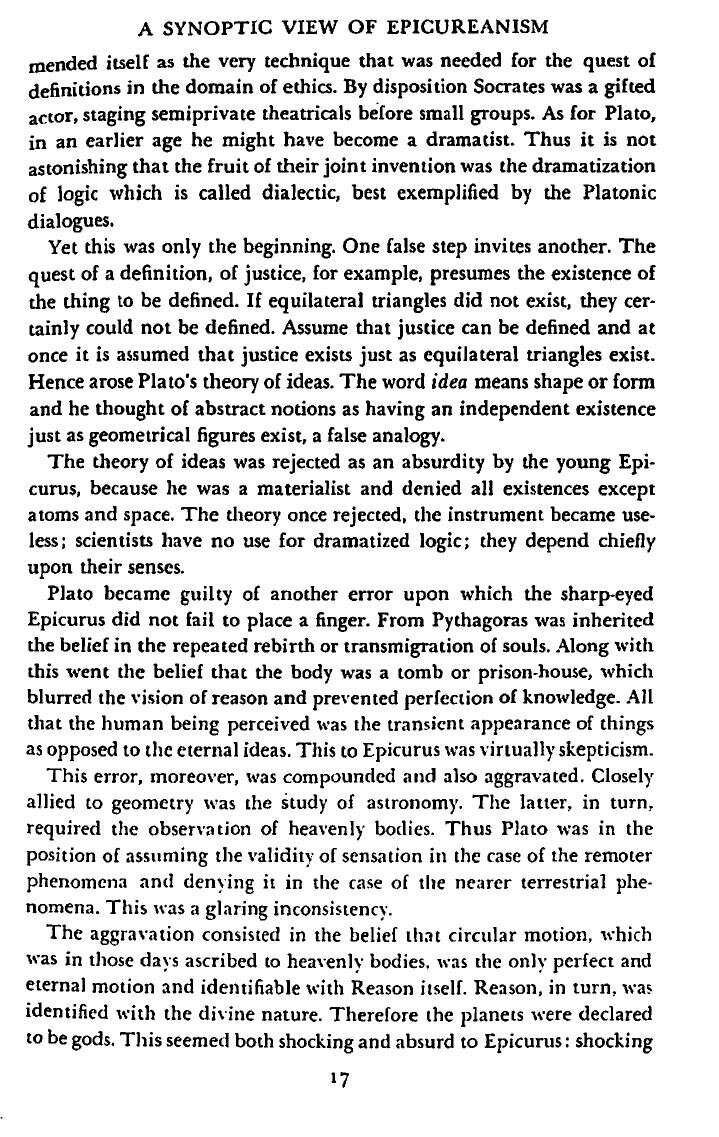
[Plato inherited from Pythagoras] the belief that the body was a tomb or prison-house, which blurred the vision of reason and prevented perfection of knowledge. — DeWitt, Ch. I (“A Synoptic View of Epicureanism”)
Epicurus’s soul, by contrast, is born and dies with the body:
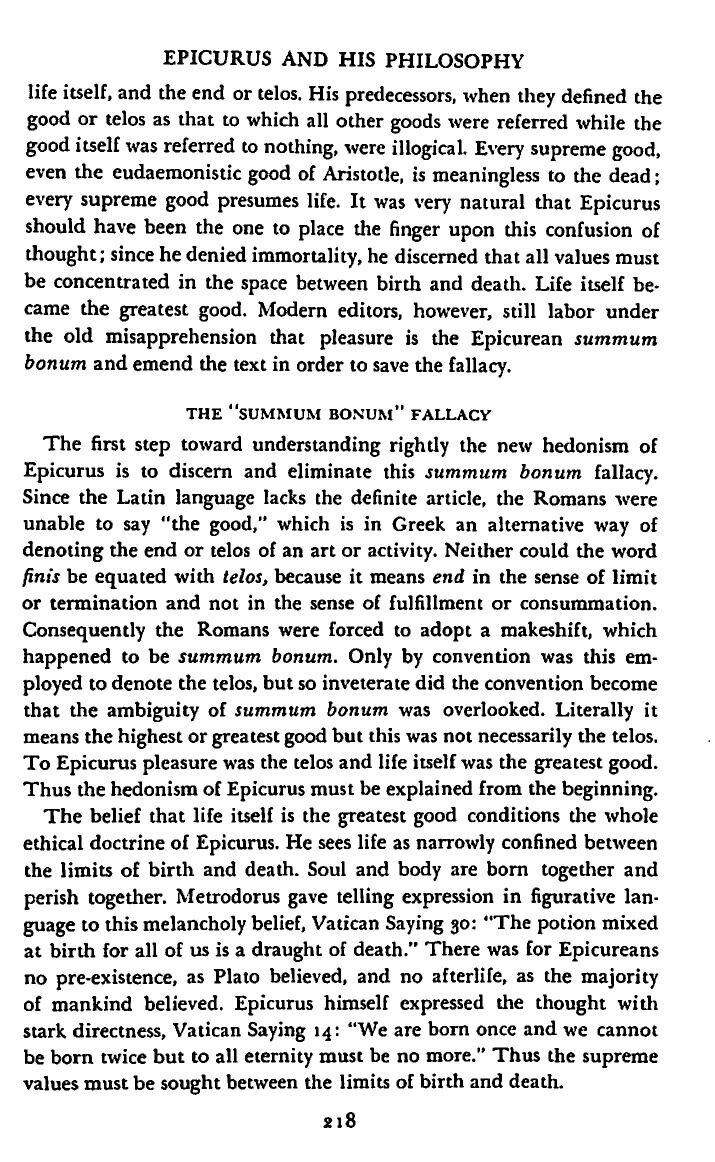
There was for Epicureans no pre-existence, as Plato believed, and no afterlife, as the majority of mankind believed. — DeWitt, Ch. XII
The two positions could not generate more different feelings about being alive right now. If the body is a prison, then the pleasures felt inside it are at best a distraction from the soul’s real business and at worst a further shackle. If body and soul rise and fall together, with nothing before and nothing after, then whatever a person feels in this one life — every pleasure secured, every friendship kept, every confidence earned — simply is the whole of what there is to value. Epicurus made this the actual test for identifying the good, rather than a further round of definition-chasing. Rather than continuing to ask, in the manner of the Republic, what “the good” abstractly is, he pointed to the plainest fact of felt experience available: the sheer joy of surviving a mortal danger:
That which occasions unsurpassable joy is the bare escape from some dreadful calamity; and this is the nature of “good,” if one apprehend it rightly and then stand by his finding, and not go on walking round and round and harping uselessly on the meaning of “good.” — Epicurus, quoted in DeWitt, Ch. XII
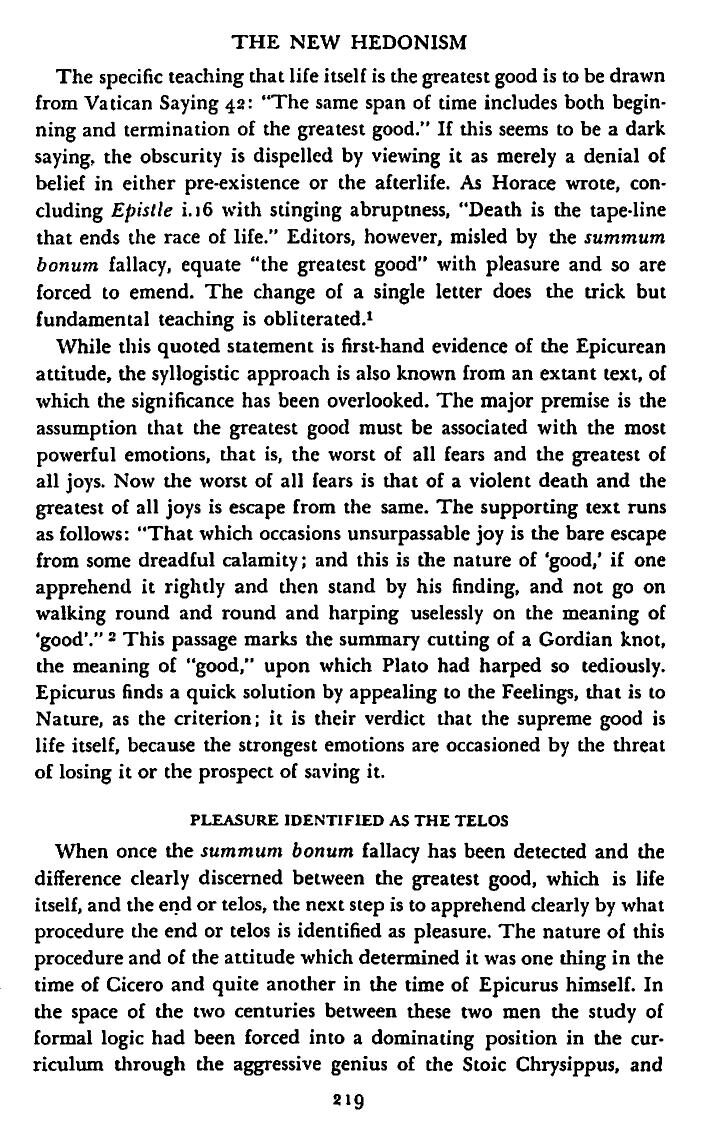
DeWitt calls this “the summary cutting of a Gordian knot, the meaning of ‘good,’ upon which Plato had harped so tediously.” The test of the good, in other words, was never going to be found by further dialectic. It is already available by considering what a person feels the instant a real threat to what matters to him has passed.
The Pleasure in the Rebellion
Section titled “The Pleasure in the Rebellion”It would be easy to tell this story as a dry catalogue of disagreements — atoms against Forms, senses against Reason, pleasure against the Good — and stop there. But that would miss the point Epicurus was making, and it would repeat the reduction of Epicurean pleasure to small, momentary comforts, as though the whole system amounted to a preference for bread over marble columns. It does not.
Recall the distinction drawn at the outset of this article — between dry intellectual assent to a proposition and the impact of feeling in actual life — because that distinction is the real meaning of this dispute. Working through the case against Plato, chapter by chapter, physics through ethics, is not a detour on the way to Epicurean pleasure. It is a direct exercise of it, because false belief is rarely a neutral error of the intellect; it is the source of the deepest and most persistent hurdles to pleasurable living that a person carries. Confidence that the gods have no interest in punishing you. Confidence that death is simply the end of sensation, not a doorway to further suffering. Confidence that living well requires no credential you were never permitted to earn. All of this is exactly what false Platonic ideas take away. Seeing through each of these means coming to feel how important these issues are to our own pleasure and happiness.
There is another pleasure Epicurus was equally explicit about: the pleasure of knowing that clearing away a friend’s false opinion has done that friend real, lasting good — not because he has been handed a better syllogism, but because he now feels differently, and better, about his own life. The ancient Epicurean writings such as the letter Against the Philosophers in Mytilene, Hermarchus’s books against Plato and Aristotle, Metrodorus’s satires against the “would-be Lycurguses and Solons” who kept reviving Plato’s taste for law-giving — were not written to win debating points from rivals who would never be persuaded. They were written, as DeWitt observes, “to insulate the minds of disciples against all other doctrines,” which is to say: to hand friends, present and future, something worth having in place of an inherited fear: confidence, gratitude, and the plain pleasure of trusting one’s own judgment. A refutation shared within the Garden was an act of care, aimed not at the friend’s intellect alone but at what the friend would come to feel, every day afterward, about the things that actually mattered to him.
This is why “the pleasure of rebelling against Plato” is not a joke title dressed up for effect. It names something real and important in Epicurean ethics: that seeing through a false picture of the world is not a grim, humorless labor to be endured on the way to some separate reward called pleasure. It is a pleasure.