The Power Of Infinity: Infinite Atoms, Limited Kinds, And Isonomia
This is one of the most important doctrines in Epicurean physics, and one of the least understood. It is the Epicurean answer to the question every creationist asks: how could a world as orderly as ours, and so well fitted for life, come into being without a designer? This page sets out the doctrine and collects the passages on which it rests. A shorter account, which places it within the whole Epicurean case, is in The Epicurean Alternative To Divine Creation.
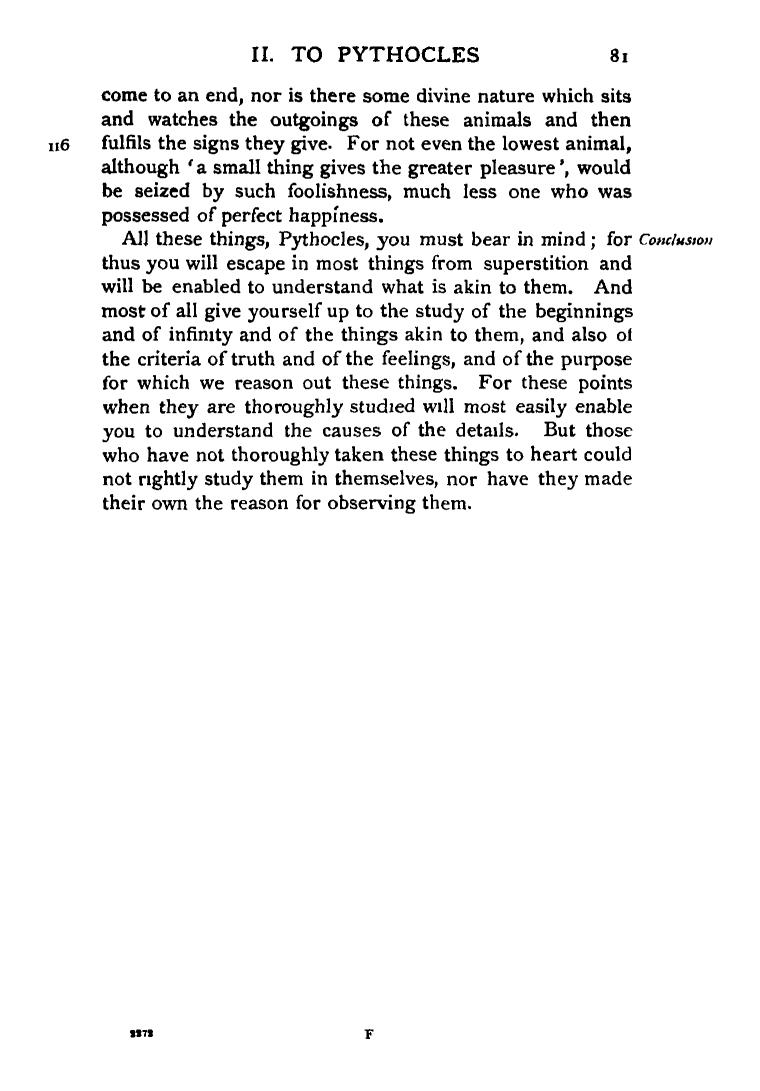
Epicurus told Pythocles to give himself “most of all” to the study of “the beginnings and of infinity”:
All these things, Pythocles, you must bear in mind; for thus you will escape in most things from superstition and will be enabled to understand what is akin to them. And most of all give yourself up to the study of the beginnings and of infinity and of the things akin to them, and also of the criteria of truth and of the feelings, and of the purpose for which we reason out these things. For these points when they are thoroughly studied will most easily enable you to understand the causes of the details. But those who have not thoroughly taken these things to heart could not rightly study them in themselves, nor have they made their own the reason for observing them.
— Epicurus, Letter to Pythocles 116 (tr. Bailey) (page image)
David Sedley, in the “Epicurean Infinity” section of Creationism and Its Critics in Antiquity (2007, pp. 155-66), shows that the Epicurean answer rests on three linked points: the atoms are infinite in number; the kinds of atoms are not; and through isonomia, equal distribution, things of the same standing are spread evenly through the infinite. Together they mean that worlds like ours form, and form again, without any maker.
A note on terms. When the Epicureans say that nothing exists but atoms and void, they mean that atoms and void are the ultimate constituents of everything, and the only things that exist eternally the same. They do not mean that nothing else is real. Stones, rivers, living things, whole worlds, and the qualities and events of all of these are fully real, as compounds of atoms and as properties of compounds.
1. The Atoms Are Infinite In Number
Section titled “1. The Atoms Are Infinite In Number”The universe is boundless both in the amount of matter and in the extent of space. Nothing comes from nothing and nothing passes into nothing, so the ultimate constituents of the universe were never created and will never be destroyed. They have always existed, moving and combining, for an infinite time already.
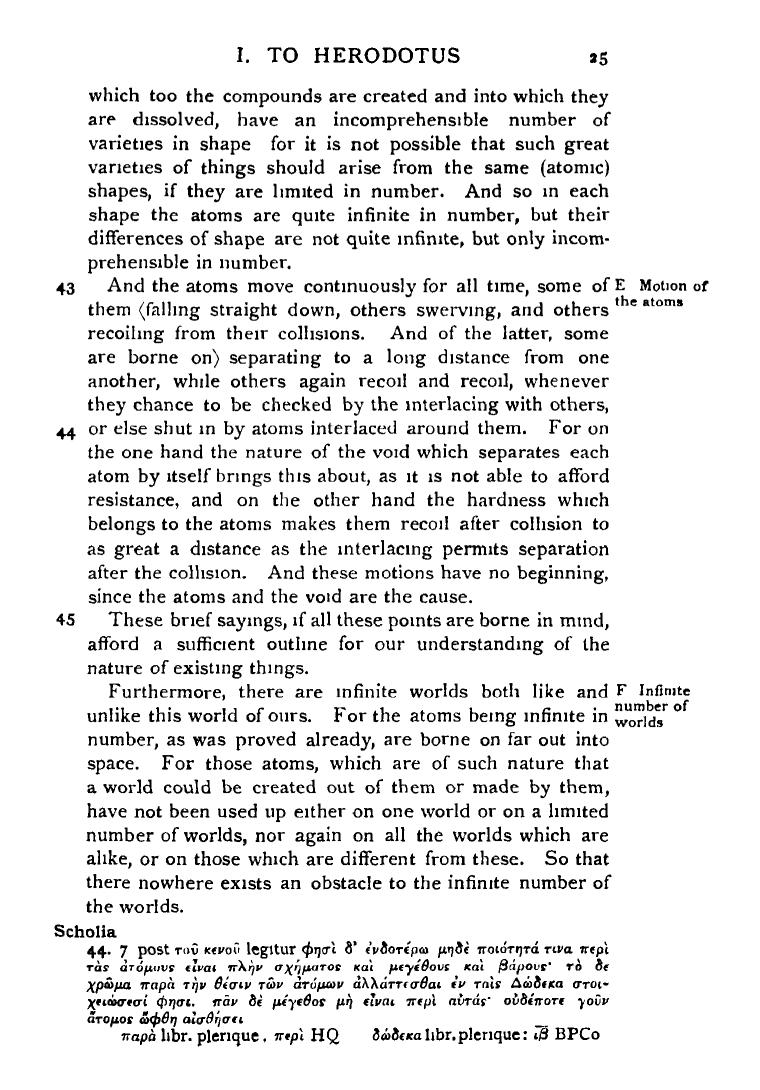
Furthermore, the infinite is boundless both in the number of the bodies and in the extent of the void. For if on the one hand the void were boundless, and the bodies limited in number, the bodies could not stay anywhere, but would be carried about and scattered through the infinite void, not having other bodies to support them and keep them in place by means of collisions. But if, on the other hand, the void were limited, the infinite bodies would not have room wherein to take their place. Besides this the indivisible and solid bodies, out of which too the compounds are created and into which they are dissolved, have an incomprehensible number of varieties in shape: for it is not possible that such great varieties of things should arise from the same atomic shapes, if they are limited in number. And so in each shape the atoms are quite infinite in number, but their differences of shape are not quite infinite, but only incomprehensible in number.
— Epicurus, Letter to Herodotus 42 (tr. Bailey) (page image)
2. The Kinds Of Atoms Are Not Infinite
Section titled “2. The Kinds Of Atoms Are Not Infinite”Atoms differ only in shape, size and weight, and their differences of shape “are not quite infinite, but only incomprehensible in number” (Letter to Herodotus 42, above). Epicurus reached this through the minimum parts. Every atom is made of a definite number of partless minima, and a definite number of parts can be arranged in only a limited number of ways. To get a new shape you must add more parts, so an unlimited number of shapes would mean atoms of unlimited size, and we see no such thing:
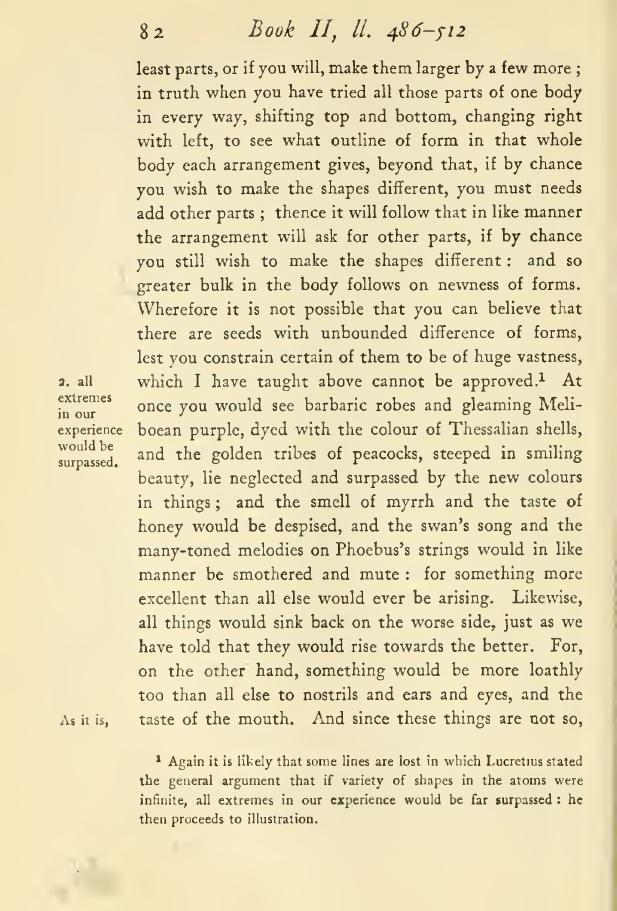
And since I have taught this much, I will hasten to link on a truth which holds to this and wins belief from it, that the first-beginnings of things are limited in the tale of their varying shapes. If it were not to be so, then once again certain seeds must needs be of unbounded bulk of body. For, within the same tiny frame of any one single seed, the shapes of the body cannot be very diverse. For suppose the first-bodies to be of three least parts, or if you will, make them larger by a few more; in truth when you have tried all those parts of one body in every way, shifting top and bottom, changing right with left, to see what outline of form in that whole body each arrangement gives, beyond that, if by chance you wish to make the shapes different, you must needs add other parts; thence it will follow that in like manner the arrangement will ask for other parts, if by chance you still wish to make the shapes different: and so greater bulk in the body follows on newness of forms. Wherefore it is not possible that you can believe that there are seeds with unbounded difference of forms, lest you constrain certain of them to be of huge vastness, which I have taught above cannot be approved.
Lucretius adds the evidence of the senses. Colors, smells, tastes and sounds all run between fixed extremes. If the shapes of atoms were unlimited, there would always be some new purple brighter than the brightest and some smell fouler than the foulest:
At once you would see barbaric robes and gleaming Meliboean purple, dyed with the colour of Thessalian shells, and the golden tribes of peacocks, steeped in smiling beauty, lie neglected and surpassed by the new colours in things; and the smell of myrrh and the taste of honey would be despised, and the swan’s song and the many-toned melodies on Phoebus’s strings would in like manner be smothered and mute: for something more excellent than all else would ever be arising. Likewise, all things would sink back on the worse side, just as we have told that they would rise towards the better. For, on the other hand, something would be more loathly too than all else to nostrils and ears and eyes, and the taste of the mouth. And since these things are not so, but a fixed limit to things marks the extreme on either side, you must needs confess that the first-matter too has a limited difference in shapes.
— Lucretius, De Rerum Natura II.500-521 (tr. Bailey) (page image)
Put the first two points together: since the kinds are limited and the total of matter is not, there must be infinitely many atoms of every kind.
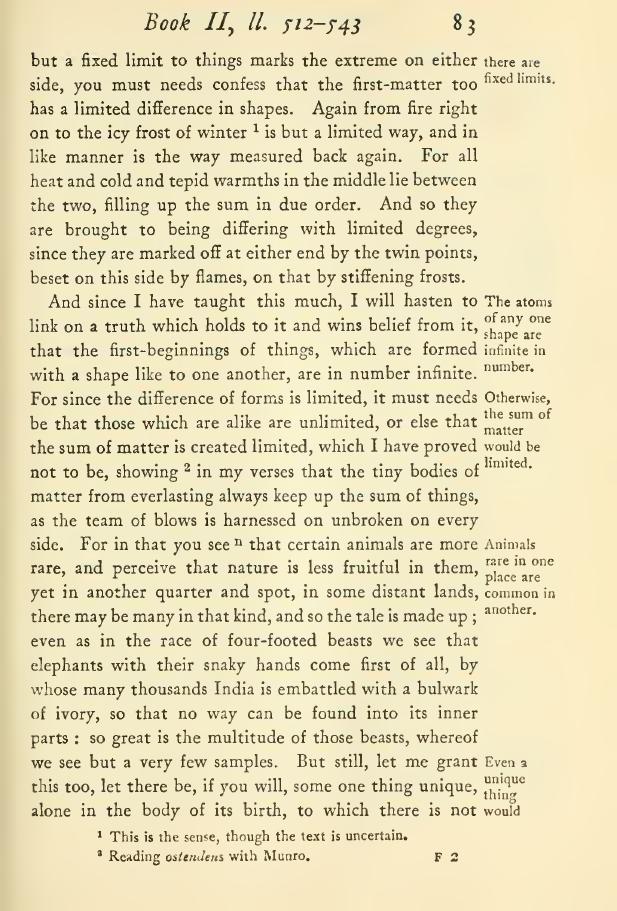
And since I have taught this much, I will hasten to link on a truth which holds to it and wins belief from it, that the first-beginnings of things, which are formed with a shape like to one another, are in number infinite. For since the difference of forms is limited, it must needs be that those which are alike are unlimited, or else that the sum of matter is created limited, which I have proved not to be, showing in my verses that the tiny bodies of matter from everlasting always keep up the sum of things, as the team of blows is harnessed on unbroken on every side.
— Lucretius, De Rerum Natura II.522-531 (tr. Bailey) (page image)
3. Isonomia: Equal Distribution Through The Infinite
Section titled “3. Isonomia: Equal Distribution Through The Infinite”Cicero’s Epicurean spokesman Velleius calls this “the supremely potent principle of infinity”: “in the sum of things everything has its exact match and counterpart,” which Epicurus called isonomia, “the principle of uniform distribution.” Velleius uses the principle to argue that immortal beings must balance the mortal ones, but it applies just as well to atoms, to species of living things, and to worlds.
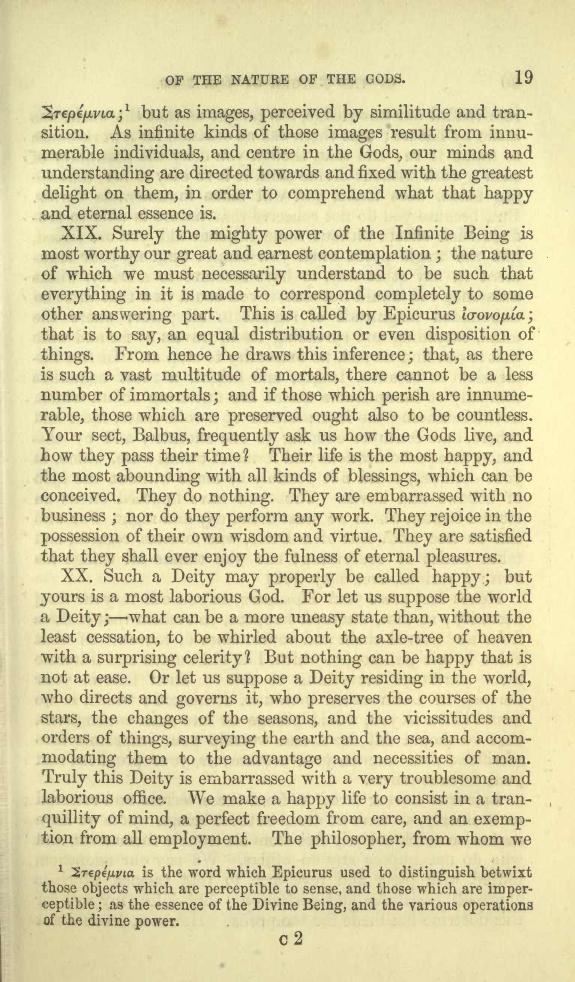
Moreover there is the supremely potent principle of infinity, which claims the closest and most careful study; we must understand that it has the following property, that in the sum of things everything has its exact match and counterpart. This property is termed by Epicurus isonomia, or the principle of uniform distribution. From this principle it follows that if the whole number of mortals be so many, there must exist no less a number of immortals, and if the causes of destruction are beyond count, the causes of conservation also are bound to be infinite.
— Cicero, On the Nature of the Gods I.50 (tr. Rackham) (page image)
Things of the same standing are spread evenly through the infinite. A kind that looks rare here is plentiful somewhere else, as elephants are seldom seen in Italy but make “a bulwark of ivory” in India:
For in that you see that certain animals are more rare, and perceive that nature is less fruitful in them, yet in another quarter and spot, in some distant lands, there may be many in that kind, and so the tale is made up; even as in the race of four-footed beasts we see that elephants with their snaky hands come first of all, by whose many thousands India is embattled with a bulwark of ivory, so that no way can be found into its inner parts: so great is the multitude of those beasts, whereof we see but a very few samples.
— Lucretius, De Rerum Natura II.532-540 (tr. Bailey) (page image)
Even if some one thing were unique in all the world, it could not be formed without an unlimited stock of the atoms it needs:
But still, let me grant this too, let there be, if you will, some one thing unique, alone in the body of its birth, to which there is not a fellow in the whole wide world; yet unless there is an unlimited stock of matter, from which it might be conceived and brought to birth, it will not be able to be created, nor, after that, to grow on and be nourished. Nay, in very truth, if I were to suppose this too, that the bodies creative of one single thing were limited as they tossed about the universe, whence, where, by what force, in what manner will they meet and come together in that vast ocean, that alien turmoil of matter? They have not, I trow, a plan for union, but as, when many a great shipwreck has come to pass, the great sea is wont to cast hither and thither benches, ribs, yards, prow, masts and swimming oars, so that along all the coasts of the lands floating stern-pieces are seen, giving warning to mortals, to resolve to shun the snares of the sea and its might and guile, nor trust it at any time, when the wiles of the windless waves smile treacherous; even so, if you once suppose that the first-beginnings of a certain kind are limited, then scattered through all time they must needs be tossed hither and thither by the tides of matter, setting towards every side, so that never can they be driven together and come together in union, nor stay fixed in union, nor take increase and grow; yet that each of these things openly comes to pass, fact proves for all to see, that things can be brought to birth and being born can grow. It is manifest then that there are, in any kind of things you will, infinite first-beginnings, by which all things are supplied.
And the motions of destruction and the motions of creation stay in balance, so that neither wins for ever:
And so, neither can the motions of destruction prevail for ever, and bury life in an eternal tomb, nor yet can the motions of creation and increase for ever bring things to birth and preserve them. So war waged from time everlasting is carried on by the balanced strife of the first-beginnings. Now here, now there, the vital forces of things conquer and are conquered alike. With the funeral mingles the wailing which babies raise as they come to look upon the coasts of light; nor has night ever followed on day, or dawn on night, but that it has heard mingled with the baby’s sickly wailings, the lament that escorts death and the black funeral.
4. Infinite Worlds, And Whatever Can Happen Does Happen
Section titled “4. Infinite Worlds, And Whatever Can Happen Does Happen”With infinite atoms of every kind spread evenly through infinite space and time, worlds form without limit, both like ours and unlike it:
Furthermore, there are infinite worlds both like and unlike this world of ours. For the atoms being infinite in number, as was proved already, are borne on far out into space. For those atoms, which are of such nature that a world could be created out of them or made by them, have not been used up either on one world or on a limited number of worlds, nor again on all the worlds which are alike, or on those which are different from these. So that there nowhere exists an obstacle to the infinite number of the worlds.
— Epicurus, Letter to Herodotus 45 (tr. Bailey) (page image)
Our own world formed “not by design,” but because the atoms, over limitless time, tried “movements and unions of every kind” until they fell into the arrangements that make it:
For in very truth, not by design did the first-beginnings of things place themselves each in their order with foreseeing mind, nor indeed did they make compact what movements each should start, but because many of them shifting in many ways throughout the world are harried and buffeted by blows from limitless time, by trying movements and unions of every kind, at last they fall into such dispositions as those, whereby our world of things is created and holds together. And it too, preserved from harm through many a mighty cycle of years, when once it has been cast into the movements suited to its being, brings it about that the rivers replenish the greedy sea with the bounteous waters of their streams, and the earth, fostered by the sun’s heat, renews its increase, and the race of living things flourishes, sent up from her womb, and the gliding fires of heaven are alive; all this they would in no wise do, unless store of matter might rise up from limitless space, out of which they are used to renew all their losses in due season.
In an infinite universe, whatever can happen does happen somewhere, “in the diverse worlds, fashioned on diverse plans”:
For it is hard to declare for certain which of these causes it is in this world; but what can happen and does happen through the universe in the diverse worlds, fashioned on diverse plans, that is what I teach, and go on to set forth many causes for the motions of the stars, which may exist throughout the universe; and of these it must needs be one which in our world too gives strength to the motions of the heavenly signs; but to affirm which of them it is, is in no wise the task of one treading forward step by step.
And over the infinite time already past, nothing truly new remains to happen:
Epicurus asserts that nothing new happens in the universe when compared to the infinite time already passed.
5. Why The Limit On The Kinds Of Atoms Matters
Section titled “5. Why The Limit On The Kinds Of Atoms Matters”Sedley explains what the Epicureans meant by the “power of infinity”:
So long as the range of accidental permutations is finite, constrained by the spatial and temporal dimensions of a single world, it takes either a sophisticated theory of evolution or a considerable act of faith, if indeed not both, to suppose that mere accident is enough to explain the origin of the eye. But when the atomists stand back and generalize across the entire infinity of worlds, the true power of their explanatory principles becomes evident. The Epicureans spoke explicitly of the vis infinitatis, the “power of infinity.” What is that? As reported by Cicero (ND I 50, 109), Epicurus associated the power of infinity with what he called isonomia, “distributive equality.” … That is, in an infinite universe, if two types of thing have coordinate status, they exist in equal quantities.
— David Sedley, Creationism and Its Critics in Antiquity (2007), pp. 155-56
Democritus, the great atomist before Epicurus, had held that the shapes of atoms are infinite in number, since there is “no more reason” for one shape to exist than another. Sedley shows the danger in that view. With infinitely many kinds of atoms, nothing guarantees that any arrangement of atoms ever happens twice, so even among infinite worlds a world like ours might be a one-time stroke of luck, and a stroke of luck leaves room for a creator:
If it is not guaranteed that our world formation recurs elsewhere in the infinite universe, it follows that its occurrence somewhere even once was not after all inevitable, but fortuitous. The concession is not ruinous, because the lucky fluke was still physically possible. But it immediately invites back in the explanatory hypothesis of a divine creator who, against the odds, turned that mere possibility into reality. To put it another way, if atomistic physics cannot furnish physical conditions sufficient for our world to come about, it risks leaving a vacuum for some nonphysical cosmogonic cause to fill.
— David Sedley, Creationism and Its Critics in Antiquity (2007), p. 160
Epicurus closes that door. He argued against Democritus that the kinds of atoms are limited:
… we know that Epicurus went to considerable lengths to argue against Democritus’s thesis that there are infinitely many types of atom. … The Epicurean conclusion is that, since there is also some upper limit to the sizes of atoms, there are only finitely many types of atom in the universe. Although the number of atomic types is “unimaginably” large, it is not actually infinite.
— David Sedley, Creationism and Its Critics in Antiquity (2007), pp. 161-62
With a limited number of kinds of atoms, infinitely many atoms of each kind, and a limit to how large a world can grow (Lucretius II.1116-1117), the number of possible kinds of world is beyond counting but still finite. Spread through infinite space and endless time, every kind of world that can exist does exist, and it forms again and again:
If even one world-type in that unimaginably vast set of permutations is capable of sustaining life as beneficially as ours does, it is — as we ourselves might choose to put it — a statistical certainty that worlds of that type exist not only here but also elsewhere in the universe, and will continue to form in the future. The existence of our world is therefore neither a bizarre fluke nor an act of god, but a simple working out of distributive inevitabilities on an infinite scale.
— David Sedley, Creationism and Its Critics in Antiquity (2007), p. 164
Most directly relevant, however, is the Epicureans’ attested commitment to the explanatory power of isonomia, “equal distribution” within infinite sets. Given only the premises that there are a finite number of possible world-types, and that across an infinite universe these will be distributed in a more or less regular and endlessly repeated pattern, the case appears to go through: even in the absence of intelligent creation, there had to be worlds like ours.
— David Sedley, Creationism and Its Critics in Antiquity (2007), p. 166
Epicurus had several grounds for holding that the kinds of atoms are limited: the minimum parts, the fixed limits we see in nature, and the fact that only a limited number of kinds lets infinity do its work in forming worlds like ours. All of them point the same way.
6. Answering The Stoic Objection
Section titled “6. Answering The Stoic Objection”The Stoic Balbus mocked the idea that atoms falling together by chance could make a world, saying that one might as well expect scattered letters of the alphabet to fall into the Annals of Ennius:
Is it possible for any man to behold these things, and yet imagine that certain solid and individual bodies move by their natural force and gravitation, and that a world so beautifully adorned was made by their fortuitous concourse? He who believes this may as well believe that if a great quantity of the one-and-twenty letters, composed either of gold or any other matter, were thrown upon the ground, they would fall into such order as legibly to form the Annals of Ennius. I doubt whether fortune could make a single verse of them. How, therefore, can these people assert that the world was made by the fortuitous concourse of atoms, which have no color, no quality — which the Greeks call poiotes, no sense? or that there are innumerable worlds, some rising and some perishing, in every moment of time? But if a concourse of atoms can make a world, why not a porch, a temple, a house, a city, which are works of less labor and difficulty?
Balbus pictures one throw of one set of letters. The Epicurean universe is an infinite number of throws, over an infinite time, with a limited alphabet. Sedley compares it to “an infinite line of monkeys with typewriters” (p. 159): as you work along the line you find a finished play once in every so many monkeys, however large that number may be. Democritus’ universe, with its infinite kinds of atoms, would be like monkeys at “typewriters each of which has an infinite number of different keys” (p. 161), and then there is no reason to expect even one finished line. The limit on the kinds of atoms is what makes the Epicurean answer work.
7. What Repeats, And What Does Not
Section titled “7. What Repeats, And What Does Not”Because atoms swerve, a world with the same physical makeup as ours need not repeat our history. Unlike Democritus and the Stoics, Epicurus did not teach that other worlds hold exact doubles of us living the same lives (Sedley, pp. 164-65). What recurs is the kind of world, with the conditions that produce and sustain life, not the same individuals. On identical bodies and the Epicurean theory of knowledge, see Identical Things.
Conclusion
Section titled “Conclusion”Infinite atoms, a limited number of kinds, and equal distribution through infinite space and time: from these three points it follows that worlds like ours are neither a miracle nor a fluke. They are what nature does, given enough time and room. Epicurus reached that conclusion more than two thousand years ago, from evidence we still have before us: nothing comes from nothing, nothing passes into nothing, the senses show fixed limits in nature, and nature never makes just one of a kind. No observation since has overturned it.
Someone will say that we should still keep an open mind, because evidence of a creator might turn up some day. Epicurus answered that objection in his rule for judging opinions. An opinion is true if the evidence confirms it or does not contradict it, and false if the evidence fails to confirm it or contradicts it (Diogenes Laertius X.34). Sextus Empiricus, no friend of Epicurus, reported the rule this way:
Hence confirmatory testimony and lack of contrary testimony form a criterion of the truth of a thing, but lack of confirmatory testimony and contradictory testimony of its falsehood. And the base and foundation of all is the evidence of sense.
The claim that the universe was made from nothing fails both tests. Nothing we have ever seen confirms it, and everything we have ever seen contradicts it. Epicurus did hold that some questions must wait for more evidence, as when we wait to come closer to a distant tower before we judge its shape. But we wait only when the evidence is divided or not yet in. We do not wait when all the evidence points one way and none points the other. To suspend judgment forever on a possibility that has no evidence for it, and that contradicts all the evidence we do have, makes no more sense than to hold open the possibility that the far side of the moon is populated by pink elephants.