
26-01-24 - David Sedley's Inferential Foundations Of Epicurean Ethics
Introduction
Section titled “Introduction”
Our topic is David Sedley’s 1998 article “Inferential Foundations of Epicurean Ethics.”
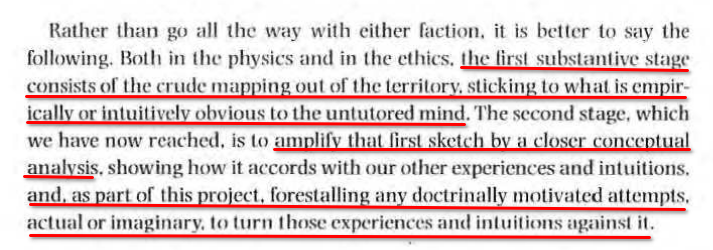
This article makes important points about how Epicurus’ position that there are only two feelings (Pleasure and Pain) parallels his argument that there are only two ultimate constituents of the Universe (Atoms and Void)
The article is divided in the following sections: 1. Outline of Epicurean Ethics 2. The Physics-Ethics Analogy 3. The Basic Division 4. The Division Defended 5. The Division’s Exhaustiveness 6. The Epicurean Good Life 7. The Instrumentality of Virtue - Epilogue
After largely skipping over the first section we’ll take a closer look at the details of each section of the argument. All of these points are of course only my opinion. I highly recommend reading the whole article so you can judge for yourself
1. Outline of Epicurean Ethics
Section titled “1. Outline of Epicurean Ethics”I find this section to be a disappointing start. Much of it is a good standard standard summary of Epicurean ethics. Unfortunately it is written from the point of view of those who assert the importance of the katastematic / kinetic distinction and that Epicurus’s ultimate goal was not “Pleasure” but “Katastematic Pleasure.” I believe this error manifests itself here, where Sedley states that “Katastematic pleasure is abence of pain” rather than “Pleasure is the absence of pain.”

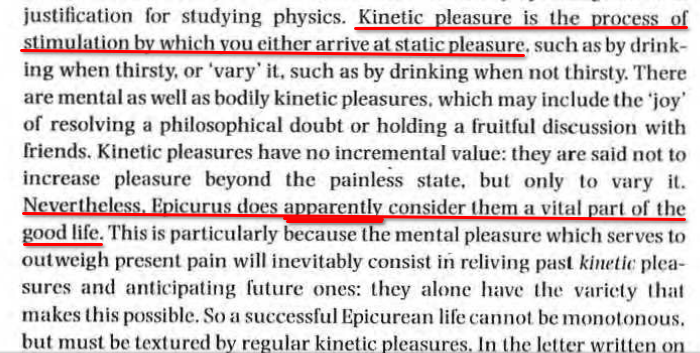
This position causes Seldey to deprecate kinetic pleasures as if the only reason we require them is to produce katastematic pleasure. The obvious problems with this position cause Sedley to have to acknowledge that Epicurus does “apparently” consider kinetic pleasures a part of the good life.
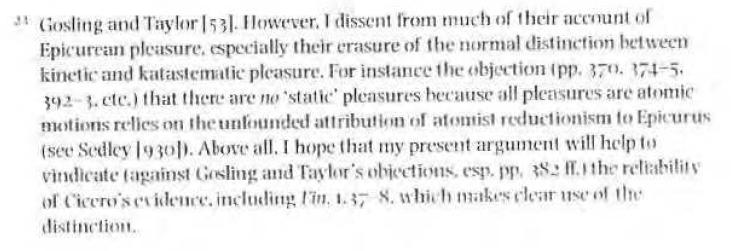
It is not the purposes of this presentation to argue this issue in detail, but it is important to note that Sedley’s position conflicts with Gosling & Taylor, who take the position in their detailed treatise “The Greeks On Pleasure” that Epicurus was focused on “Pleasure” as the goal. They argue that any attention to distinguishing kinetic and katastematic pleasure was at best secondary, and that katastematic pleasures are not inherently more important than kinetic ones. The Gosling & Taylor position was expanded at length by Boris Nikolsky in his article “Epicurus On Pleasure.” Emily Austin took sides with Gosling & Taylor in her footnote eight in Chapter 4 of “Living for Pleasure”:
[!quote] This is a non-specialist text, so I have chosen not to wade into the dispute about katastematic and kinetic pleasures in the body of the text. A specialist will recognize that I am adopting a view roughly in line with Gosling and Taylor (1982) and Arenson (2019). On my reading, katastematic pleasures are sensory pleasures that issue from confidence in one’s ability to satisfy one’s necessary desires and an awareness of one’s healthy psychological functioning; choice-worthy kinetic pleasures are the various pleasures consistent with maintaining healthy functioning, and those pleasures vary, but do not increase healthy psychological functioning. (emphasis added)
From here we can move on to the reason that his article is so helpful.
2. The Physics - Ethics Analogy
Section titled “2. The Physics - Ethics Analogy”A. The Foundations of Epicurean Physics and Epicurean Ethics Are Analogous
Section titled “A. The Foundations of Epicurean Physics and Epicurean Ethics Are Analogous”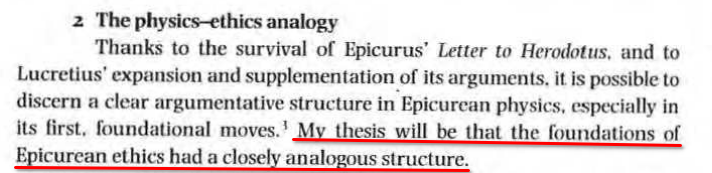
B. In Physics, The Senses Tell Us There Are Bodies And Space
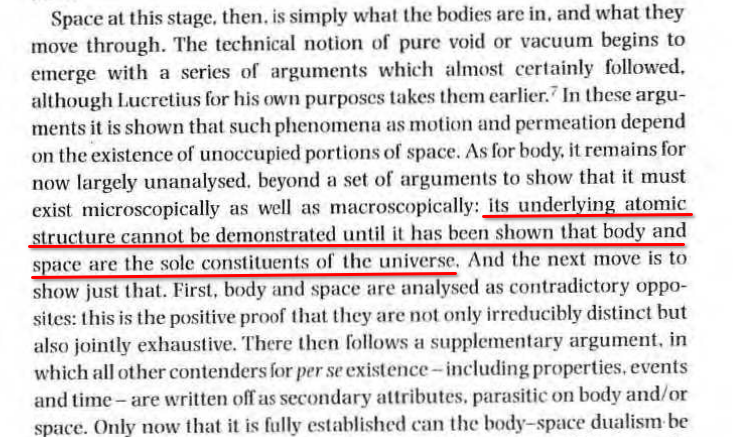
Section titled “B. In Physics, The Senses Tell Us There Are Bodies And Space”In physics Epicurus starts off with positions which he can argue to be self evident: that there are bodies and there is space within which the bodies move.
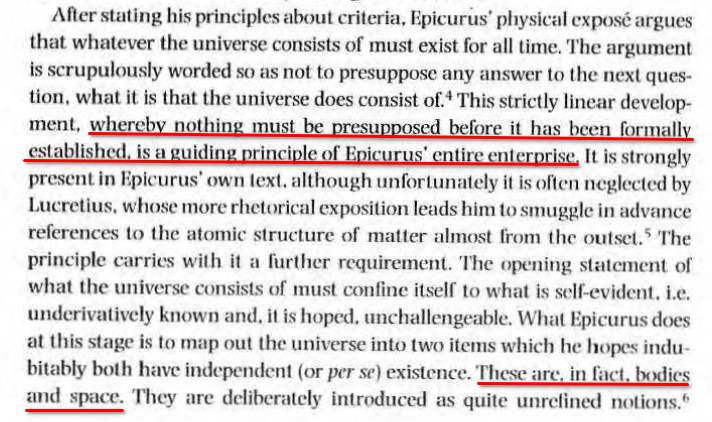
Epicurus does not attempt to discuss the underlying specific natures of atoms and void until he first establishes that these are the two categories that exclusively exist - that these are the sole constituents of the universe.
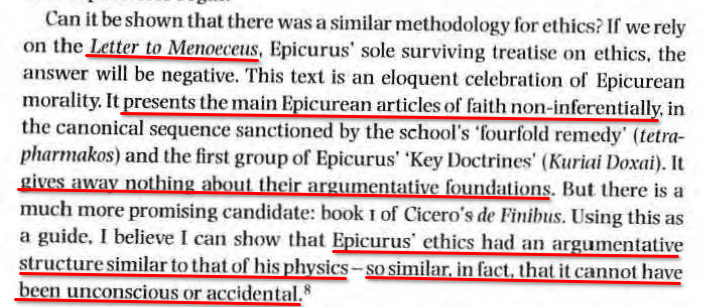
C. Where Does This Same Procedure Exist? Not In Menoeceus, But in Torquatus’ Presentation in Cicero’s On Ends Book One.
Section titled “C. Where Does This Same Procedure Exist? Not In Menoeceus, But in Torquatus’ Presentation in Cicero’s On Ends Book One.”The letter to Menoeceus is a straightforward listing of doctrine, not argument.
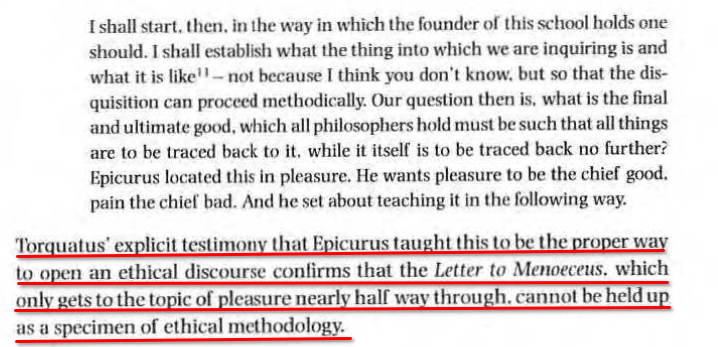
We see that the ethics argument follows the pattern of the physics argument because Torquatus explicitly tells us that Epicurus’ argument starts with the establishment of the two possibilities - pleasure and pain.
3. The Basic Division
Section titled “3. The Basic Division”The Good Is Pleasure and The Evil Is Pain
Section titled “The Good Is Pleasure and The Evil Is Pain”Epicurus places the summum bonum in pleasure and the summum mallum in pain.
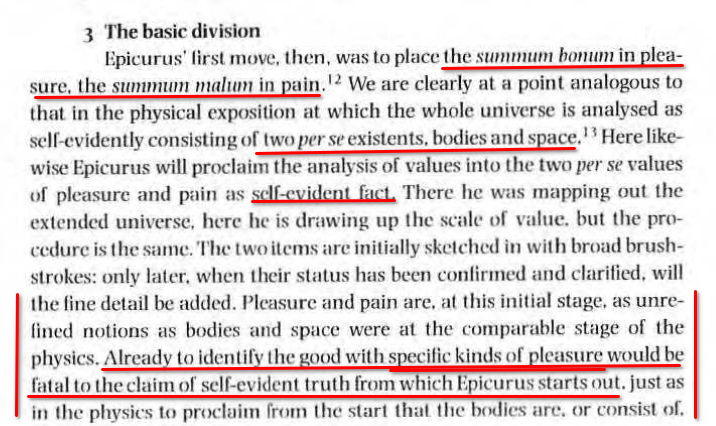
This is not a logical argument based on words but an appeal to the perceptions of the senses.
Section titled “This is not a logical argument based on words but an appeal to the perceptions of the senses.”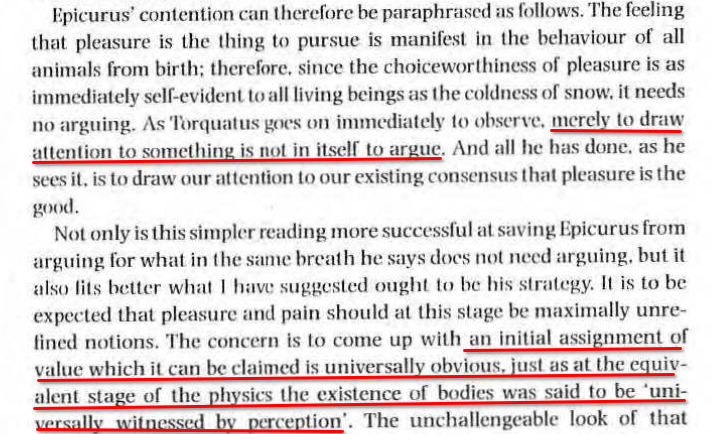
In His Argument To Establish “Pleasure” As The Goal, Epicurus Specifies Nothing At All About How Individual Creatures Conduct Their Pursuit of Pleasure
Section titled “In His Argument To Establish “Pleasure” As The Goal, Epicurus Specifies Nothing At All About How Individual Creatures Conduct Their Pursuit of Pleasure”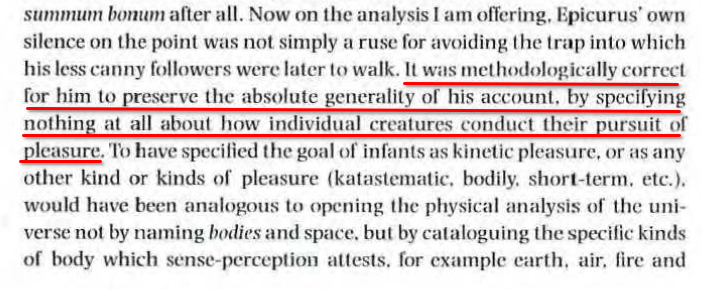
4. The Division Defended
Section titled “4. The Division Defended”Explaining Why Torquatus Says That Later Epicureans Differed As To How To interpret Epicurus’ Arguments In Light Of His Position That No Argument Is Needed To Establish Pleasure As the Good.
Section titled “Explaining Why Torquatus Says That Later Epicureans Differed As To How To interpret Epicurus’ Arguments In Light Of His Position That No Argument Is Needed To Establish Pleasure As the Good.”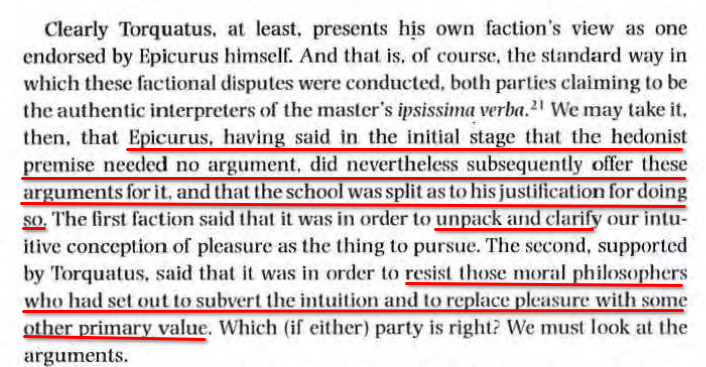
5. The Division’s Exhaustiveness
Section titled “5. The Division’s Exhaustiveness”Any Feeling Which Is Not Painful Is Ipso Facto Pleasant And Vice Versa
Section titled “Any Feeling Which Is Not Painful Is Ipso Facto Pleasant And Vice Versa”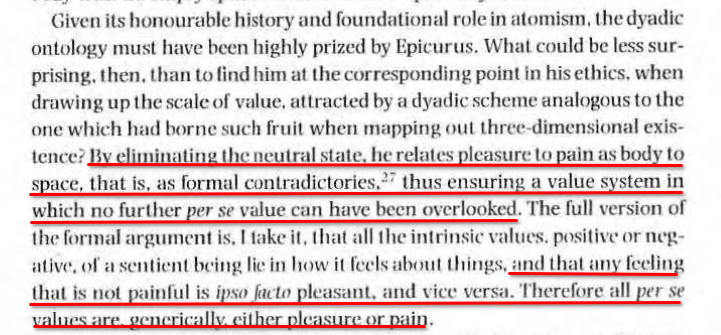
6. The Epicurean Good Life
Section titled “6. The Epicurean Good Life”Three Parallel Stages Of Argument
Section titled “Three Parallel Stages Of Argument”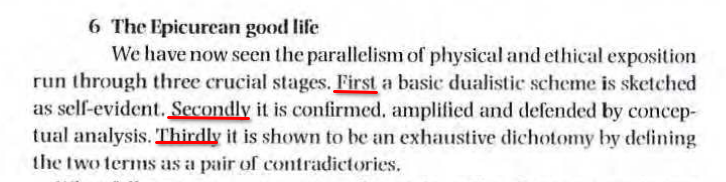
Summum Bonum Means Simply “The Good”
Section titled “Summum Bonum Means Simply “The Good””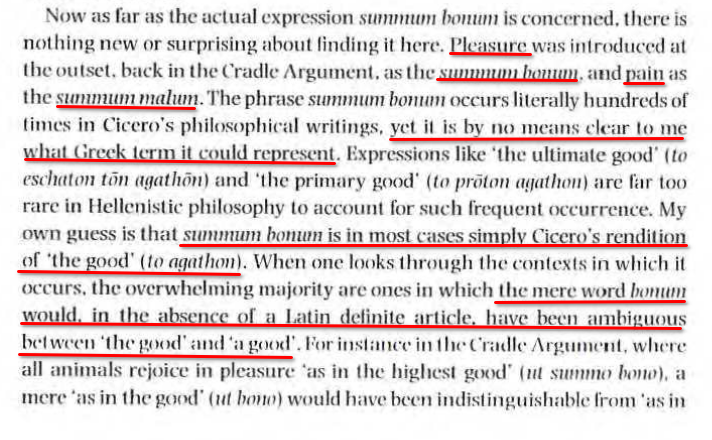
7. The Instrumentality Of Virtue
Section titled “7. The Instrumentality Of Virtue”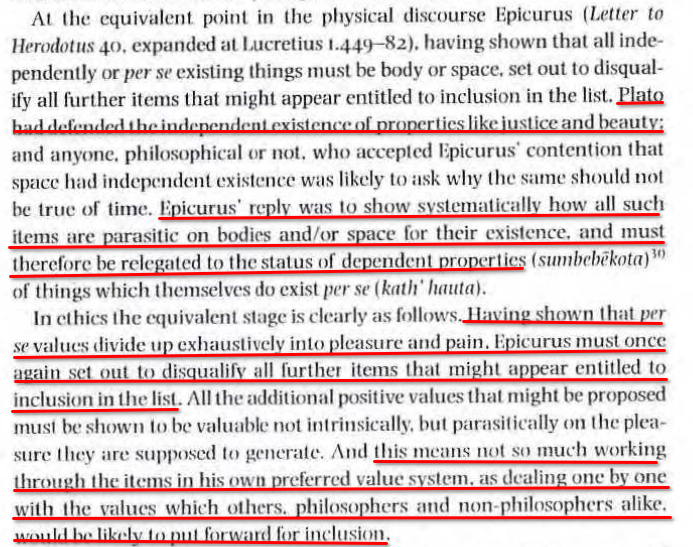
8. Epilogue
Section titled “8. Epilogue”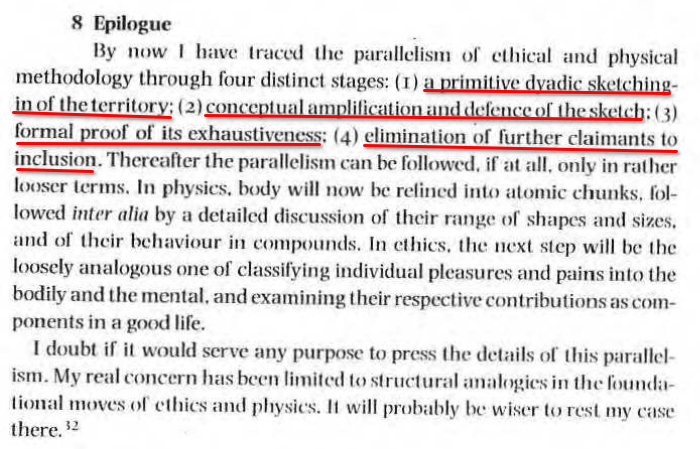
Epicurus’ first focus is on establishing that in physics everything divides into bodies and void, while in ethics the duality is pleasure and pain.
In Physics It is both correct to say that (1) at the highest level of analysis everything is composed of matter and void and (2) the things we see around us differ vastly in all sorts of details in the way they affect us.
Seeing that everything from a physical perspective resolves into either matter or void is essential to understanding that there is no third supernatural nature. But as essential as that is as a starting point, you then have to figure out how the atoms and void combine in different ways to form different things if you’re going to work with physics successfully to see that everything happens naturally.
Seeing that everything from an ethical perspective resolves into either pleasure or pain is essential to understanding that there is no third middle or neutral state and no good and evil outside of pleasure and pain. But as essential as that is as a starting point, you then have to figure out how the pleasures and pains work together in different ways to produce different results if you’re going to work with ethics successfully to live happily.